Learn about APC in Academic Publishing, how Article Processing Charges work, who pays them, and how publishers can manage APC policies and workflows effectively.
TL;DR
- APC stands for Article Processing Charge, a fee some academic journals charge to cover the costs of publishing an article.
- APCs are commonly associated with open access publishing, where published research is freely available to readers.
- Authors, institutions, or research funders may pay an APC depending on the journal’s policies and available funding.
- Not all open access journals charge APCs, as some use alternative funding models.
- Clear APC policies help publishers communicate costs transparently and create a more organised publishing process.
Open access has changed how academic research is published and accessed.
Instead of restricting published articles behind subscriptions, many journals make research freely available online. One way publishers support this model is through Article Processing Charges, commonly known as APCs.
An APC is a fee associated with publishing an academic article, usually after it has gone through the journal’s editorial and peer review process.
Understanding how these charges work is important for publishers developing sustainable publishing models and for authors planning how their research will be published.
For publishers managing journals and growing their academic publishing operations, having organised workflows is equally important.
Alkademy Press is an academic publishing platform that helps publishers manage journal submissions, editorial workflows, peer review, article records, and publication processes from a centralised environment.
What Is APC in Academic Publishing?
An Article Processing Charge (APC) is a fee that an academic journal may charge to cover some of the costs involved in processing and publishing a research article.
APCs are particularly common among open access journals, where readers can access published articles without paying a subscription.
The amount and structure of an APC depend on the journal and publisher. Some journals charge a standard fee, while others offer different rates, waivers, or discounts based on factors such as funding, location, or institutional agreements.
Importantly, an APC is a publishing charge, not a payment for acceptance. A legitimate editorial process should assess manuscripts based on the journal’s academic and editorial standards.
Table of Contents
What Does an APC Cover?
An APC can contribute toward several activities involved in taking a manuscript from submission to a published article, including:
- Editorial and administrative processing
- Peer review management
- Copyediting and proofreading
- Typesetting and article production
- Online publication and hosting
- Digital preservation and archiving
- Publishing platform and infrastructure costs
The exact services covered vary between publishers, so journals should clearly explain what their APC includes.
How Does the APC Model Work?
The APC model generally connects the financial side of publishing with the workflow that takes a manuscript from submission to publication.
While processes vary between journals, the journey commonly follows these stages.
Manuscript Submission
An author submits a manuscript to a journal for consideration. At this stage, the publisher may provide information about the journal’s APC policy, including the applicable charge, payment conditions, and any available waivers or discounts.
An APC should not automatically be required simply because a manuscript has been submitted. Submission fees and APCs are separate charges and should be clearly distinguished.
Editorial Review and Peer Review
After submission, the manuscript goes through an initial editorial assessment to determine whether it fits the journal’s scope and requirements. Suitable manuscripts may then proceed to peer review.
The editorial and peer review process should remain independent of the author’s ability to pay an APC. The academic quality and suitability of the manuscript should guide the publication decision.
Acceptance and APC Notification
If the manuscript is accepted, the publisher can notify the author of the applicable APC and provide instructions for payment.
At this stage, the author may also be informed about available funding options, institutional agreements, discounts, or waivers where applicable.
Payment and Publication
Once the payment process is completed or an approved waiver is applied, the manuscript can move into the production stage.
Depending on the journal’s workflow, this may involve:
- Copyediting and proofreading
- Typesetting
- Final author review
- Article publication
- Online hosting and indexing
- Digital preservation
A structured workflow helps publishers keep editorial, financial, and publication activities organised while providing authors with greater clarity throughout the process.
Who Pays an Article Processing Charge?

The responsibility for paying an APC can vary depending on the journal, author, institution, and available research funding.
In many cases, the author is not personally responsible for the full cost.
Common sources of APC funding include:
- Authors: Researchers may pay directly using personal or research funds.
- Universities and institutions: Institutions may cover APCs for researchers through dedicated publishing funds or agreements.
- Research funders: Grants may include funding for publication and open access costs.
- Government or nonprofit organisations: Some programmes provide financial support for making research openly available.
- Institutional agreements: Publishers may have agreements with universities or research organisations that cover or reduce APCs for eligible authors.
Publishers should clearly explain who is responsible for payment and what funding or support options are available.
Can Authors Publish Without Paying an APC?
Yes. An author may be able to publish without paying the standard APC depending on the journal’s publishing model or policies.
Possible options include:
- APC waivers for eligible authors
- Partial discounts
- Institutional agreements
- Funder-supported publishing
- Journals that do not charge APCs
Some journals use alternative funding models that allow authors to publish without an APC. Authors should therefore check a journal’s fees and funding policies before submitting their work.
How Much Does an APC Cost?
There is no single standard APC across academic publishing.
Charges vary considerably between journals and publishers based on their publishing model, discipline, services, and operating costs.
Factors that may influence an APC include:
- Editorial and peer review infrastructure
- Copyediting and production services
- Publishing technology and hosting
- Digital preservation and archiving
- Journal discipline and scope
- Funding and institutional arrangements
For publishers, transparency is important. APC information should be easy to find, clearly explained, and communicated before authors reach the publication stage.
APC vs Other Academic Publishing Models
APCs are only one approach to funding academic publishing.
Understanding how they differ from other models helps publishers and authors identify how publication costs are handled.
APC-Based Open Access
In an APC-based open access model, the publisher charges an Article Processing Charge to cover some of the costs of publishing an article. The published article is then made freely accessible to readers.
This model shifts some of the financial responsibility from readers and subscribers to authors, institutions, or research funders.
Subscription Publishing
In a subscription model, readers, libraries, or institutions pay for access to journal content.
The publisher generates revenue through subscriptions rather than relying primarily on APCs. Depending on the journal, authors may publish without paying an APC for standard access.
Diamond or Platinum Open Access
Diamond, sometimes called platinum, open access makes research freely available without charging readers subscription fees or authors APCs.
Publishing costs may instead be supported by:
- Universities
- Research institutions
- Academic societies
- Government programmes
- Grants
- Nonprofit organisations
This model aims to remove financial barriers for both readers and authors.
Hybrid Publishing
Hybrid publishing combines elements of subscription and open access models. A journal may operate primarily through subscriptions while allowing authors to pay an APC to make individual articles openly accessible.
This gives authors an open access option within a subscription-based journal, although the specific terms and fees vary between publishers.
What Should Publishers Consider When Setting an APC?

Setting an APC requires publishers to balance the costs of producing and maintaining a journal with the needs of authors and the wider research community.
A clear approach can also help publishers build trust with contributors.
Key considerations include:
- Publishing costs: Account for editorial, production, hosting, preservation, and administrative costs.
- Journal discipline: Publishing requirements and operating costs can differ across academic fields.
- Author affordability: Consider the funding realities of the researchers the journal serves.
- Funding availability: Take institutional agreements, grants, and other funding sources into account.
- Waivers and discounts: Establish clear criteria for authors who may qualify for financial support.
- Long-term sustainability: Ensure the APC supports the journal’s ongoing publishing operations.
- Transparency: Communicate the charge and its terms clearly before authors commit to publication.
Why APC Transparency Matters
Authors need to understand publication costs before submitting or accepting an article. Transparent APC information reduces confusion and helps researchers make informed decisions about where to publish.
Publishers should clearly communicate:
- The APC amount and applicable currency
- What the charge covers
- When payment is required
- Available waivers or discounts
- Eligibility requirements for financial support
- Any additional applicable charges
APC information should also be easy to find on the journal website rather than hidden within lengthy publishing policies.
What Should an APC Policy Include?
A well-structured APC policy gives authors a clear understanding of the financial side of publication. It should typically include:
- APC amount and currency
- Payment timing and process
- Accepted payment methods
- Eligibility for waivers and discounts
- Institutional or funder agreements
- Refund conditions
- Information about taxes or additional charges
- Contact details for billing enquiries
The policy should be written in straightforward language and kept updated whenever the journal changes its publishing or payment arrangements.
Common Misconceptions About APCs
Several misconceptions can create confusion around Article Processing Charges.
- APCs are not the same as submission fees. An APC is generally associated with publishing an article, while a submission fee may be charged when a manuscript is submitted.
- Paying an APC does not guarantee acceptance. Editorial and peer review decisions should be based on the manuscript’s academic suitability.
- Not every open access journal charges an APC. Some journals use institutional, grant, society, or other funding models.
- APCs do not determine journal quality. The presence or amount of an APC alone does not establish the academic quality of a publication.
- APC policies vary between journals. Authors should review the specific fees and conditions of each journal before submitting.
How Publishers Can Manage APC Workflows Efficiently
Managing APCs becomes easier when financial processes are integrated with the wider publishing workflow. Publishers can improve efficiency by:
- Keeping author and manuscript information organised in one system.
- Recording APC status alongside article records.
- Establishing clear payment and waiver workflows.
- Providing authors with timely billing information.
- Tracking accepted articles through production and publication.
- Maintaining accurate financial and publication records.
- Separating editorial decisions from payment administration.
- Reducing repetitive manual tasks through publishing technology.
A structured workflow can help publishers reduce administrative friction while giving authors better visibility into the status of their articles.
Managing Academic Publishing Workflows With Alkademy Press
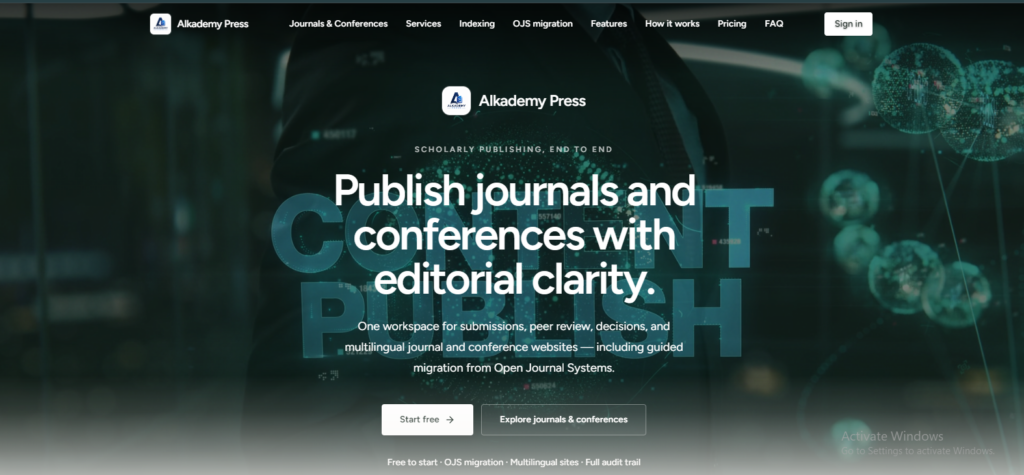
Alkademy Press provides a centralised platform for managing academic journal publishing workflows.
Instead of treating submissions, editorial activities, peer review, and publication as disconnected processes, publishers can organise these activities within a structured publishing environment.
The platform can support key areas of journal management, including:
- Manuscript submission management
- Editorial workflows
- Peer review management
- Structured journal and article records
- Publication management
- Centralised administration
For publishers managing one or multiple journals, having these processes organised in one platform can make it easier to maintain consistent workflows and keep important publishing information accessible.
APC management can therefore become part of a broader publishing workflow rather than an isolated administrative task.
With the right systems in place, publishers can maintain clearer processes from manuscript submission through editorial review, production, and publication.
Best Practices for Managing APCs in Academic Publishing
A clear APC process can make publishing easier for both journals and authors. Publishers can improve their approach by following a few practical best practices:
- Publish APC information clearly: Make charges, payment terms, and eligibility requirements easy to find.
- Communicate early: Tell authors about applicable charges before they reach the publication stage.
- Maintain consistent policies: Apply APC, waiver, and discount policies fairly and consistently.
- Keep accurate records: Track payments, waivers, invoices, and article publication status.
- Separate financial and editorial decisions: Payment should not determine whether a manuscript is accepted.
- Review policies regularly: Update APC information when pricing, funding arrangements, or publishing processes change.
- Use structured workflows: Connect APC administration with submission, editorial, production, and publication processes.
FAQs
APC stands for Article Processing Charge. It is a fee that some academic journals charge to cover part of the costs involved in processing and publishing an article, particularly in open access publishing.
An APC may be paid by the author, their university or institution, a research funder, or another organisation supporting the research. Some publishers also have agreements that cover or reduce APCs for eligible authors.
The timing varies between journals. In many cases, the APC becomes applicable after an article has been accepted for publication. Publishers should clearly state their payment requirements in their APC policy.
No. Some open access journals use other funding models, including institutional support, research grants, academic societies, nonprofit funding, or sponsorship. Diamond or platinum open access journals, for example, generally do not charge authors APCs.
Yes. Some journals offer full or partial waivers based on their policies. Eligibility may depend on factors such as funding circumstances, institutional agreements, or other criteria established by the publisher.
Final Thoughts on APC in Academic Publishing
Article Processing Charges are an important part of the publishing model used by many academic journals, particularly those providing open access to research.
For publishers, managing APCs effectively requires more than simply setting a fee. Clear policies, transparent communication, accurate records, and organised workflows all contribute to a smoother publishing process.
As academic publishing becomes increasingly digital, publishers can benefit from systems that bring different stages of journal management together. A structured platform can help connect submissions, editorial workflows, peer review, publication, and related administrative processes.
Ready to simplify how you manage your academic journals?
Explore Alkademy Press to bring submissions, peer review, editorial workflows, article records, and publication management into a more organised publishing environment.
With the right tools behind your journals, you can spend less time managing disconnected processes and more time supporting the research your publications bring to readers.