Looking for an Open Journal System alternative? Compare the best low-cost journal management platforms, including hosted solutions with AI tools.

TL;DR
- OJS is a popular journal management system, but maintaining it can become expensive.
- Many publishers are moving to hosted platforms to reduce technical work.
- The best OJS alternatives combine submissions, peer review, publishing, billing, and reporting in one system.
- AI is starting to improve editorial workflows by helping editors screen submissions faster.
- Alkademy Press offers a fully hosted journal management platform with built-in AI and a free plan for new journals.
Open Journal Systems (OJS) has long been a popular choice for academic publishers because it’s free and open source. However, managing servers, software updates, plugins, and security can become time-consuming, especially for journals without dedicated IT support.
As publishing workflows evolve, many editorial teams are looking for an Open Journal System alternative that’s easier to manage and includes modern features like integrated peer review, journal websites, APC billing, and workflow automation.
In this guide, we’ll compare the best low-cost OJS alternatives, highlight the features that matter most, and explain why platforms like Alkademy Press are becoming a popular choice for modern academic publishing.
What Is Open Journal Systems (OJS)?
Open Journal Systems, or OJS, is an open-source journal management platform developed by the Public Knowledge Project (PKP). It was created to help universities and research organisations publish academic journals online without expensive software licences.
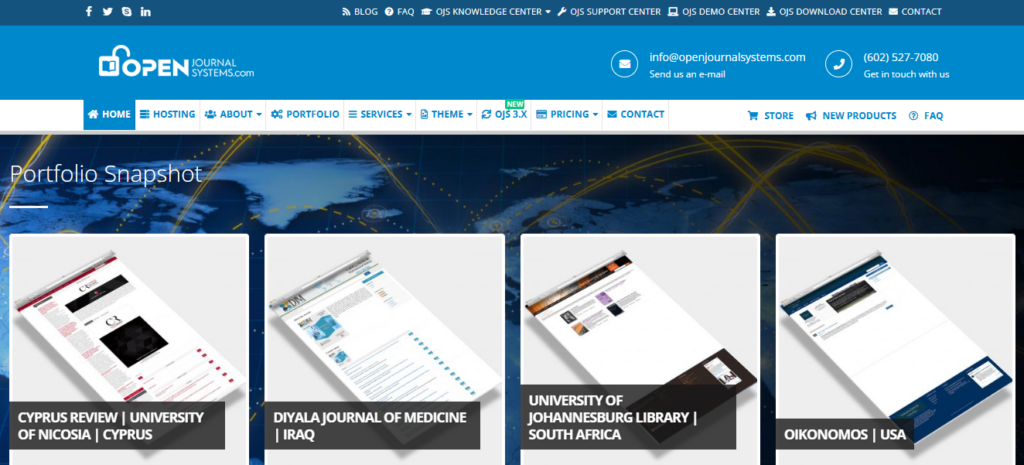
Today, OJS powers thousands of journals across disciplines including medicine, engineering, education, business, and the humanities.
The platform covers the core publishing workflow. Authors submit manuscripts, editors assign reviewers, reviewers provide feedback, and accepted articles are published through the journal website.
Publishers also appreciate OJS because it offers:
- No software licensing fees
- Flexible customisation
- Multi-language support
- Peer review management
- A large plugin ecosystem
- An active global user community
These strengths have made OJS one of the most trusted platforms in scholarly publishing.
The challenge isn’t the software itself. It’s everything that comes with running it.
Most OJS installations require publishers to manage hosting, software updates, backups, security, and plugin compatibility. As submission numbers grow, so does the time spent maintaining the platform.
For organisations with experienced IT teams, this may not be an issue. For smaller publishers, however, maintaining the software can become a distraction from the work that matters most—publishing quality research.
Why Publishers Look for an Open Journal System Alternative
OJS remains a capable publishing platform, but many journals eventually reach a point where maintaining the software becomes more work than expected.
The biggest challenge is usually infrastructure.
A typical OJS installation requires web hosting, server management, database maintenance, backups, security monitoring, and regular software updates. Even small journals often rely on external developers or university IT staff whenever something breaks or a major upgrade is released.
Plugins create another challenge. New OJS releases don’t always work perfectly with existing plugins or custom themes. Before updating the platform, administrators often need to test everything to avoid breaking the journal website or editorial workflow.
Many editorial offices also work across multiple systems. Manuscript submissions may be handled in OJS, reviewer communication through email, APC payments in another application, and published articles on a separate website. Switching between these tools slows editors down and creates unnecessary administrative work.
Artificial intelligence is another reason publishers are exploring newer platforms. Editors increasingly want tools that can identify duplicate submissions, flag manuscripts outside the journal’s scope, or highlight potential quality issues before peer review begins. These capabilities are rarely built into traditional journal management systems.
Publishers commonly move away from OJS because they want to:
- Spend less time managing servers and software
- Eliminate plugin maintenance
- Simplify peer review
- Manage multiple journals from one dashboard
- Improve the experience for authors and reviewers
- Reduce reliance on IT teams
- Access AI-assisted editorial tools
Most publishers aren’t replacing OJS because it lacks essential features. They’re replacing it because they want a platform that’s easier to manage and better suited to modern publishing workflows.
Best Low-Cost Open Journal System Alternatives
There are plenty of journal management systems on the market, but they don’t all solve the same problems. Some focus on flexibility through open-source software, while others prioritise ease of use with fully managed hosting.
If your goal is to spend less time managing technology and more time publishing research, a hosted platform is often the better choice.
Below are five of the best Open Journal System alternatives, starting with Alkademy Press, a modern journal management platform built to simplify every stage of academic publishing.
1. Alkademy Press
If you’re looking for an Open Journal System alternative that doesn’t require servers, plugins, or ongoing maintenance, Alkademy Press is worth considering.
It’s a fully hosted journal management platform that brings the entire publishing workflow into one place. From manuscript submission and peer review to journal publishing, APC billing, and AI-assisted screening, everything runs from a single dashboard.
Instead of spending time maintaining software, editorial teams can focus on reviewing manuscripts and publishing quality research.
One of its biggest advantages is accessibility. You can launch a journal on the free plan, making it a practical choice for independent publishers, university departments, academic societies, and new open access journals.
Everything You Need in One Platform
Unlike many publishing systems that require several third-party tools, Alkademy Press combines the essential parts of journal publishing into one platform.
Authors can submit papers through a clean submission portal, upload supporting files, invite co-authors, and save drafts before submission.
Editors receive every submission in one dashboard, making it easy to assign reviewers, monitor progress, and keep the editorial process moving.
Peer Review
The peer review workflow supports multiple review rounds, structured reviewer forms, deadline tracking, and revision management.
Every action is recorded, giving editors a complete history of each manuscript without searching through email conversations.
Journal Websites
Every journal includes a professional publishing website with:
- Custom branding
- Custom domains
- HTTPS security
- Editorial board pages
- Volumes and issues
- Author guidelines
Accepted articles move directly from the editorial workflow to publication, removing the need for a separate website.
APC Billing
For open access journals, Alkademy Press includes built-in Article Processing Charge (APC) management.
Publishers can collect payments, manage waivers, issue institutional invoices, and monitor payment status without relying on separate billing software.
AI That Helps Editors Make Better Decisions
AI is one of the biggest differences between Alkademy Press and traditional journal management systems.
Rather than trying to replace editors, the platform uses AI to speed up the early stages of manuscript assessment.
Each submission receives:
- A quality score from 0 to 100
- An Accept, Revise, or Reject recommendation
- A breakdown of potential concerns
The AI can identify issues such as:
- Scope mismatch
- Possible plagiarism risks
- Weak methodology
- Unclear research contribution
- Potential ethical concerns
This helps editors identify submissions that may require closer attention before peer review begins.
Editorial decisions, however, always remain with the journal’s editors. The AI provides recommendations only and manuscript data is never used to train AI models.
Built for Growing Publishers
Alkademy Press works equally well for a single journal or an entire publishing portfolio.
Publishers can manage multiple journals from one dashboard while keeping each journal’s editorial team, branding, workflow, and reporting separate.
Because the platform is fully hosted, there’s no need to worry about:
- Server maintenance
- Software updates
- Plugin compatibility
- Security patches
- System backups
Everything is managed automatically.
Why Alkademy Press Stands Out
Many journal platforms solve only part of the publishing process. One handles submissions, another manages billing, while another hosts the journal website.
Alkademy Press brings these workflows together in one place.
It also goes beyond traditional journal management software by adding practical AI tools that help editors work faster without taking control away from them.
For publishers looking for an affordable Open Journal System alternative, it offers a modern publishing experience without the technical overhead that often comes with self-hosted platforms.
Best for:
- University presses
- Academic societies
- Independent publishers
- Research institutions
- Open access journals
- Publishers managing multiple journals
With a free plan available and setup taking less than a day, Alkademy Press makes it easy to launch or modernise a scholarly journal.
2. Scholastica
Scholastica is one of the best-known hosted journal management platforms and a popular choice among independent journals and scholarly societies.
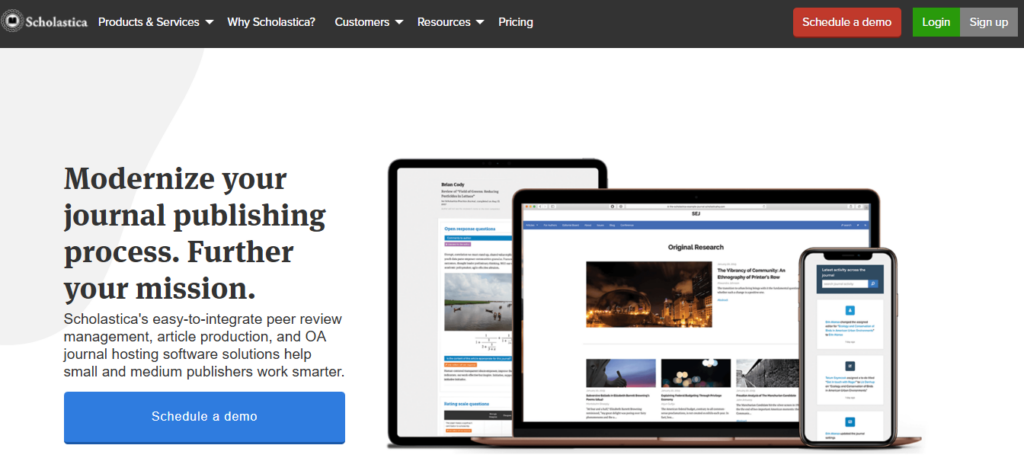
Like Alkademy Press, it removes the need to manage servers or install software updates. Editors can handle submissions, peer review, and editorial decisions through a web-based interface that’s easy to learn.
Its biggest strength is simplicity. Smaller editorial teams often choose Scholastica because it offers a clean workflow without the complexity of traditional publishing systems.
That said, some publishing services are offered separately, so costs can increase as your journal grows.
Pros
- Fully hosted
- Easy to use
- Streamlined peer review
- Professional publishing workflow
- No server maintenance
Cons
- Limited built-in AI features
- Costs can increase with additional services
- Less suitable for larger publishing groups
Best for: Independent journals, scholarly societies, and small editorial teams looking for a simple hosted publishing platform.
3. Janeway
Janeway is an open-source publishing platform developed by the Centre for Technology and Publishing at Birkbeck, University of London.
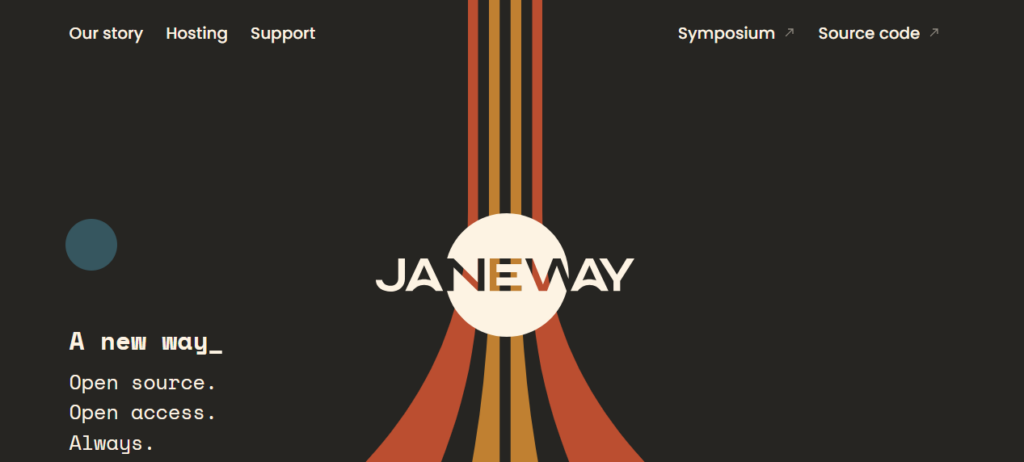
Like OJS, it gives publishers full control over the platform and supports manuscript submission, peer review, editorial decisions, and online publishing.
Its modern interface is often seen as an improvement over older open-source systems. However, publishers who choose to self-host Janeway are still responsible for servers, updates, security, and ongoing maintenance unless they purchase managed hosting.
Pros
- Open source
- Modern interface
- Flexible workflows
- Active development
Cons
- Requires technical expertise for self-hosting
- Managed hosting increases costs
- Smaller community than OJS
Best for: Universities and publishers that want an open-source platform with modern design and have access to technical support.
4. Digital Commons Journals
Digital Commons Journals is designed primarily for universities and institutional publishers. It combines journal publishing with institutional repository services, making it a good fit for higher education institutions that already use the wider Digital Commons ecosystem.
The platform is fully hosted, so publishers don’t need to manage servers, updates, or security. It also provides professional journal websites and supports the full publishing workflow.
However, it’s built with institutions in mind. Smaller publishers or independent journals may find it offers more than they need, both in features and cost.
Pros
- Fully hosted
- Professional journal websites
- Reliable infrastructure
- Strong integration with institutional repositories
- Well suited to university publishing
Cons
- Primarily designed for higher education institutions
- Less flexible for smaller publishers
- Pricing may not suit independent journals
- Limited built-in AI features
Best for: University presses, academic libraries, and institutions already using Digital Commons.
5. Editorial Manager
Editorial Manager is one of the most established journal management systems in academic publishing. Many large commercial publishers and scientific journals use it to manage high submission volumes and complex editorial workflows.
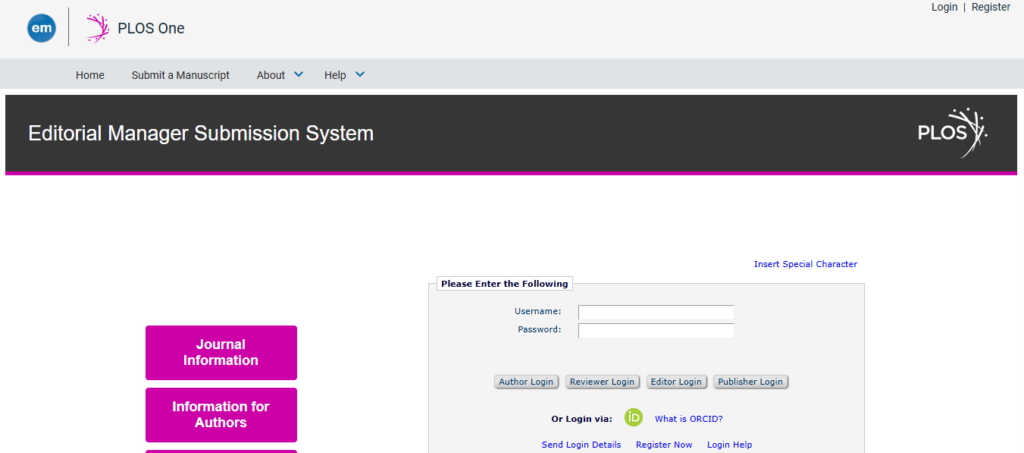
The platform offers extensive workflow customisation, detailed reporting, and advanced reviewer management. It works well for publishers with dedicated editorial teams and specialised processes.
For smaller journals, however, it can feel more complex than necessary. It also comes with a higher price tag than many alternatives.
Pros
- Highly configurable workflows
- Strong reviewer management
- Detailed reporting and analytics
- Built for large publishing operations
- Proven at scale
Cons
- Higher cost
- More complex to implement
- Longer learning curve
- Often more than smaller journals require
Best for: Large publishers, established academic journals, and organisations managing high submission volumes.
Comparing the Best Open Journal System Alternatives
Which Platform Offers the Best Value?
The right platform depends on your journal’s goals.
If your institution has an experienced IT team and wants complete control over the software, an open-source platform like Janeway may be a good fit. Universities already using Digital Commons may benefit from keeping everything in one ecosystem. Larger commercial publishers with complex editorial workflows may find Editorial Manager meets their needs.
For many publishers, though, the priority is different. They want a platform that’s easy to use, quick to deploy, and doesn’t require ongoing technical maintenance.
That’s where Alkademy Press stands out.
Instead of relying on separate systems for submissions, peer review, journal websites, APC billing, and AI tools, everything is built into one platform. Because it’s fully hosted, there’s no server management, plugin maintenance, or software updates to worry about.
The free plan also makes it easier for new journals to get started without a large upfront investment.
If you’re looking for an Open Journal System alternative that balances affordability, ease of use, and modern publishing tools, Alkademy Press offers one of the strongest all-round solutions available today.
Hosted vs Self-Hosted Journal Management Systems
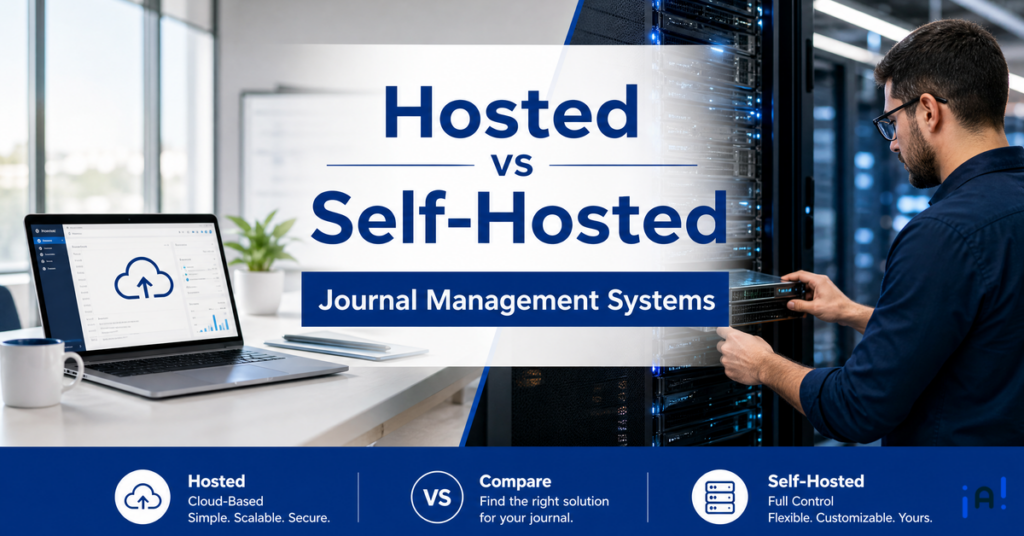
One of the first decisions you’ll make when choosing an Open Journal System alternative is whether to self-host the software or use a hosted platform.
The difference goes beyond where the software runs. It affects your costs, workload, and how much time your editorial team spends managing technology instead of publishing research.
Self-Hosted Platforms
With a self-hosted platform like OJS, you’re responsible for installing and maintaining the software. That includes managing the server, applying updates, monitoring security, creating backups, and fixing technical issues.
The biggest advantage is flexibility. You have complete control over the system and can customise it to suit your journal.
The downside is that every update, plugin, and security patch becomes your responsibility. If your journal doesn’t have dedicated IT support, those tasks often fall to editors or external developers.
Hosted Platforms
Hosted platforms remove the technical work.
The provider manages the infrastructure, updates, backups, and security, while your editorial team focuses on submissions, peer review, and publication.
You simply log in and use the platform.
This approach has become increasingly popular with university presses, scholarly societies, and independent publishers that want to reduce operational overhead.
Which Is More Cost-Effective?
At first glance, self-hosted software looks cheaper because there are no licensing fees. In reality, the total cost often tells a different story.
Beyond the software itself, you may need to pay for:
- Web hosting
- Server maintenance
- SSL certificates
- Security monitoring
- Software updates
- Plugin maintenance
- Technical support
- Backups
You also need to consider staff time. Every hour spent fixing technical issues is time that could have been spent reviewing manuscripts, recruiting reviewers, or improving the journal.
Hosted platforms bundle these responsibilities into one service, making costs easier to predict and reducing the workload for editorial teams.
Which OJS Alternative Is Right for You?
A self-hosted solution may still make sense if your institution has an experienced IT department and requires extensive customisation.
For most publishers, however, a hosted platform offers a simpler path. You can launch faster, avoid ongoing maintenance, and scale without worrying about servers or software updates.
If your goal is to spend more time publishing research and less time managing technology, a hosted solution is usually the better long-term investment.
How to Choose the Right Open Journal System Alternative
With so many journal management systems available, choosing the right one can feel overwhelming. The best platform isn’t necessarily the one with the longest feature list. It’s the one that fits the way your journal operates.
Here are a few questions to ask before making a decision.
How Many Journals Do You Manage?
A single-journal publisher has very different needs from a university press managing dozens of titles.
If you expect your publishing programme to grow, look for a platform that supports multiple journals from one dashboard.
Do You Have IT Support?
If your institution has developers who can manage servers, updates, and security, a self-hosted platform may still work well.
If not, a hosted platform will save considerable time and reduce technical headaches.
Does It Cover the Entire Workflow?
Switching between multiple tools slows editors down.
Look for a platform that brings together:
- Manuscript submission
- Peer review
- Editorial decisions
- Publishing
- Journal websites
- APC billing
- Reporting
Managing everything in one place creates a much smoother workflow.
Will It Grow With Your Journal?
Changing platforms later can be expensive and disruptive.
Choose software that can support increasing submissions, larger editorial teams, additional journals, and new publishing models as your organisation grows.
Does It Improve the Author Experience?
A complicated submission process discourages authors.
A good platform should make it easy to submit manuscripts, track progress, and communicate with editors. Reviewers should also have a straightforward way to access papers and submit feedback.
Small improvements in usability can make a big difference over time.
How Does It Use AI?
AI is becoming a useful assistant for editorial teams, but it should never replace editorial judgement.
The best platforms use AI to identify potential issues, speed up routine tasks, and help editors prioritise submissions while leaving every publishing decision in human hands.
Best Open Journal System Alternative: Our Recommendation
Every platform in this guide has its strengths.
If you want maximum customisation and have the technical resources to support it, an open-source solution may still be the right choice.
If your priority is reducing maintenance, simplifying editorial work, and launching quickly, a hosted platform is a better fit.
Alkademy Press is well suited to publishers that want everything in one place. It combines submissions, peer review, journal publishing, APC billing, and AI-assisted screening in a fully managed platform, helping editorial teams spend less time maintaining software and more time publishing quality research.
FAQs
What is the best Open Journal System alternative?
That depends on your needs. If you want a fully hosted platform with built-in peer review, journal websites, APC billing, and AI-assisted editorial tools, Alkademy Press is one of the strongest options. Publishers that prefer open-source software may also consider Janeway.
Is there a free alternative to OJS?
OJS itself is free to download, but you’ll still need to cover hosting, maintenance, and technical support. Alkademy Press also offers a free plan, allowing publishers to launch a journal without managing the underlying infrastructure.
Can I move my journal from OJS?
Yes. Many publishers migrate from OJS as their journals grow or their publishing requirements change. Planning the migration carefully helps preserve manuscripts, user accounts, and journal content while minimising disruption.
What features should a journal management system include?
Look for a platform that supports the complete publishing workflow, including manuscript submission, peer review, editorial decisions, publishing, reporting, and journal websites. Built-in APC billing and AI-assisted editorial tools are also becoming valuable additions.
Should I choose a hosted or self-hosted platform?
If you have strong technical resources and need extensive customisation, self-hosting can work well. If you want to reduce maintenance and focus on publishing, a hosted platform is usually the better option.
Final Thoughts: Choosing the Right OJS Alternative
Open Journal Systems has earned its place as one of the most widely used journal management platforms. For publishers with dedicated IT teams, it remains a flexible and reliable solution.
But publishing has changed. Editorial teams now need software that does more than manage submissions. They need tools that simplify peer review, reduce administrative work, support open access publishing, and scale as their journals grow.
That’s why more publishers are looking beyond traditional self-hosted systems.
A good Open Journal System alternative should save time, not create more work. It should bring submissions, peer review, publishing, billing, and reporting together in one platform, allowing editors to focus on research instead of software maintenance.
If you’re looking for a modern, fully hosted solution, Alkademy Press is a strong option. It combines manuscript submission, peer review, journal publishing, APC billing, and AI-assisted editorial tools in one platform, without the need to manage servers or plugins.
It provides the tools to streamline your editorial workflow and grow with your publishing programme, whether you’re launching a new journal or managing an established publication.
Now, What Next?
If you’re ready to move beyond the limitations of self-hosted journal software, Alkademy Press can help.
Start with the free plan or book a personalised demo to see how the platform simplifies manuscript submission, peer review, editorial decisions, publishing, and APC management—all from a single, fully hosted dashboard.