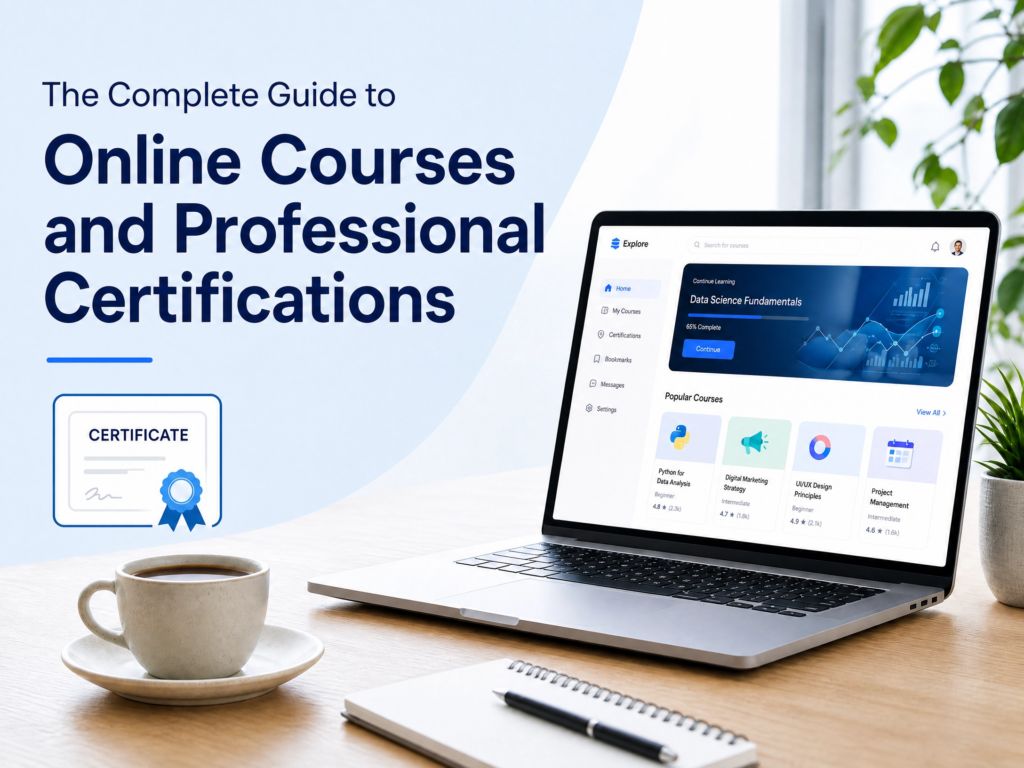
Discover how online courses and professional certifications can accelerate career growth. Learn the differences, benefits, learning formats, and how to choose the right path for your professional goals in 2026.
Key Takeaways
- Online courses help learners build new skills, while professional certifications validate expertise and professional competencies.
- The best learning pathway depends on your career goals, industry requirements, preferred learning style, and desired outcomes.
- Online learning now extends beyond self-paced courses to include live classes, workshops, cohort-based programs, and blended learning experiences.
- Professional certifications can strengthen credibility and employability, but practical skills and real-world experience remain equally important.
- Continuous learning has become essential for long-term career success in an increasingly skills-driven workforce.
The way people learn and develop professionally has changed dramatically over the last decade. Rapid technological advancements, evolving workplace demands, and the rise of skills-based hiring have transformed how individuals acquire knowledge and advance their careers.
Traditional education remains important, but it is no longer the only pathway to professional growth. Today, learners have access to thousands of online courses, certification programs, virtual workshops, and specialized training opportunities that make it possible to develop new skills from virtually anywhere.
As industries continue to evolve, professionals are increasingly expected to learn continuously rather than rely solely on qualifications earned early in their careers. Whether someone is preparing for their first job, pursuing a promotion, changing careers, or keeping pace with industry developments, ongoing learning has become a critical component of long-term career success.
Online courses and professional certifications have emerged as two of the most popular approaches to continuous learning. While these terms are often used interchangeably, they serve different purposes. Online courses are primarily designed to help learners acquire knowledge and develop skills, while professional certifications validate expertise and demonstrate competency in specific areas.
Understanding the differences between these learning pathways is essential for making informed educational and career decisions.
This guide explores everything you need to know about online courses and professional certifications, including how they differ, who they benefit, the various learning formats available, how employers view them, and how to choose the right learning opportunities to support your professional goals.
What Are Online Courses?
Online courses are structured learning experiences delivered through digital platforms that allow individuals to acquire new knowledge, develop skills, or deepen expertise in specific subjects. Unlike traditional classroom-based education, online courses provide learners with the flexibility to study from virtually anywhere using internet-connected devices.
Over the past decade, online learning has evolved from simple recorded lectures to highly interactive experiences that may include live instruction, discussion forums, practical projects, assessments, and collaborative activities. Today, online courses cover virtually every industry and discipline, from technology and business to healthcare, design, marketing, and professional development.
One of the biggest advantages of online learning is accessibility. Learners can often choose when, where, and how they learn, making education more flexible and adaptable to individual schedules and career goals.
Defining Online Courses
An online course is a digital educational program designed to teach specific knowledge, skills, or competencies through online delivery methods.
Depending on the provider, online courses may include video lessons, reading materials, assignments, quizzes, live sessions, practical exercises, peer discussions, and instructor feedback. Some courses are designed for beginners seeking foundational knowledge, while others target experienced professionals looking to expand specialized expertise.
Online courses may be offered by universities, training organizations, professional associations, businesses, or dedicated online learning platforms.
Common Types of Online Courses
Online learning is available in several formats, each designed to meet different learner needs and preferences.
Self-Paced Courses
Self-paced courses allow learners to progress through materials at their own speed. This format offers maximum flexibility and is particularly popular among working professionals balancing learning with other commitments.
Live Virtual Classes
Live classes take place in real time and allow learners to interact directly with instructors and peers. These sessions often provide greater accountability, engagement, and opportunities for discussion.
Cohort-Based Programs
Cohort learning groups learners so they progress through the course simultaneously. This approach encourages collaboration, networking, and shared learning experiences.
Workshops
Online workshops are typically shorter and more interactive than traditional courses. They often focus on specific skills, practical exercises, or problem-solving activities.
Bootcamps
Bootcamps are intensive learning programs designed to help learners develop job-ready skills within a relatively short period. Many bootcamps emphasize hands-on projects and career preparation.
Microlearning Programs
Microlearning delivers educational content in short, focused lessons that learners can complete quickly. This format is increasingly popular among busy professionals seeking continuous skill development.
Who Benefits From Online Courses?
Online courses support a wide range of learners because they offer flexibility, accessibility, and opportunities for continuous skill development.
They can benefit:
- Students seeking additional knowledge or career preparation.
- Recent graduates looking to strengthen employability and develop practical skills.
- Working professionals pursuing career advancement or upskilling opportunities.
- Career changers building knowledge for new industries or roles.
- Entrepreneurs and business owners are developing skills to grow their businesses.
- Organizations investing in employee training and workforce development.
Because of their flexibility, online courses have become an important component of lifelong learning for individuals and organizations alike.
What Are Professional Certifications?
Professional certifications are credentials awarded to individuals who demonstrate competency, knowledge, or expertise in a specific profession, industry, technology, or skill area.
Unlike many online courses, which primarily focus on learning and skill development, certifications are designed to validate that an individual meets established standards within a particular field. In many industries, certifications serve as recognized indicators of professional capability and can enhance credibility, employability, and career advancement opportunities.
Professional certifications are commonly offered by industry associations, technology vendors, certification bodies, universities, and professional organizations.
Defining Professional Certifications
A professional certification is a formal credential that verifies an individual’s proficiency in a specific discipline or area of expertise.
Earning a certification typically involves meeting predefined requirements, such as completing training, gaining practical experience, or passing a standardized examination. Some certifications also require ongoing professional development or periodic renewal to ensure that certified professionals remain current with industry standards and best practices.
Professional certifications are especially common in industries where specialized knowledge, technical expertise, or regulatory compliance is important.
Major Types of Professional Certifications
Professional certifications can take several forms depending on the industry, provider, and intended outcomes.
Industry Certifications
Industry certifications are developed by professional associations or independent certification bodies to establish recognized standards within specific professions.
Examples include certifications in project management, cybersecurity, human resources, finance, and healthcare.
Well-known examples include:
- Project Management Professional (PMP)
- Certified Information Systems Security Professional (CISSP)
- SHRM Certified Professional (SHRM-CP)
These certifications are often widely recognized by employers and may play an important role in career progression.
Vendor Certifications
Vendor certifications validate expertise in specific technologies, software platforms, products, or services offered by technology companies.
Examples include:
- AWS Certified Solutions Architect
- Microsoft Certified: Azure Administrator Associate
- Google Professional Cloud Architect
- Cisco Certified Network Associate (CCNA)
Vendor certifications can help professionals demonstrate proficiency with technologies commonly used in the workplace.
Professional Certificates
Professional certificates are educational credentials awarded after completing structured learning programs focused on career-relevant skills.
Unlike traditional certifications, professional certificates may not always require formal examinations. Instead, learners often complete coursework, projects, and assessments to demonstrate competency.
These programs are commonly offered by universities, online learning platforms, and industry organizations.
Who Should Consider Professional Certifications?
Professional certifications can provide significant value, but they are not essential for everyone. The decision to pursue certification should depend on your career goals, industry requirements, level of experience, and long-term professional aspirations.
In some industries, certifications are highly valued and may even be required for certain roles. In others, practical experience and demonstrated skills may carry greater weight. Understanding whether certification aligns with your career objectives can help you make a more informed investment of your time and resources.
Students and Recent Graduates
Students and recent graduates often face the challenge of entering competitive job markets with limited professional experience. Professional certifications can help bridge this gap by demonstrating initiative, commitment to learning, and foundational industry knowledge.
Entry-level certifications can strengthen resumes, improve employability, and help graduates stand out when applying for internships or first-time professional roles.
Working Professionals Seeking Advancement
Many professionals pursue certifications to support career progression, qualify for promotions, or prepare for leadership opportunities.
Certifications can demonstrate specialized expertise, strengthen professional credibility, and signal a commitment to continuous improvement. In some industries, earning additional credentials may also increase earning potential or open doors to more advanced positions.
Career Changers
Individuals transitioning into new industries often use certifications to establish credibility and demonstrate competency in unfamiliar fields.
For example, someone moving from a marketing role into cybersecurity may pursue industry-recognized certifications to validate newly acquired knowledge and reassure potential employers of their capabilities.
Certifications can provide structure during career transitions and help learners focus on the skills most relevant to their new career path.
Technical Professionals
Professionals working in technology, cybersecurity, cloud computing, networking, and related fields frequently pursue certifications to validate technical expertise.
Because technology evolves rapidly, certifications can help professionals stay current with industry developments, emerging technologies, and changing workplace requirements.
Many employers actively seek certified professionals when hiring for specialized technical roles.
Managers and Leaders
Managers, executives, and aspiring leaders may pursue certifications to strengthen leadership, project management, strategic planning, or industry-specific competencies.
Professional credentials can support leadership development and help managers demonstrate expertise in areas such as project management, change management, human resources, or business operations.
Ultimately, certifications are most valuable when they align with clear professional goals and support long-term career development.
Online Courses vs Professional Certifications
Online courses and professional certifications are often discussed together because both support learning and professional development. However, they serve different purposes and should not be viewed as competing options.
In many cases, the most effective career development strategy involves combining both approaches.
The Core Difference
The primary difference lies in their purpose.
Online courses are designed to help learners acquire knowledge, develop skills, and explore new subject areas. Professional certifications, on the other hand, are designed to validate competency and formally demonstrate expertise.
| Area | Online Courses | Professional Certifications |
| Primary Purpose | Skill development and learning | Competency validation |
| Assessment | Usually course-based or optional | Formal examination or evaluation |
| Recognition | Varies by provider | Often industry recognized |
| Flexibility | Usually highly flexible | Typically more structured |
| Outcome | Knowledge acquisition | Professional credential |
Neither option is inherently better. The right choice depends on what you want to achieve.
When Online Courses Make Sense
Online courses are often the best choice when learners want to:
- Explore a new field or subject area.
- Develop practical skills for work or personal growth.
- Learn at their own pace.
- Stay current with industry developments.
- Build foundational knowledge before pursuing certification.
- Acquire new competencies without formal assessment requirements.
Because online courses are typically flexible and accessible, they are particularly well suited for continuous learning and professional development.
When Professional Certifications Make Sense
Professional certifications may be more appropriate when learners want to:
- Validate existing knowledge and expertise.
- Meet industry or employer requirements.
- Strengthen professional credibility.
- Improve competitiveness in the job market.
- Pursue specialized or regulated career paths.
- Demonstrate proficiency in specific technologies or professional disciplines.
In industries such as information technology, project management, cybersecurity, and healthcare, certifications can play an important role in career advancement.
When Combining Both Creates Better Outcomes
For many learners, the strongest approach is not choosing between online courses and certifications, but combining them strategically.
A common pathway looks like this:
- Use online courses to build foundational knowledge and practical skills.
- Apply those skills through projects, workplace experience, or hands-on practice.
- Pursue professional certifications to validate expertise and strengthen credibility.
For example, an aspiring cloud engineer may first complete online courses covering cloud fundamentals, networking, and security concepts before earning an industry certification such as AWS Certified Solutions Architect.
This combined approach allows learners to develop both practical competence and recognized credentials, creating a stronger foundation for long-term career success.
Learn through courses. Validate through certification. Apply through experience.
Online Courses vs Certifications vs Degrees
Learners today have more educational options than ever before. Alongside traditional degree programs, online courses and professional certifications have emerged as flexible pathways for skill development and career advancement.
Rather than viewing these options as competing choices, it is often more helpful to understand the role each plays in professional growth. The right pathway depends on your goals, industry requirements, career stage, available resources, and the outcomes you hope to achieve.
The table below highlights some of the key differences.
| Factor | Online Courses | Professional Certifications | Degrees |
| Primary Goal | Skill development and learning | Competency validation | Comprehensive academic education |
| Time Commitment | Low to moderate | Moderate | High |
| Cost | Low to moderate | Moderate | High |
| Flexibility | High | Moderate | Lower |
| Recognition | Varies by provider | Often industry recognized | Broad academic recognition |
| Assessment | Usually course-based | Formal examination | Multiple assessments over several years |
| Typical Outcome | New knowledge and skills | Professional credential | Academic qualification |
Each pathway serves a different purpose, and many professionals combine multiple forms of learning throughout their careers.
When Each Option Makes Sense
Online Courses May Be Best When You Want To:
- Learn new skills quickly.
- Explore a new field before making a larger commitment.
- Stay current with industry developments.
- Upskill while balancing work or personal responsibilities.
- Learn at your own pace.
Professional Certifications May Be Best When You Want To:
- Validate existing knowledge and expertise.
- Meet employer or industry requirements.
- Strengthen professional credibility.
- Improve competitiveness in the job market.
- Demonstrate proficiency in specialized disciplines.
Degrees May Be Best When You Want To:
- Pursue careers that require formal academic qualifications.
- Build deep foundational knowledge within a discipline.
- Access professions with regulatory or licensing requirements.
- Obtain broad educational preparation for long-term career growth.
In many situations, combining these pathways produces the strongest outcomes. A professional may earn a university degree, complete online courses to develop emerging skills, and pursue certifications to validate expertise throughout their career.
Why Continuous Learning Matters More Than Ever
The modern workplace is changing faster than ever. New technologies, evolving business models, and shifting employer expectations mean that professionals can no longer rely solely on the knowledge acquired early in their careers.
Continuous learning has become essential for individuals who want to remain relevant, competitive, and prepared for future opportunities.
Rapid Technology Change
Technological innovation continues to transform industries at an unprecedented pace. Artificial intelligence, automation, cloud computing, and digital transformation are reshaping how organizations operate and the skills employees need to succeed.
Professionals who continuously develop new competencies are often better positioned to adapt to these changes and remain valuable in the workforce.
Skills-Based Hiring
Many employers are increasingly prioritizing demonstrated skills and competencies rather than relying exclusively on traditional qualifications.
As organizations adopt skills-first hiring practices, professionals who consistently invest in learning often gain a competitive advantage in the job market.
Career Mobility and Advancement
Modern careers are rarely linear. Many professionals change roles, employers, industries, or career paths multiple times throughout their working lives.
Continuous learning supports this mobility by helping individuals acquire new knowledge, adapt to changing responsibilities, and prepare for emerging opportunities. It also plays an important role in promotions, leadership development, and long-term career progression.
Lifelong Learning
Education is no longer a one-time event that ends after graduation. Lifelong learning has become an ongoing process of acquiring new knowledge, refining existing skills, and adapting to changing professional environments.
Individuals who embrace lifelong learning are often better prepared to navigate uncertainty and sustain long-term career growth.
Types of Online Learning Formats
One of the greatest advantages of online education is the variety of learning formats available. Different formats provide different levels of flexibility, interaction, accountability, and support.
Understanding these options can help learners choose experiences that align with their goals and preferred learning styles.
Self-Paced Learning
Self-paced learning allows individuals to complete courses according to their own schedules.
Learners can access materials whenever it is convenient, making this format particularly attractive for busy professionals, parents, and individuals balancing multiple responsibilities.
Self-paced learning offers maximum flexibility, but it also requires discipline, motivation, and effective time management.
Live Online Classes
Live online classes take place in real time and allow learners to interact directly with instructors and peers.
This format provides opportunities for discussion, immediate feedback, and collaborative learning. Many learners find that live instruction improves accountability and helps maintain motivation throughout the learning process.
Cohort-Based Learning
Cohort-based programs bring groups of learners together to progress through a course simultaneously.
Because participants learn alongside peers, cohort learning often encourages collaboration, networking, shared experiences, and stronger engagement.
This format can be especially valuable for professionals seeking community and peer support.
Workshops and Bootcamps
Workshops and bootcamps are typically more intensive and practice-oriented than traditional online courses.
Workshops often focus on developing specific skills through hands-on activities, while bootcamps provide immersive learning experiences designed to prepare learners for particular roles or career transitions.
Many bootcamps emphasize real-world projects and job readiness.
Blended Learning Experiences
Blended learning combines multiple learning formats within a single educational experience.
For example, learners may complete self-paced modules while also participating in live classes, workshops, mentoring sessions, or collaborative activities.
This approach allows learners to benefit from both flexibility and human interaction, creating a more comprehensive and engaging learning experience.
For a deeper comparison of learning formats, explore our guide on Self-Paced Online Courses vs Live Classes: Which Is Better for Working Professionals?
Benefits of Online Courses and Professional Certifications
Online courses and professional certifications provide practical advantages that support both personal and professional development.
Faster Skill Acquisition
Online learning allows individuals to develop targeted skills more efficiently than many traditional educational pathways.
Rather than studying broad subject areas, learners can focus on specific competencies that align directly with their career goals.
Increased Professional Credibility
Professional certifications and recognized learning achievements can strengthen credibility with employers, clients, colleagues, and industry peers.
Credentials demonstrate commitment to professional growth and, in many cases, validate expertise according to established industry standards.
Greater Career Flexibility
Online learning enables professionals to continuously expand their capabilities and explore new areas of expertise.
This flexibility makes it easier to pursue new roles, adapt to changing industries, and respond to evolving workplace demands.
Support for Career Transitions
Online courses and certifications can help individuals build foundational knowledge and demonstrate competency when transitioning into new professions or industries.
Together, these learning pathways can reduce barriers to entry and create clearer pathways for career change.
What Makes Learning Truly Career-Focused?
Not all learning experiences contribute equally to career growth. Completing courses and collecting certificates can be valuable, but true professional development requires more than content consumption alone.
Career-focused learning emphasizes practical application, real-world relevance, and the ability to translate knowledge into measurable workplace outcomes.
Practical Skill Development
Employers increasingly prioritize skills that can be applied immediately in professional settings.
Effective learning experiences focus not only on theory but also on developing practical competencies that learners can use to solve problems, improve performance, and contribute meaningfully in their roles.
Practical skill development helps bridge the gap between education and employment.
Real-World Projects
Projects provide learners with opportunities to apply concepts in realistic scenarios.
Hands-on assignments, case studies, simulations, and problem-solving exercises help reinforce learning while allowing individuals to demonstrate their abilities.
Real-world projects also help learners gain confidence and better understand how newly acquired skills translate into workplace environments.
Portfolio Building
In many industries, demonstrating capability is just as important as presenting credentials.
Portfolios allow learners to showcase completed projects, practical work, case studies, and accomplishments. Employers increasingly use portfolios to evaluate skills, particularly in fields such as technology, design, marketing, data analytics, and content creation.
A strong portfolio can significantly strengthen employability and professional credibility.
Mentorship and Guidance
Learning is often more effective when supported by experienced instructors, mentors, or industry professionals.
Guidance can help learners clarify goals, overcome challenges, receive constructive feedback, and make informed career decisions.
Mentorship also provides valuable industry insights that may not be captured through course materials alone.
Industry Relevance
Career-focused learning should align with current industry practices, workplace technologies, and employer expectations.
Programs that reflect real-world requirements are more likely to produce meaningful career outcomes because learners develop skills that organizations actively seek.
Regularly updated content is particularly important in fast-changing industries where knowledge and technologies evolve rapidly.
Understanding the Cost of Online Courses and Certifications
The cost of online learning can vary significantly depending on the provider, learning format, subject area, and credential type. While cost is an important consideration, it should not be the only factor influencing learning decisions.
The true value of a learning investment often depends on its ability to support career growth, skill development, and long-term professional outcomes.
Free Learning Resources
Many organizations, universities, and online platforms offer free educational resources.
Examples include:
- Free online courses
- Webinars and workshops
- Educational videos
- Open course materials
- Industry publications and documentation
Free resources can be excellent for exploring new topics, developing foundational knowledge, or supplementing formal learning.
However, free learning opportunities may not always include instructor support, assessments, certifications, or structured learning pathways.
Paid Online Courses
Paid online courses typically provide more comprehensive learning experiences.
Additional benefits may include:
- Structured learning paths
- Instructor access
- Assessments and feedback
- Practical projects
- Certificates of completion
- Community engagement
Course pricing can range from relatively inexpensive individual courses to premium training programs and intensive bootcamps.
Certification Exam Fees
Professional certifications often involve examination or assessment fees in addition to preparation costs.
Depending on the certification, learners may also need to budget for:
- Study materials
- Training programs
- Practice examinations
- Renewal fees
- Continuing education requirements
Some advanced certifications can represent substantial investments, making careful planning important.
Subscription Learning Platforms
Many online learning platforms operate on subscription models that provide ongoing access to extensive course libraries.
Subscription-based learning can offer significant value for individuals who plan to complete multiple courses over time. However, learners should evaluate whether they are likely to use the platform consistently before committing to recurring payments.
Employer-Sponsored Learning
Many organizations invest in employee development through tuition reimbursement programs, certification sponsorship, or corporate training initiatives.
Professionals should explore whether their employers provide financial support for learning and development activities. Employer-sponsored education can significantly reduce personal learning expenses while supporting career advancement.
Ultimately, learning investments should be evaluated based on career impact, skill development, and long-term return on investment rather than price alone.
How to Evaluate Learning Opportunities
With thousands of courses, certifications, and training programs available, selecting the right learning opportunity can feel overwhelming.
Rather than focusing solely on popularity or cost, learners should evaluate opportunities based on how well they align with their professional goals and development needs.
Before enrolling, consider the following questions:
- Does this learning opportunity align with my career goals?
- Will the skills gained remain relevant in my industry?
- Is the content practical and applicable to real-world situations?
- Does the provider have credibility within the industry?
- What learning format best suits my schedule and preferences?
- Are there opportunities for practical application, projects, or mentorship?
- What outcomes can I realistically expect after completion?
The best learning opportunities are those that provide meaningful value, support professional growth, and align closely with long-term career objectives.
For a more detailed framework, explore our guide on How to Choose the Right Professional Certification Course for Your Career.
Common Mistakes to Avoid
Even well-intentioned learners sometimes make decisions that limit the value of their educational investments. Being aware of these common mistakes can help you make more informed choices.
- Pursuing certifications without clear career goals. Choose learning opportunities that align with your long-term objectives rather than following trends.
- Collecting certificates without applying skills. Learning becomes far more valuable when knowledge is reinforced through projects, workplace experience, or practical exercises.
- Ignoring practical experience. Credentials can strengthen your profile, but real-world application remains essential for career growth.
- Choosing courses based solely on price. The least expensive option is not always the best. Consider instructor expertise, content quality, industry relevance, and learning outcomes.
- Prioritizing quantity over quality. Completing numerous unrelated courses rarely produces meaningful expertise. A focused learning strategy often delivers better results.
- Following trends without career alignment. Not every popular course or certification will be relevant to your goals. Prioritize learning opportunities that support your desired career path.
Do Employers Value Online Learning?
As online education has become more mainstream, many professionals wonder whether employers genuinely value online courses and certifications.
The answer is increasingly yes, but with an important caveat. Employers are often less concerned with where learning takes place and more interested in whether candidates can apply what they have learned in real-world situations.
Modern hiring practices are shifting toward skills, competencies, and demonstrated capabilities rather than relying solely on traditional qualifications.
Employers Increasingly Value Skills
Many organizations are adopting skills-based hiring practices that prioritize what candidates can do rather than simply the credentials they hold.
Employers increasingly assess candidates based on practical competencies, problem-solving abilities, adaptability, communication skills, and continuous learning potential.
As a result, individuals who consistently develop relevant skills through online learning often strengthen their competitiveness in the job market.
Certifications Can Strengthen Credibility
Professional certifications can serve as credible indicators of expertise, particularly in industries with recognized standards.
Certifications help employers evaluate technical knowledge, professional commitment, and competency in specialized disciplines. In fields such as cloud computing, cybersecurity, project management, healthcare, and data analytics, certifications often carry significant weight.
However, certifications are most valuable when combined with practical experience and demonstrable skills.
Demonstrated Ability Matters More Than Credentials Alone
Degrees, certifications, and course completions can help candidates stand out, but employers increasingly want evidence that individuals can apply their knowledge effectively.
A certification may demonstrate that someone understands a concept. Still, employers also want to know whether that individual can solve problems, collaborate with others, and perform successfully in real workplace environments.
This does not mean credentials no longer matter. Rather, employers are evaluating credentials alongside practical competencies and real-world accomplishments.
Why Practical Experience and Portfolios Matter
Practical experience often provides the strongest evidence of capability.
Experience can take many forms, including:
- Workplace responsibilities
- Internships
- Freelance work
- Volunteer projects
- Personal projects
- Simulations and case studies
Many employers also review portfolios to evaluate the quality of a candidate’s work and assess practical abilities.
Depending on the profession, portfolios may include:
- Software applications
- Marketing campaigns
- Design projects
- Data analysis projects
- Writing samples
- Business case studies
- Research projects
Projects and portfolios provide tangible proof of competence and frequently differentiate candidates in competitive job markets.
The Future of Skills-Based Hiring
The future of hiring is expected to become even more skills-driven.
Organizations are increasingly adopting hiring practices that focus on demonstrated competencies, adaptability, and continuous learning potential rather than relying exclusively on traditional educational pathways.
Several trends are shaping this shift:
- Skills-first recruitment
- Competency-based assessments
- Portfolio-driven hiring
- Digital credentials and microcredentials
- Continuous professional development
- AI-assisted talent assessment
Professionals who commit to lifelong learning and can clearly demonstrate their capabilities will likely be better positioned for long-term career success.
How Modern Learning Platforms Are Evolving
Online learning platforms have evolved considerably over the past decade. Early platforms primarily focused on delivering recorded video content. Today’s learning ecosystems increasingly provide richer, more interactive, and career-focused educational experiences.
Several trends are shaping the evolution of modern learning platforms:
- AI-powered personalization helps learners discover relevant content, identify skill gaps, and receive tailored learning recommendations.
- Live and cohort-based learning is becoming increasingly popular as learners seek greater accountability, collaboration, and engagement.
- Structured skill pathways are replacing isolated courses, helping learners progress toward specific professional outcomes.
- Learning analytics provide insights into learner progress, strengths, and areas for improvement.
- Microlearning enables busy professionals to continuously develop new skills through shorter, focused learning experiences.
- Career-focused learning ecosystems increasingly combine courses, mentoring, practical projects, communities, and career support within a single platform.
The shift is clear: modern learning platforms are moving beyond content delivery to create more personalized, interactive, and career-oriented learning experiences.
For learners evaluating different providers, explore our guide on Best Online Certification Platforms for Career Development.
Challenges and Limitations
While online courses and professional certifications provide significant benefits, they also have limitations that learners should understand.
Learning Requires Discipline
Online learning often provides flexibility, but this flexibility requires self-discipline, motivation, and effective time management.
Without consistent effort, learners may struggle to complete programs or achieve desired outcomes.
Certifications Do Not Guarantee Employment
Certifications can strengthen professional profiles, but they do not automatically lead to employment or career advancement.
Employers typically evaluate a combination of skills, experience, achievements, and cultural fit during hiring decisions.
Practical Experience Remains Essential
Learning and certification should complement practical experience, not replace it.
Applying knowledge in real-world situations remains one of the most important components of professional development.
Quality Varies Across Providers
Not all online courses and certification programs provide the same level of quality.
Learners should carefully evaluate providers, instructors, content relevance, and learning outcomes before enrolling.
Human Support Still Matters
Technology can support learning, but instructors, mentors, peers, and professional communities continue to play important roles in educational success.
Many learners benefit from guidance, feedback, discussion, and collaborative learning experiences that technology alone cannot fully replace.
How Alkademy Supports Continuous Professional Development
As professional learning continues to evolve, many learners are looking for educational experiences that extend beyond traditional course libraries. Modern learners increasingly want flexibility, practical skill development, instructor interaction, and learning opportunities that align with long-term career goals.
Alkademy reflects this shift by combining multiple learning experiences within a single ecosystem designed to support continuous professional growth.
Flexible Learning Pathways
Every learner has unique goals, experience levels, and professional aspirations. Some individuals are preparing for their first job, while others are pursuing promotions, changing careers, or expanding existing expertise.
Alkademy supports these diverse needs by offering flexible learning pathways that allow learners to develop skills at different stages of their educational and professional journeys. This flexibility helps learners pursue learning experiences that align with their specific objectives rather than following a one-size-fits-all approach.
Multiple Learning Formats
Effective learning does not always occur through a single format.
Alkademy combines self-paced online courses with live virtual classes, workshops, and instructor-led learning experiences. By offering multiple learning formats, the platform allows learners to choose educational experiences that match their schedules, learning preferences, and development needs.
This blended approach helps create a more engaging and interactive learning environment while supporting both flexibility and accountability.
Professional Development Ecosystem
Career growth often requires more than completing individual courses.
Alkademy is designed as a broader professional development ecosystem that supports continuous learning, practical skill development, and long-term career progression. Learners can access educational opportunities across different disciplines while continuing to build new competencies as their careers evolve.
By combining learning experiences with career-focused development, the platform aims to help learners move beyond knowledge acquisition toward meaningful professional outcomes.
Learning for Individuals and Organizations
Professional development is important for both individual learners and organizations.
In addition to supporting students, graduates, professionals, and career changers, Alkademy also provides corporate training solutions that help organizations upskill teams and prepare workforces for evolving industry demands.
This dual focus reflects the growing recognition that continuous learning is essential at both the individual and organizational levels.
FAQs
What Is the Difference Between an Online Course and a Professional Certification?
An online course is designed primarily to help learners acquire knowledge and develop new skills. A professional certification validates competency and formally demonstrates expertise in a specific discipline, technology, or profession.
Are Online Certifications Worth It in 2026?
Yes, online certifications can provide significant value when they align with career goals and industry requirements. Certifications can strengthen credibility, support career advancement, and demonstrate commitment to continuous learning. However, practical experience remains equally important.
Do Employers Recognize Online Certificates?
Many employers recognize online certificates, particularly when they are offered by reputable institutions, industry organizations, or recognized learning providers. Employers increasingly focus on both credentials and demonstrated skills when evaluating candidates.
Can Online Courses Help Me Advance My Career?
Yes. Online courses can help professionals develop new competencies, stay current with industry developments, prepare for promotions, and transition into new career paths. The greatest career benefits often occur when learning is combined with practical application.
What Is Better: A Certification or a Degree?
Neither option is universally better. Degrees provide broad academic education, while certifications validate specific professional competencies. The best choice depends on career goals, industry expectations, and individual circumstances. Many professionals benefit from combining both pathways.
Which Certifications Are Most Valuable for Career Growth?
The most valuable certifications depend on the industry and career path. Certifications in areas such as project management, cloud computing, cybersecurity, data analytics, and digital marketing are often highly regarded by employers.
Can I Get a Job With Online Certifications?
Online certifications can strengthen employability, but they do not guarantee employment. Employers typically evaluate a combination of certifications, practical experience, portfolios, communication skills, and demonstrated competencies during hiring decisions.
Should I Take Online Courses Before Pursuing Certification?
In many cases, yes. Online courses can help learners build foundational knowledge and develop practical skills before attempting certification examinations. This preparation often improves both learning outcomes and certification success rates.
Final Thoughts on Online Courses and Professional Certifications
Online courses and professional certifications have become essential components of modern professional development. As industries continue to evolve and workplace demands change, continuous learning is increasingly important for individuals seeking to remain competitive, adaptable, and prepared for future opportunities.
While online courses help learners acquire knowledge and develop practical skills, professional certifications provide opportunities to validate expertise and strengthen professional credibility. Together, these learning pathways can support career advancement, career transitions, and long-term professional growth.
However, successful career development requires more than simply collecting credentials. Practical experience, real-world application, mentorship, and continuous upskilling remain equally important in today’s skills-driven economy.
Platforms like Alkademy reflect the future of professional learning by combining flexible learning pathways, multiple learning formats, and career-focused educational experiences within a connected ecosystem.
Whether you are preparing for your first job, pursuing a promotion, changing careers, or investing in workforce development, the right learning opportunities can help you build the skills and confidence needed to achieve your professional goals.
Ready to take the next step in your professional development journey? Explore Alkademy’s courses, live classes, workshops, and corporate training solutions to discover learning experiences designed to support lifelong career growth.