
Discover the best AI tools for academic research and journal publishing. Compare Alkademy Press, Elicit and Scite for smarter research and publishing workflows.
TL;DR
- AI tools are helping researchers discover academic literature, analyse citations and organise research activities more efficiently.
- Elicit simplifies academic literature discovery, research synthesis and systematic reviews.
- Scite helps researchers understand how published studies are cited and whether subsequent research supports or challenges their findings.
- Alkademy Press combines AI-assisted manuscript screening, submission management, peer review and journal publishing in one platform.
- For academic journals, editors and publishers looking to streamline their publishing operations, Alkademy Press offers an integrated solution built around their needs.
Finding relevant research papers, reviewing published studies and preparing manuscripts for publication can take a lot of time.
AI is increasingly becoming part of how researchers handle these tasks. According to Wiley’s 2025 researcher survey, 84% of researchers use AI in some aspect of their work, while 62% use it for research and publication-related tasks.
This growing adoption highlights the need for tools that support different stages of academic work, from literature discovery and citation analysis to journal management.
In this guide, we explore three AI-powered platforms: Alkademy Press, Elicit and Scite. Each serves a different purpose, helping researchers and journal editors find more efficient ways to manage their work.
We’ll compare their capabilities and explain why Alkademy Press stands out for academic journal management and publishing.
Table of Contents
What Should You Look for in AI Tools for Academic Research?
Not all AI tools are built for the same purpose.
Some help researchers find and understand academic studies, while others support journal editors with publishing tasks.
Before choosing one, consider these five capabilities:
- Academic Literature Discovery: Helps you find relevant research papers, explore related studies and discover useful academic sources.
- Literature Review and Research Synthesis: Makes it easier to summarise papers, identify key findings and compare research from different studies.
- Citation Analysis and Verification: Helps you understand how other researchers have cited a publication and whether they support or challenge its findings.
- Manuscript Screening and Evaluation: Supports editors in identifying submissions with potential scope, quality, similarity or ethical concerns.
- Journal Submission and Publishing Management: Helps journal teams organise submissions, coordinate peer reviews, manage editorial decisions and publish articles.
Best AI Tools for Academic Research Compared
Although Alkademy Press, Elicit and Scite all use AI to support academic activities, they are designed for different purposes.
Understanding these differences can help researchers, journal editors and academic publishers identify the platform that best fits their needs.
The comparison below highlights their primary functions, intended users and practical applications.
| Comparison criteria | Alkademy Press | Elicit | Scite |
| Primary purpose | Journal management and academic publishing | AI-assisted academic research and literature reviews | Scholarly citation analysis and research discovery |
| Main users | Journal editors, academic societies and publishers | Researchers, students and systematic review teams | Researchers, reviewers and journal editors |
| Manuscript screening | AI-assisted quality scoring and editorial recommendations | Screens papers within research review workflows | Checks references and citation context |
| Peer review | Manages reviewers, review rounds and feedback | Not a journal peer review management system | Not a journal peer review management system |
| Editorial management | Centralised editorial dashboard and decision workflows | Not its primary function | Not its primary function |
| Publishing infrastructure | Hosted journal websites, volumes, issues and branding | Does not provide journal publishing infrastructure | Does not provide journal publishing infrastructure |
| Best application | Running and managing academic journals | Finding and synthesising academic evidence | Evaluating research claims and citation credibility |
Each platform serves a different purpose: Elicit supports literature discovery, Scite focuses on citation analysis, while Alkademy Press helps academic journals manage submissions, editorial workflows and publishing.
The right choice depends on your specific research or publishing needs.
Best AI Tools for Academic Research and Journal Publishing
AI tools support different aspects of academic research and publishing.
Some help researchers discover and analyse literature, while others assist with manuscript evaluation and journal management.
Here are three platforms worth exploring, each serving a different academic need.
Alkademy Press: Best for AI-Assisted Academic Publishing and Journal Management
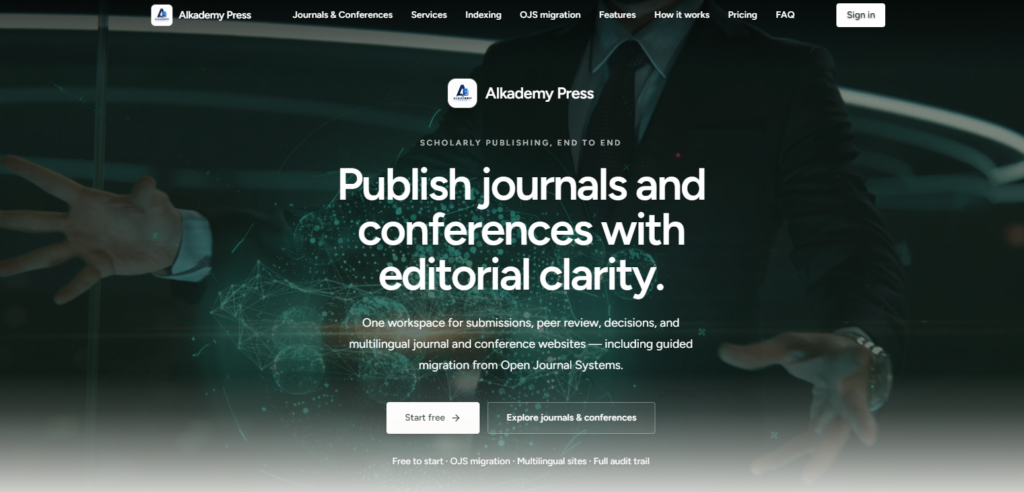
Alkademy Press is an AI-assisted journal management and publishing platform designed to support academic publishers from manuscript submission to publication.
Key Features
- AI Submission Screening: Assesses manuscripts, generates quality scores and provides editorial recommendations with specific concern flags.
- Manuscript Submission Management: Allows authors to submit manuscripts, upload files, save drafts and invite co-authors.
- Peer Review Management: Supports reviewer assignments, multiple review rounds, structured feedback and deadline tracking.
- Editorial Dashboard: Gives editors an overview of submission activity, review progress and editorial decisions.
- Journal Publishing Websites: Provides hosted websites with custom branding, domains, volumes, issues and editorial board pages.
- Billing and Open Access Management: Supports article processing charges, payment processing, waivers and institutional invoicing.
For more insights, read our article on how AI is changing academic journal editorial workflows.
How It Supports Academic Publishing
Alkademy Press helps journal teams move manuscripts through the editorial process in a more organised way.
Its AI screening feature evaluates submissions using their titles, abstracts and keywords, generating a score from 0 to 100 alongside recommendations and potential concern flags.
Editors can use these insights during preliminary assessments before deciding whether a manuscript should proceed to peer review. This helps make initial evaluations more structured while keeping editorial decisions under human control.
Who Should Use Alkademy Press?
- Academic journal editors managing submissions and peer review.
- Universities and research institutions operating scholarly journals.
- Academic societies managing journal publications.
- Independent academic publishers establishing publishing operations.
- Editorial teams looking to replace disconnected tools and manual processes.
What Makes Alkademy Press Different?
Unlike research assistants that focus on discovering and analysing academic literature, Alkademy Press is built around the operational needs of academic publishing.
Its combination of AI-assisted screening and journal management infrastructure makes it a practical option for publishers seeking one platform to manage their publishing activities.
Elicit: Best for AI-Assisted Literature Reviews and Research Discovery
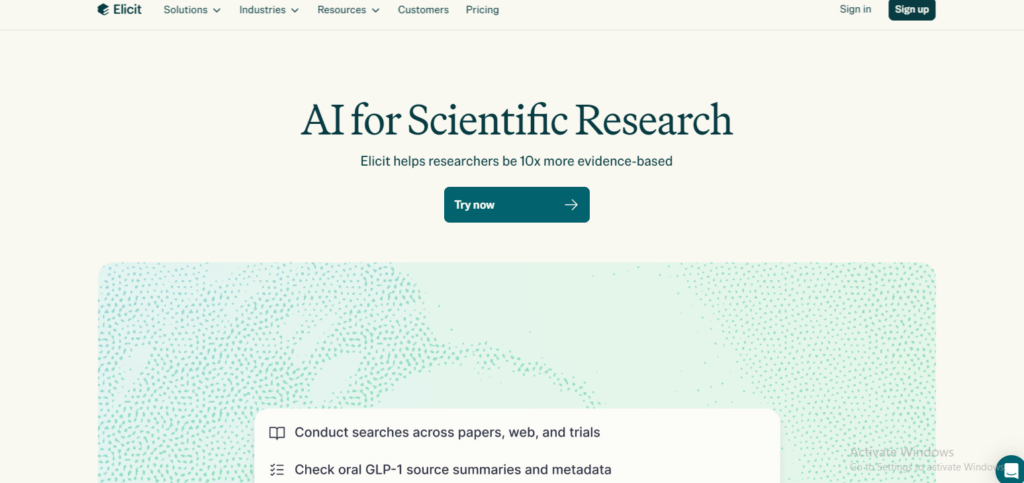
Elicit is an AI-powered research assistant that helps researchers find, analyse and organise academic literature.
It is particularly useful when investigating a research question, reviewing existing studies or gathering evidence from multiple publications.
Instead of manually working through large collections of academic papers, researchers can use Elicit to explore relevant literature, extract information and organise findings into structured outputs.
Key Features
- Research Agent: Helps investigate research questions using academic papers and uploaded resources.
- Research Reports: Produces structured reports that provide an overview of a research topic.
- Systematic Review Workflow: Guides researchers through paper discovery, screening, data extraction and report generation.
- Data Extraction: Helps extract relevant information from research papers into organised tables.
- Research Synthesis: Supports the comparison and organisation of findings across multiple studies.
How It Supports Academic Research
Elicit simplifies literature reviews by helping researchers find relevant studies and extract information about their methods, findings and research populations.
Its structured workflows also help organise evidence for further analysis.
For example, a postgraduate student researching AI and student performance can use Elicit to identify relevant studies and compare their findings.
Who Should Use Elicit?
- Postgraduate students conducting literature reviews.
- Researchers investigating specific research questions.
- Research assistants organising academic publications.
- Systematic review teams gathering evidence.
Limitations and Considerations
Elicit’s summaries and extracted information should be checked against original publications.
Researchers must still evaluate the quality and relevance of their sources. Some advanced features and usage limits depend on the subscription plan.
Scite: Best for AI-Powered Citation Analysis and Research Verification
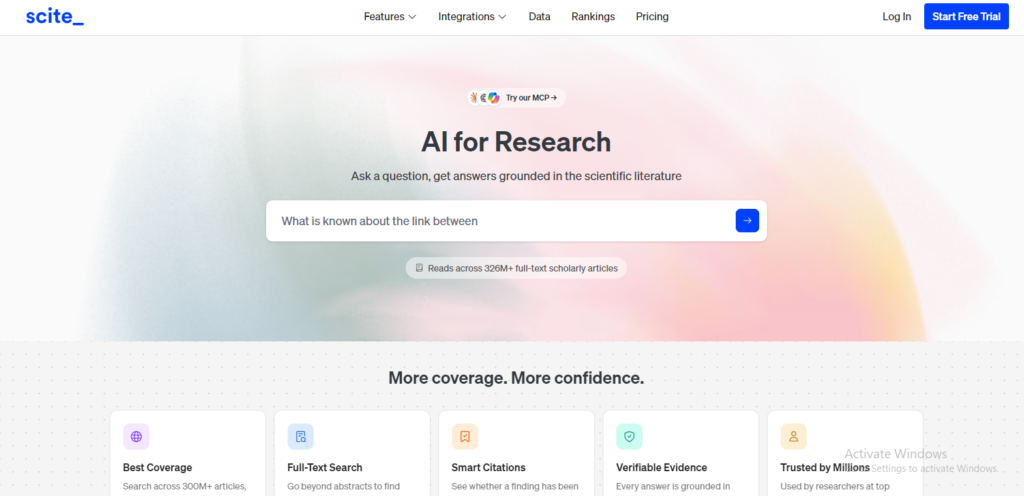
Scite is an AI-powered research platform that helps researchers discover scholarly literature and understand how academic publications are cited by subsequent studies.
Its Smart Citations feature goes beyond conventional citation counts by examining the context in which a publication is referenced.
This helps researchers see whether other studies support, contrast with or simply mention a particular finding.
Key Features
- Smart Citations: Classifies citation statements as supporting, contrasting or mentioning a published study.
- Scite Assistant: Provides AI-assisted research answers grounded in scholarly literature.
- Academic Search: Helps users discover publications and search within scholarly research content.
- Citation Reports: Provides detailed information about how individual publications have been cited.
- Collections: Allows researchers to organise publications and monitor citation activity.
- Reference Check: Examines manuscript references and highlights relevant citation concerns, including retractions and editorial notices.
How It Supports Academic Research
Scite gives researchers more context when evaluating academic sources.
Rather than relying only on citation counts, they can examine whether subsequent studies support or challenge a publication’s findings.
Its Reference Check feature also helps researchers and journal teams identify potentially problematic references before submitting or reviewing manuscripts.
Who Should Use Scite?
- Researchers evaluating published studies.
- Postgraduate students reviewing academic sources.
- Journal editors checking manuscript references.
- Peer reviewers assessing supporting literature.
- Scholars monitoring citation activity in their research fields.
Limitations and Considerations
Citation classifications provide useful context but do not prove whether a study is scientifically correct. Researchers should examine the original publications before drawing conclusions.
Scite’s coverage also depends on its indexed scholarly content, so some publications and citations may not be available.
How to Choose the Right AI Tool for Your Academic Needs
The right AI tool depends on your specific needs.
Researchers conducting literature reviews, evaluating citations and managing academic journals require different capabilities.
For Researchers Conducting Literature Reviews
Elicit helps researchers discover academic papers, extract information and organise findings. It is useful for:
- Finding publications related to research questions.
- Extracting key information from academic papers.
- Comparing research findings and methodologies.
- Organising evidence for literature reviews.
Researchers should still verify extracted information against the original publications.
For Researchers Evaluating Academic Sources
Scite helps researchers understand how academic publications are cited and evaluated in subsequent studies. Its capabilities include:
- Identifying supporting and contrasting citations.
- Examining citation context.
- Evaluating the credibility of research references.
- Identifying retracted publications and editorial notices.
This helps researchers assess sources and build evidence-based arguments.
For Journal Editors and Academic Publishers
Alkademy Press is designed for journal teams managing academic publishing activities. Its features support:
- Receiving and organising manuscript submissions.
- AI-assisted manuscript screening.
- Assigning reviewers and coordinating peer review.
- Managing revisions and editorial decisions.
- Publishing articles through journal websites.
- Managing billing and article processing charges.
These capabilities help editorial teams coordinate publishing activities and reduce the administrative work involved in managing academic journals.
Benefits of Using AI Tools for Academic Research and Publishing
AI tools help researchers and academic publishers reduce repetitive tasks, organise information and improve research and publishing workflows.
- Faster Academic Literature Discovery: Tools such as Elicit and Scite help researchers find relevant publications and explore related studies more efficiently.
- More Efficient Literature Reviews: AI can summarise papers, extract key findings, organise evidence and help identify research gaps.
- Better Citation Evaluation: Scite helps researchers examine whether publications are supported, contrasted or mentioned by subsequent studies.
- Streamlined Manuscript Screening: Alkademy Press provides AI-assisted manuscript quality scores and editorial recommendations to support preliminary assessments.
- More Efficient Journal Management: Alkademy Press brings submission management, peer review coordination, editorial tracking and journal publishing websites into one platform.
Why We Chose Alkademy Press for Academic Journal Management and Publishing
While Elicit and Scite focus on research discovery and citation analysis, Alkademy Press addresses the operational needs of academic journals.
We chose it for three key reasons:
- An All-in-One Publishing Platform: Combines journal management, manuscript submissions, peer review and publishing activities in one environment.
- AI That Supports Editorial Teams: Assists with manuscript screening and editorial assessments while leaving important publishing decisions to human editors.
- A Professional Publishing Infrastructure: Gives journals the tools to manage their operations and present published research through dedicated journal websites.
Together, these capabilities make Alkademy Press a practical choice for academic societies, institutions and publishers looking to manage their journals more efficiently.
FAQs
What Are the Best AI Tools for Academic Research?
Some useful AI tools for academic research include Elicit, Scite and other platforms designed for literature discovery, research synthesis and citation analysis. Elicit supports literature reviews and evidence extraction, while Scite helps researchers examine how scholarly publications are cited. For journal management and academic publishing, Alkademy Press provides tools for managing submissions, editorial workflows and publishing activities.
Which AI Tool Is Best for Academic Literature Reviews?
Elicit is a useful option for academic literature reviews because it helps researchers discover relevant papers, extract information and organise evidence from academic studies. It can support literature review workflows, although researchers should still evaluate the original publications and verify the information extracted.
Can AI Tools Help With Academic Manuscript Screening?
Yes. AI tools can support manuscript screening by helping editors assess submissions, identify potential issues and organise preliminary evaluations. Alkademy Press offers AI-assisted manuscript screening with quality scoring and editorial recommendations. However, editors should review these outputs and retain responsibility for manuscript decisions.
What Is the Best AI Tool for Academic Journal Publishing?
The best tool depends on a journal’s publishing requirements. Alkademy Press is a strong option for academic journal management and publishing because it brings submission management, AI-assisted manuscript screening, editorial workflows and journal publishing websites into one platform.
Can AI Tools Replace Human Editors and Peer Reviewers?
No. AI tools can assist with administrative tasks, manuscript screening and research evaluation, but they cannot replace the expertise and accountability required from human editors and peer reviewers. Editorial decisions should remain under human control to protect research quality, fairness and publication integrity.
Final Thoughts on Best AI Tools for Academic Research
AI is making academic research and publishing more efficient, from discovering relevant literature and evaluating citations to managing manuscripts and editorial workflows.
However, the best results come from choosing tools that address specific needs while maintaining accuracy, transparency and human oversight.
For researchers, Elicit and Scite offer useful support for literature reviews and citation analysis. For academic journals, Alkademy Press provides an integrated platform for managing submissions, editorial activities and publishing operations.
Ready to make academic journal management and publishing more efficient?
Explore Alkademy Press and discover how its tools can support your journal’s publishing workflow.