Learn how to create and sell online courses from scratch. Discover how to choose a profitable topic, develop a curriculum, record lessons, set prices, and attract students.
TL;DR
- Choose a course topic that matches your expertise and addresses a genuine learning need.
- Research your audience and validate demand before developing your content.
- Create a structured curriculum with clear learning objectives and practical exercises.
- Choose suitable tools and a platform to host and sell your course.
- Set a reasonable price, promote your course, and use student feedback to improve it.
Online learning continues to create opportunities for instructors to share their knowledge and earn from their expertise.
According to the OECD Digital Economy Outlook 2024, the proportion of internet users taking online courses across OECD countries increased from 7% in 2013 to 21% in 2023.
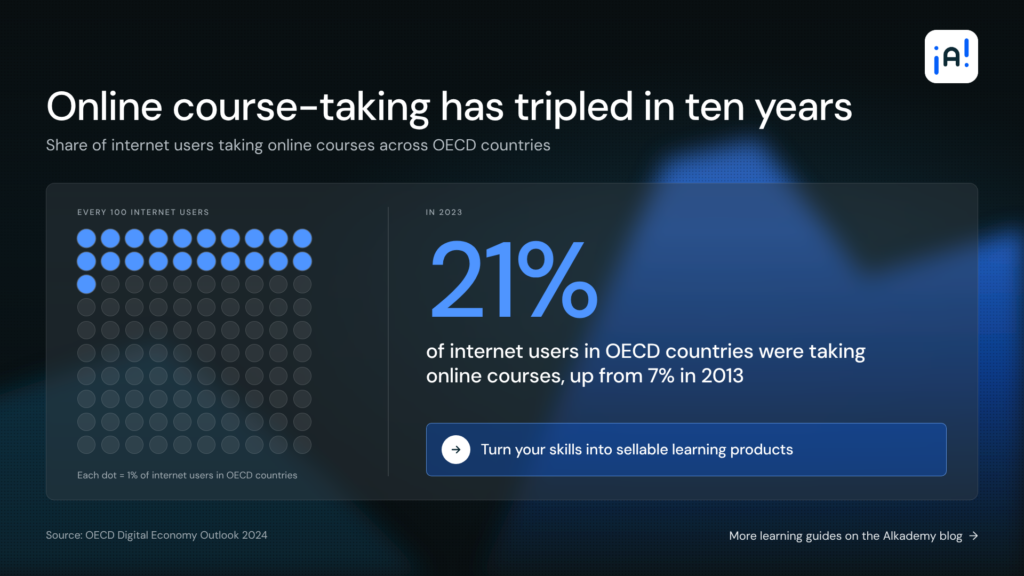
This growth creates opportunities for people looking to turn their skills into sellable learning products.
However, success requires more than subject knowledge. You also need a clear curriculum, effective teaching methods, and the right platform to attract students and generate sales.
Table of Contents
What Are Online Courses?
Online courses are structured learning programmes delivered over the internet.
They help students develop knowledge or practical skills without attending a traditional classroom.
You can find online courses covering subjects such as programming, business, digital marketing, graphic design, data science, and professional development.
For instructors, creating an online course means packaging knowledge into lessons, activities, and supporting resources that help students achieve specific learning goals.
Unlike traditional classroom teaching, online courses can reach learners in different locations. Depending on the format, students can also access lessons at convenient times.
Types of Online Courses
The best course format depends on your subject, teaching style, and students’ learning needs.
Common options include:
- Self-paced courses: Pre-recorded lessons that students complete on their own schedules.
- Live online classes: Real-time teaching sessions where students can ask questions and interact with instructors.
- Text-based courses: Written lessons, guides, and downloadable resources.
- Project-based courses: Practical programmes built around assignments and real-world projects.
- Hybrid courses: A combination of recorded lessons, live sessions, and independent activities.
For example, a programming course might combine recorded explanations with coding exercises and live troubleshooting sessions. This gives students the flexibility to study independently while receiving support when needed.
How to Create and Sell Online Courses: 10 Essential Steps
Creating an online course involves more than recording videos and uploading them to a website.
You need a clear plan for developing the learning experience, reaching prospective students, and maintaining course quality.
Here are ten steps to help you get started:
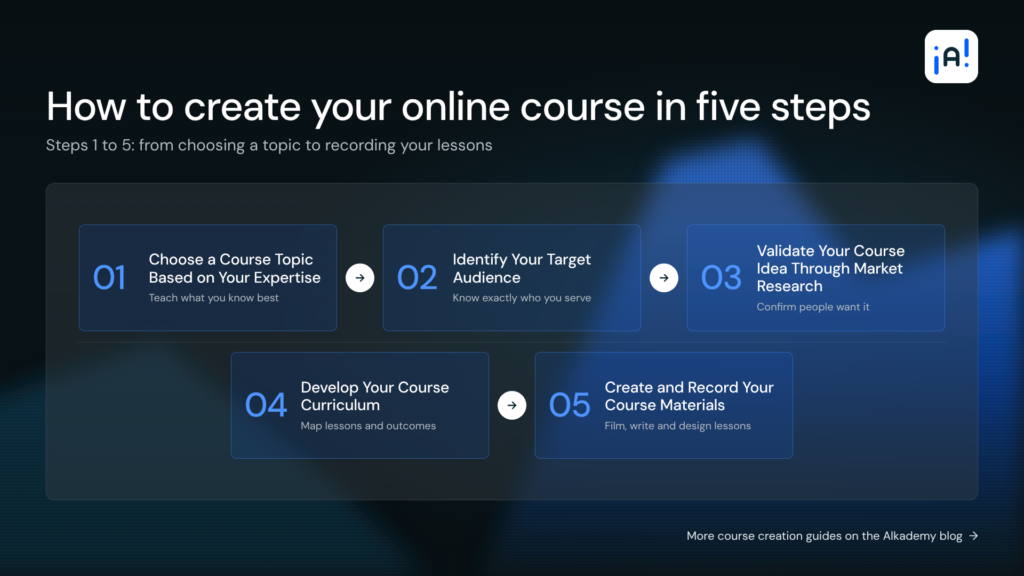
Step 1: Choose a Course Topic Based on Your Expertise
Start with something you understand well enough to teach.
Your professional experience, technical skills, academic background, or practical knowledge can provide a strong foundation.
However, don’t choose a topic simply because you enjoy it. Consider whether people need the knowledge and whether your course can help them solve a specific problem.
For example, instead of creating a broad course on digital marketing, you could focus on helping small business owners develop their first social media marketing strategy.
When choosing your topic:
- Identify the subjects you understand particularly well.
- Consider the problems your knowledge can help people solve.
- Explore skills people are actively trying to develop.
- Narrow your topic to a specific audience and learning outcome.
A focused topic makes it easier to develop relevant lessons and communicate the value of your course.
Step 2: Identify Your Target Audience
Your course should be designed around the people you want to teach.
A beginner learning Python has different needs from a software developer exploring advanced programming techniques.
Start by identifying your intended students and understanding their existing knowledge, challenges, and learning goals.
Consider these questions:
- Are you teaching beginners, intermediate learners, or experienced professionals?
- What skills do they already have?
- What problem are they trying to solve?
- What should they be able to accomplish after completing your course?
- How much time can they realistically dedicate to learning?
You can gather this information through surveys, interviews, social media discussions, and relevant online communities.
The better you understand your audience, the easier it becomes to create lessons that address their actual needs.
Step 3: Validate Your Course Idea Through Market Research
Before spending weeks developing a course, check whether people are interested in learning the subject and whether they are willing to pay for it.
Market research helps you understand demand, identify competing courses, and find opportunities to offer something different.
Here are some practical ways to validate your idea:
- Research competing courses: Compare their topics, lesson structures, pricing, and student reviews.
- Explore search demand: Use keyword research tools to discover what people are searching for.
- Study online discussions: Look for recurring questions and problems in relevant communities.
- Interview potential students: Ask what they want to learn and what makes existing learning resources inadequate.
- Test an early offer: Share a course outline or introductory workshop and measure actual interest in enrolling.
For example, if you’re considering a course on artificial intelligence, investigate whether your audience wants to learn prompt engineering, AI automation, or machine learning fundamentals.
Don’t confuse general interest with buying intent. People saying a course sounds interesting is not the same as people registering or paying for it.
How to Validate Your Course Idea
Before developing your course, use these five steps to assess its market potential:
- Identify a learning need: Determine the specific problem your course will solve.
- Interview potential students: Speak with at least five people in your target audience.
- Research competitors: Compare similar courses, pricing, and student feedback.
- Create a course outline: Share your proposed lessons and learning outcomes for feedback.
- Test demand: Run a free workshop or paid pilot to gauge genuine interest.
Use the feedback to refine your idea before investing time and money in course development.
Step 4: Develop Your Course Curriculum
Your curriculum determines what students learn and how they progress through the subject.
A good structure takes learners from their starting knowledge to a clearly defined outcome.
Begin with the result you want students to achieve. Then work backwards to identify the knowledge and practical skills they need.
For example, a beginner’s web development course might have this structure:
| Module | Topics | Learning outcome |
| Introduction | How websites work | Explain basic web concepts |
| HTML | Elements and page structure | Build a basic webpage |
| CSS | Styling and layouts | Create a responsive page |
| JavaScript | Variables and functions | Add basic interactivity |
| Final project | Build a complete website | Apply the skills independently |
Each module should have clear learning objectives.
A useful learning objective describes what students should be able to do, rather than simply naming what the instructor plans to discuss.
For instance, “Understand HTML” is less specific than “Create a webpage using headings, paragraphs, links, and images.”
Also consider including:
- Short, focused lessons.
- Practical exercises and assignments.
- Quizzes to check understanding.
- Downloadable resources and reference materials.
- A final project where students apply what they’ve learned.
Avoid adding unnecessary topics to make your course longer. Focus on what students need to achieve the intended outcome.
Step 5: Create and Record Your Course Materials
Once your curriculum is ready, start developing the actual lessons.
Your materials should explain concepts clearly and give students opportunities to apply what they learn. Depending on your subject, you might use videos, presentations, written guides, demonstrations, or downloadable templates.
Keep these points in mind:
- Prepare lesson outlines: Organise your explanations before recording to avoid unnecessary repetition.
- Use clear audio: A good microphone is often more important than an expensive camera.
- Record practical demonstrations: Show students how to complete tasks rather than relying entirely on theory.
- Edit your recordings: Remove unnecessary pauses, correct mistakes, and check sound quality.
- Provide supporting materials: Include worksheets, templates, code samples, or reference guides where relevant.
- Make content accessible: Use captions, readable text, and clear visual layouts.
You don’t need an expensive studio to produce a useful course.
Clear instruction and practical learning activities matter more than elaborate production effects.
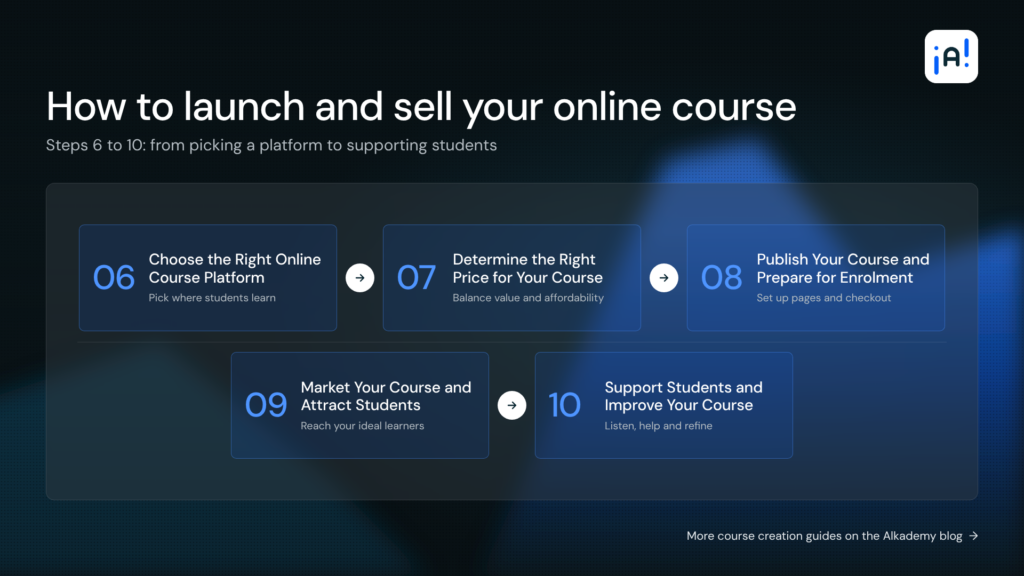
Step 6: Choose the Right Online Course Platform
Your course needs a reliable place where students can enrol, access lessons, and receive the learning materials.
You can host courses on your own website or use an established online learning platform. Each option has different advantages.
| Consideration | Your own website | Established platform |
| Branding | Greater control | Depends on platform |
| Setup | Requires more configuration | Often simpler |
| Student management | You manage the infrastructure | Depends on available features |
| Payments | You arrange payment integration | May include payment tools |
| Discoverability | You build your own audience | May offer an existing audience |
Before choosing, check whether the platform provides:
- Course and lesson management.
- Student registration and enrolment.
- Secure payment processing.
- Quizzes and assignments.
- Student progress tracking.
- Instructor profiles.
- Communication and support tools.
- Clear pricing and revenue-sharing terms.
Also check content ownership, refund policies, payment withdrawal arrangements, and whether you can export your student or course data.
The right platform should support your current needs without making it difficult to grow your teaching business.
Step 7: Determine the Right Price for Your Course
Course pricing should reflect the value of the learning experience, your audience’s expectations, and the costs involved in delivering it.
A specialised course with practical projects and instructor support may justify a different price from a short introductory programme.
Consider these factors:
- Course depth: How much useful content and practical instruction does it provide?
- Audience: What can your intended students reasonably afford?
- Market positioning: How are comparable courses priced?
- Support: Are you providing feedback, mentorship, or live sessions?
- Delivery costs: What platform fees, payment charges, and other expenses will you incur?
You can use different pricing models:
- One-time payment: Students pay once for course access.
- Subscription: Learners pay recurring fees for ongoing access.
- Tiered pricing: Different packages provide different levels of resources or support.
- Course bundles: Related courses are sold together.
- Paid live sessions: Students pay for instructor-led training.
Start with a price that reflects the course’s value and is appropriate for your target audience. Review it as you gather feedback and learn more about enrolment patterns.
Step 8: Publish Your Course and Prepare for Enrolment
Before launching, review your course from a student’s perspective.
A well-organised course should make it easy for learners to understand what they are buying, access their lessons, and follow the learning sequence.
Check the following:
- Upload lessons in the correct order.
- Write a clear course description.
- Explain who the course is designed for.
- List the learning outcomes.
- Include relevant instructor information.
- Check downloadable materials and assignments.
- Test the registration and payment process.
- Review the course on mobile and desktop devices.
Your course landing page should answer three important questions:
- What will I learn?
- Is this course suitable for my current skill level?
- What will I be able to do after completing it?
Make the enrolment process straightforward. Unnecessary steps or unclear pricing can discourage interested students from completing their registration.
Step 9: Market Your Course and Attract Students
Publishing your course doesn’t guarantee enrolments.
You need a strategy for reaching people who are likely to benefit from what you’re teaching.
Start with the marketing channels your target audience already uses.
Here are some approaches worth considering:
- Search engine optimisation: Publish useful articles and optimise your course landing page for relevant search terms.
- Social media: Share educational tips, short tutorials, and course updates.
- Email marketing: Build an audience and send useful learning resources alongside course announcements.
- Free introductory lessons: Give potential students a preview of your teaching style and course content.
- Webinars and workshops: Demonstrate your expertise through interactive learning sessions.
- Professional communities: Participate in relevant groups and discussions without relying on constant promotional messages.
- Student referrals: Encourage satisfied learners to recommend your course.
Focus on providing value before asking people to buy. When prospective students find your free content useful, they have a better opportunity to understand your teaching approach and decide whether your course is right for them.
Step 10: Support Students and Improve Your Course
Your work doesn’t end when the first students enrol.
You need to make sure the course continues to deliver the learning experience you promised.
Pay attention to student questions, assessment results, course completion, and recurring difficulties.
For example, if several students struggle with the same programming exercise, the problem may be an unclear explanation or a missing prerequisite lesson.
Use feedback to:
- Clarify difficult lessons.
- Add practical examples where needed.
- Update outdated information.
- Improve assignments and assessments.
- Provide additional learning resources.
- Identify gaps in the curriculum.
You should also evaluate whether students are achieving the learning objectives. Course completion alone doesn’t necessarily mean that learning has taken place.
Regular improvements help keep your course useful and give students a better learning experience.
Essential Tools for Creating Online Courses
You don’t need dozens of applications to create your first course.
A few suitable tools can handle most of the planning, recording, editing, and publishing work.
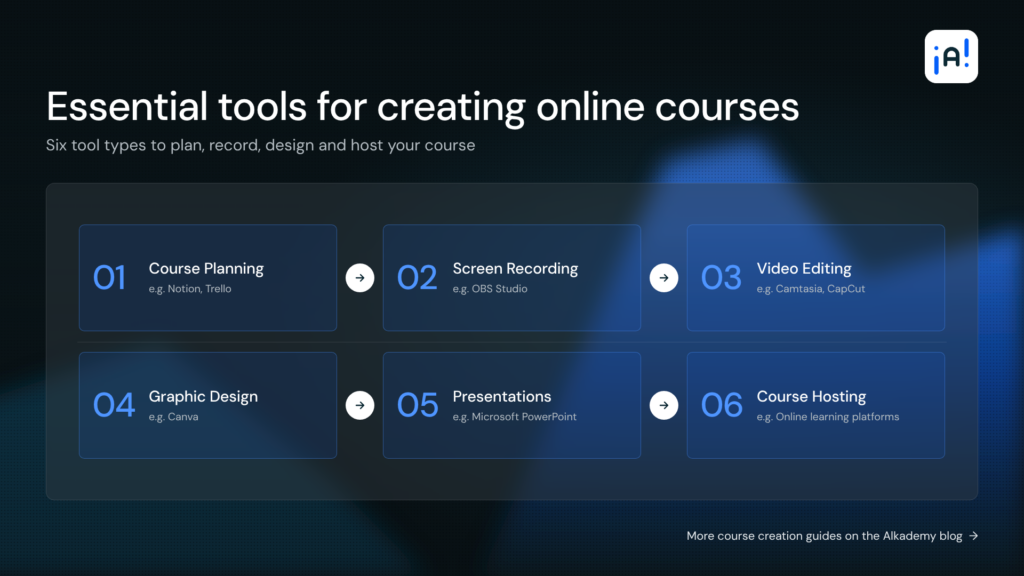
| Tool category | Examples | What they’re useful for |
| Course planning | Notion, Trello | Organising lessons and tasks |
| Screen recording | OBS Studio | Recording demonstrations |
| Video editing | Camtasia, CapCut | Editing course videos |
| Graphic design | Canva | Creating slides and visuals |
| Presentations | Microsoft PowerPoint | Developing lesson presentations |
| Course hosting | Online learning platforms | Publishing and managing courses |
Choose tools based on your actual requirements.
For example, a programming instructor may need screen recording software, while someone teaching business communication may rely more heavily on presentations and video lessons.
Start with what you need and expand your toolkit as your course offerings grow.
Common Mistakes First-Time Online Course Instructors Should Avoid
A few common mistakes can make it harder to attract students or deliver a good learning experience.
Watch out for these:
- Skipping market research: Don’t assume people will pay for a course simply because the topic interests you.
- Overloading the curriculum: Too many unrelated lessons can make learning confusing.
- Ignoring practical application: Students need opportunities to use the knowledge they acquire.
- Prioritising production over teaching: Professional-looking videos cannot compensate for unclear explanations.
- Choosing the wrong platform: Review costs, features, payment arrangements, and content ownership before committing.
- Pricing without research: Consider your audience, course value, and delivery costs.
- Neglecting marketing: Build a plan to reach prospective students before launching.
- Ignoring student feedback: Recurring questions and poor assessment results can reveal problems in your course.
The goal is not to create the longest or most visually impressive course. It’s to create a learning experience that helps students achieve a meaningful result.
How to Build Your Visibility and Credibility as an Online Instructor
Creating a useful course is important, but prospective students also need to know who you are and why they should trust your teaching.
Start by building a professional instructor profile that clearly communicates your qualifications, relevant experience, subject knowledge, and teaching interests.
You should also consider how prospective learners can discover your expertise.
Alkademy provides an instructor directory where learners can explore educators and their areas of specialisation.
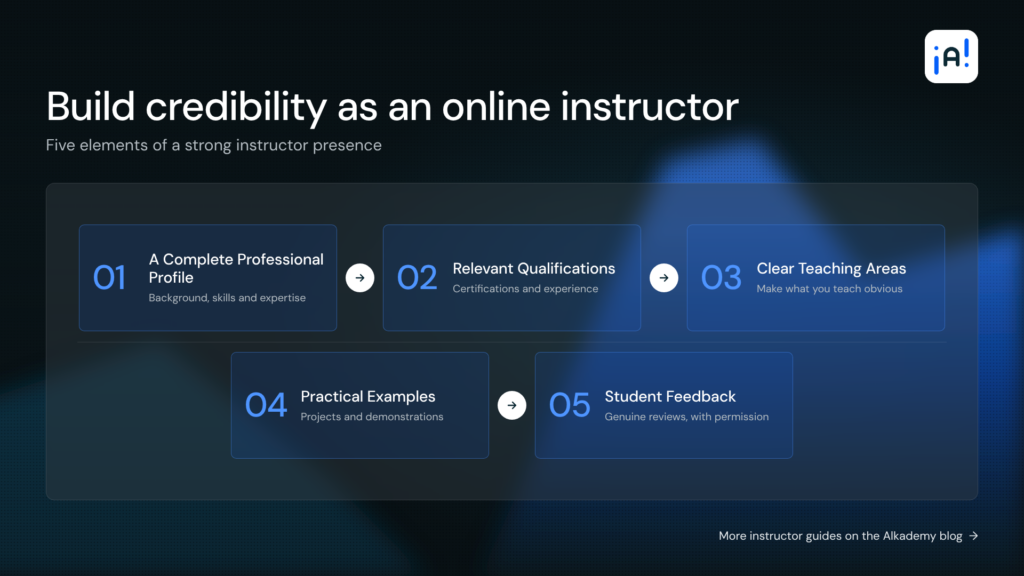
A strong instructor presence should include:
- A complete professional profile: Explain your background, skills, and areas of expertise.
- Relevant qualifications: Highlight certifications, education, or professional experience that support your subject knowledge.
- Clear teaching areas: Make it easy for learners to understand what you teach.
- Practical examples: Where possible, showcase projects, demonstrations, or other evidence of your knowledge.
- Student feedback: Share genuine reviews and testimonials with appropriate permission.
The Alkademy Instructor Directory offers another way to make your teaching expertise discoverable to people searching for instructors.
Building credibility takes time. Keep your profile accurate, demonstrate your knowledge, and focus on delivering the learning experience you promise.
Online Courses vs Live Online Classes: Which Should You Choose?
Both formats can support effective online learning, but they work differently.
| Feature | Self-paced online courses | Live online classes |
| Delivery | Pre-recorded lessons | Real-time instruction |
| Schedule | Flexible | Fixed sessions |
| Interaction | Mostly independent | Direct interaction |
| Learning pace | Student-controlled | Instructor-guided |
| Best for | Independent study | Discussions and guided practice |
Self-paced courses work well when students can learn through organised lessons and independent exercises. They also allow instructors to reuse recorded content across multiple enrolments.
Live classes are useful when students need immediate feedback, demonstrations, discussions, or direct guidance.
You don’t have to choose only one. A hybrid approach can combine recorded lessons with scheduled sessions for questions, demonstrations, and practical activities.
Alkademy offers live learning opportunities for instructors who want to engage with students through interactive, real-time teaching alongside self-paced courses.
FAQs
How do beginners create and sell online courses?
Start by choosing a subject you understand, researching your target audience, and validating demand. Develop a structured curriculum, record your lessons, choose a suitable platform, and promote your course to attract students.
How much does it cost to create an online course?
The cost depends on your equipment, recording software, course platform, and production requirements. You can start with basic equipment and free tools, then invest in better resources as your course business grows.
Can I sell online courses without formal teaching qualifications?
Yes. Many subjects don’t require formal teaching qualifications, but you should have sufficient knowledge and practical experience to teach responsibly. Some regulated professions may have specific qualification requirements.
What is the best platform for creating and selling online courses?
The best platform depends on your budget, audience, and teaching needs. Compare course management features, payment options, student support, marketing tools, and platform fees before making a decision.
How much money can I make selling online courses?
Your earnings depend on course pricing, student enrolments, audience size, and marketing efforts. You should also account for platform fees, production costs, taxes, and refunds when calculating your actual profit.
Final Thoughts on How to Create and Sell Online Courses
Creating and selling online courses allows you to share your expertise, reach new learners, and earn from your knowledge. Start with a focused topic, develop valuable lessons, and use student feedback to improve your course as you grow.
Build your teaching presence with Alkademy, showcase your expertise, and connect with learners looking for skills you can teach.