
Learn how AI literacy for students builds critical thinking, responsible AI use, and practical digital skills for learning and future opportunities.
TL;DR
- AI literacy for students involves understanding how AI works, evaluating its outputs, and using it responsibly.
- Essential skills include prompt writing, fact-checking, recognising bias, protecting personal information, and understanding AI limitations.
- Students can use AI platforms such as ChatGPT, Gemini, NotebookLM, and Perplexity for studying, research, revision, writing, and creating learning materials.
- Practical exercises help students develop critical thinking and use AI to support learning without replacing independent work.
- Alkademy supports students’ digital skill development through online courses, live classes, and workshops.
Artificial intelligence is becoming part of everyday student life.
From explaining difficult concepts to helping with revision, AI tools offer new ways to learn. However, using these tools effectively requires more than knowing what questions to ask.
AI literacy for students involves understanding how AI works, recognising its limitations, evaluating the information it produces, and making responsible decisions about when to use it. These skills help students benefit from AI while maintaining their own judgement and independence.
Developing AI literacy takes practice, and students can build these skills gradually. As an AI Powered Online Learning Ecosystem, Alkademy provides opportunities to develop knowledge and practical digital skills through online courses, live classes, and workshops.
You may also like: AI Literacy for Teachers: A Practical Guide
Table of Contents
What Is AI Literacy for Students?
AI literacy is the ability to understand, use, evaluate, and interact responsibly with artificial intelligence.
For students, it means knowing what AI tools can do, how they produce responses, and when their outputs need to be questioned or verified.
Being AI-literate goes beyond entering questions into a chatbot. Students need to recognise that AI can generate inaccurate information, reflect biases, overlook important context, or produce references that do not exist.
For example, a student researching climate change might ask an AI tool to explain the greenhouse effect. An AI-literate student would use that explanation as a starting point, check important claims against reliable scientific sources, and develop an independent understanding of the topic.
The Four Core Areas of AI Literacy for Students
UNESCO’s AI competency framework for students provides a useful reference for understanding the knowledge and practical skills students need to develop AI literacy.
- Understanding AI and Its Applications: Learn basic AI concepts, recognise common applications, and understand how AI systems generate responses, including the differences between AI, machine learning, and generative AI.
- Using AI Ethically and Responsibly: Understand privacy, fairness, and academic integrity. Protect personal information and follow your school or university’s guidelines for AI use.
- Evaluating AI-Generated Information: Question AI responses, verify facts, recognise potential bias, and compare information with credible sources rather than assuming confident answers are always correct.
- Exploring How AI Systems Are Developed: Learn how AI systems are designed, tested, and improved. As your knowledge grows, explore beginner-friendly activities such as experimenting with simple classification tools or creating a basic AI-assisted project.
Together, these areas help students progress from understanding AI to applying it effectively and exploring how AI-powered systems are created.
Why Is AI Literacy Important for Students?
AI literacy helps students make informed decisions about technology and develop skills that support learning both inside and outside the classroom.
It Strengthens Critical Thinking
AI tools can provide quick answers, but students still need to decide whether those answers make sense. Evaluating evidence, comparing explanations, and identifying missing information encourages students to think beyond the first response they receive.
It Supports Independent Learning
Students can use AI to explore unfamiliar subjects, request alternative explanations, and practise difficult concepts. When they attempt problems independently and review AI feedback critically, they can use the technology to support their understanding.
It Encourages Responsible Technology Use
Understanding AI helps students recognise potential privacy risks, bias, misinformation, and academic integrity concerns. They can make better decisions about which tools to use and what information to share.
It Builds Practical Digital Skills
Prompt writing, information evaluation, problem-solving, and digital research are useful skills across many educational and professional settings. AI literacy helps students develop these abilities while learning to adapt to changing technology.
It Prepares Students for an AI-Enabled World
Artificial intelligence is increasingly used in education, research, business, and creative work. Students who understand its capabilities and limitations will be better equipped to assess opportunities, recognise risks, and use AI appropriately in different contexts.
Essential AI Literacy Skills Every Student Should Develop
Developing AI literacy requires more than knowing how to use a chatbot.
Students need a combination of technical understanding, critical thinking, practical experience, and responsible decision-making.
Understanding Artificial Intelligence
Students should begin with the basics of artificial intelligence and its everyday applications.
They should understand that:
- Artificial intelligence refers to technologies that perform tasks associated with human intelligence, such as recognising patterns, generating content, and interpreting information.
- Machine learning is an approach that enables systems to learn patterns from data.
- Generative AI produces content such as text, images, audio, and code based on patterns learned during training and other inputs.
- AI outputs can be inaccurate, outdated, incomplete, or misleading.
For example, a generative AI tool might produce a useful summary of a historical event but include an incorrect date. Understanding this limitation helps students recognise why verification matters.
Writing Effective AI Prompts
A prompt is the instruction or question given to an AI tool. Clear prompts help students obtain responses that are more relevant to their learning goals.
An effective prompt usually includes the task, relevant context, the intended audience, and the desired format.
For example, instead of writing:
“Explain biology.”
A student could write:
“Explain photosynthesis in simple terms for a secondary school student. Describe the main stages, define the key terms, and give one practical example.”
Students should also learn to refine prompts when the initial response is unclear or incomplete. However, a well-written prompt does not guarantee an accurate answer, so the output still needs to be evaluated.
Evaluating AI-Generated Information
AI tools can produce plausible-sounding errors, misleading explanations, and fabricated references. Students need to develop the habit of checking important information before using it in assignments or research.
They can practise this by:
- Comparing AI-generated claims with textbooks, academic publications, and credible educational websites.
- Checking statistics, dates, quotations, and references independently.
- Looking for supporting evidence rather than relying on confident wording.
- Comparing different explanations when a topic is disputed or complex.
- Correcting their understanding when reliable sources contradict an AI response.
This skill helps students treat AI as a starting point for investigation rather than an unquestionable source of truth.
Recognising AI Bias and Limitations
AI systems may reflect biases in their training data, overlook certain perspectives, or generate responses that do not account for important context.
Students should learn to ask questions such as:
- Whose perspective is represented in this response?
- Is there evidence to support the main claims?
- What information might be missing?
- Could this answer contain stereotypes or unfair assumptions?
- Would another reliable source explain the issue differently?
They should also recognise that AI tools can struggle with specialised subjects, complex reasoning, and questions requiring current information.
Using AI Ethically and Responsibly
Responsible AI use involves understanding how technology should be applied in academic and everyday settings.
Students should learn to:
- Follow school or university guidelines on AI-assisted assignments.
- Acknowledge AI assistance when required.
- Protect personal details, passwords, and confidential information.
- Avoid presenting AI-generated work as their own when this violates academic rules.
- Check the accuracy and originality of their final work.
- Retain responsibility for their decisions and submitted work.
The goal is to use AI to strengthen learning, not to bypass the effort needed to understand a subject.
Understanding Privacy and Digital Safety
Students should know that information entered into an AI tool may be collected or processed according to the service’s data policies and settings.
Good digital safety habits include avoiding the upload of identifiable student records, private messages, passwords, and confidential academic information. Students should review the privacy policies of tools they use and seek guidance from a teacher or trusted adult when necessary.
These habits help students make safer decisions about the information they share online.
How AI Literacy Differs by Education Level
Students have different learning needs depending on their age, experience, and educational environment. AI literacy should therefore develop progressively rather than follow a single approach for everyone.
Primary School Students
Younger learners can begin by recognising common AI applications, understanding that AI can make mistakes, and learning basic online safety.
Suitable activities include identifying AI-powered features in everyday applications, comparing an AI-generated answer with a teacher’s explanation, and discussing why personal information should remain private.
Secondary School Students
Secondary school students can develop more advanced skills in prompting, fact-checking, recognising bias, and responsible academic use.
They can compare AI-generated explanations with textbook content, evaluate sources for research assignments, and discuss when AI assistance is appropriate for schoolwork.
University Students
University students often need to apply AI literacy to independent research, specialised subjects, and academic writing.
They should learn to verify citations, assess the quality of evidence, evaluate discipline-specific limitations, and follow institutional policies on AI-assisted research and assessment.
At this level, students can also explore more advanced applications, including AI-assisted data analysis, programming, and the development of simple AI-powered projects.
Across all levels, the objective remains the same: to understand AI, evaluate its outputs, and use it in ways that support genuine learning.
Practical AI Literacy Activities for Students
Reading about AI literacy is useful, but students also need opportunities to apply what they learn. These activities can help them practise essential skills using familiar subjects.
Activity 1: Test an AI Explanation
Choose a topic you are studying, such as photosynthesis, fractions, or a historical event.
- Ask an AI tool to explain the topic.
- Identify two factual claims in the response.
- Check both claims using a textbook or credible source.
- Identify any errors, missing details, or unclear explanations.
- Write a corrected explanation in your own words.
Skills developed: Understanding AI limitations, fact-checking, and independent thinking.
Activity 2: Improve an AI Prompt
Start with a vague prompt such as “Help me study chemistry.”
Rewrite it to specify the topic, your educational level, and the type of help you need.
For example:
“Explain acids and bases for a secondary school student. Give three everyday examples, explain the pH scale, and finish with five practice questions.”
Compare the responses and identify which details made the second prompt more useful.
Skills developed: Prompt writing, communication, and problem-solving.
Activity 3: Identify Possible Bias
Ask an AI tool a question about a historical event, social issue, or familiar subject.
Review the response and consider whose perspectives it includes, what evidence supports its claims, and whether important viewpoints are missing.
Compare the answer with reliable sources before drawing your own conclusion.
Skills developed: Critical thinking, information evaluation, and awareness of bias.
Activity 4: Use AI for Revision Without Copying Answers
Ask an AI tool to generate five practice questions about a topic you have already studied.
Answer the questions independently before requesting feedback. Review any mistakes and return to your course materials to strengthen your understanding.
Skills developed: Active learning, self-assessment, and problem-solving.
These exercises can be repeated with different subjects and tools. The important part is not simply obtaining a useful AI response, but understanding how to evaluate and apply it.
Popular AI Platforms Students Should Know About
Understanding AI literacy for students also means knowing which AI-powered platforms are available and how to use them effectively. Different tools support different learning activities, from researching unfamiliar topics and improving writing to practising mathematics and creating presentations.
Here are some popular AI platforms students can explore to support their learning.
ChatGPT: For Explanations and Study Practice
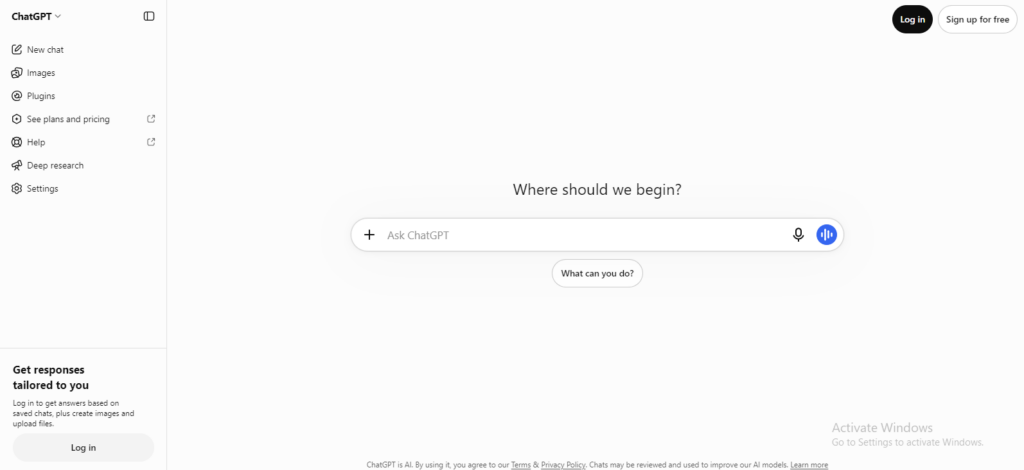
ChatGPT can help students understand difficult concepts, explore unfamiliar topics, generate practice questions, and work through problems step by step.
Student use cases:
- Ask for a simpler explanation of a difficult subject.
- Generate quizzes and revision questions before an exam.
- Practise problem-solving with hints and explanations.
- Brainstorm ideas for projects and organise research outlines.
Students should use ChatGPT to strengthen their understanding rather than simply copy its answers. They should also verify important facts against reliable sources.
Google Gemini: For Guided Learning and Research
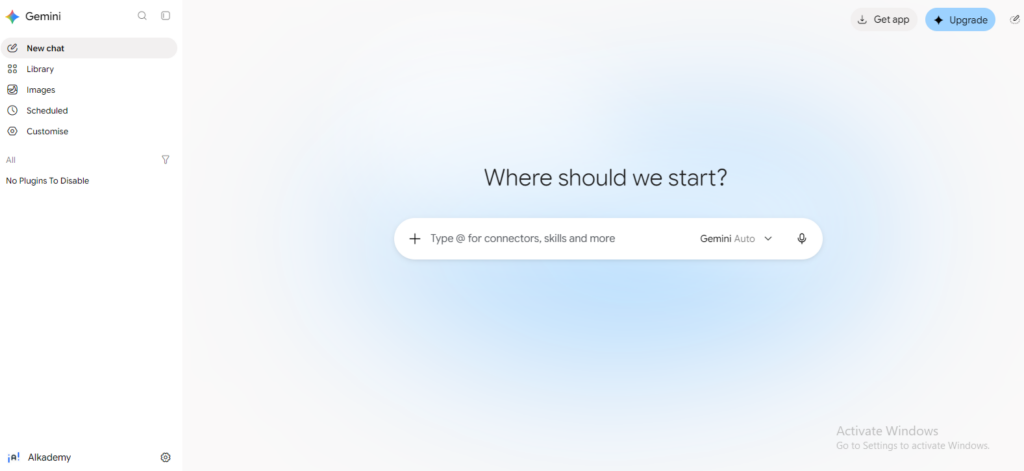
Google Gemini can help students explore topics, understand complex ideas, and work through questions. Its learning-focused features can support guided explanations and step-by-step exploration.
Student use cases:
- Explore a topic through follow-up questions.
- Compare explanations of a concept from different perspectives.
- Break a complex subject into smaller learning steps.
- Brainstorm project ideas and organise study plans.
Students should check the accuracy of generated information and confirm whether the features they need are available on their account.
NotebookLM: For Studying Notes and Learning Materials
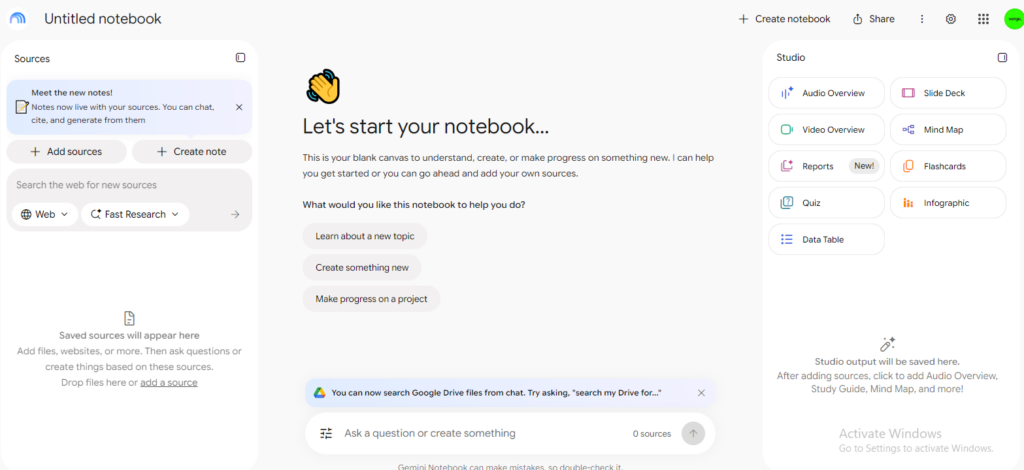
NotebookLM helps students work with supplied sources, such as uploaded documents, notes, and supported reference materials. It can generate summaries and answer questions based on those sources.
Student use cases:
- Summarise lecture notes and lengthy reading materials.
- Identify key concepts in study documents.
- Generate questions to test understanding of assigned readings.
- Compare ideas across multiple supplied sources.
Students should review the original materials to confirm important details and avoid relying on summaries alone.
Perplexity: For Research and Source Discovery
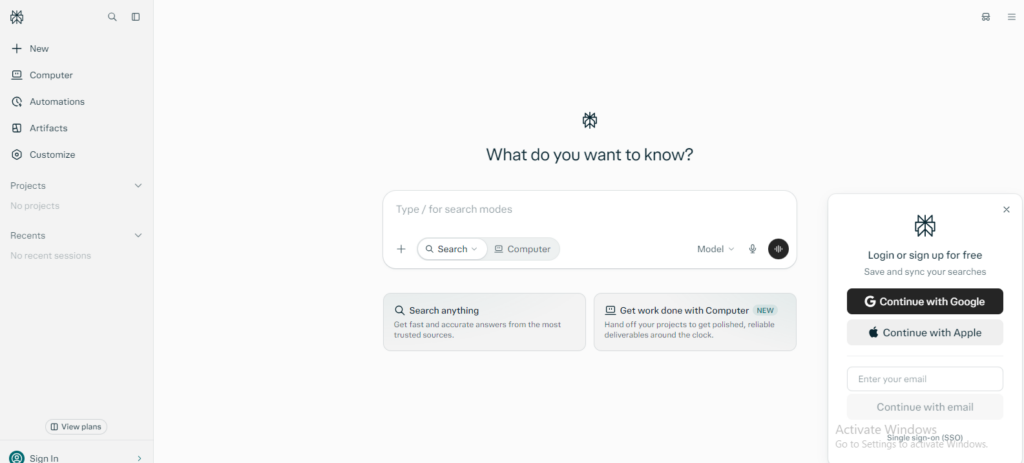
Perplexity is an AI-powered search and research platform that provides responses with links to sources. It can help students explore a subject and find material for further investigation.
Student use cases:
- Explore a research topic and identify potentially relevant sources.
- Find background information on unfamiliar subjects.
- Compare explanations and perspectives from different sources.
- Follow citations to locate material for further reading.
Citations make it easier to investigate an answer, but they do not guarantee that every claim is accurate or that every source is authoritative. Students should open and evaluate the original sources.
Grammarly: For Writing and Editing
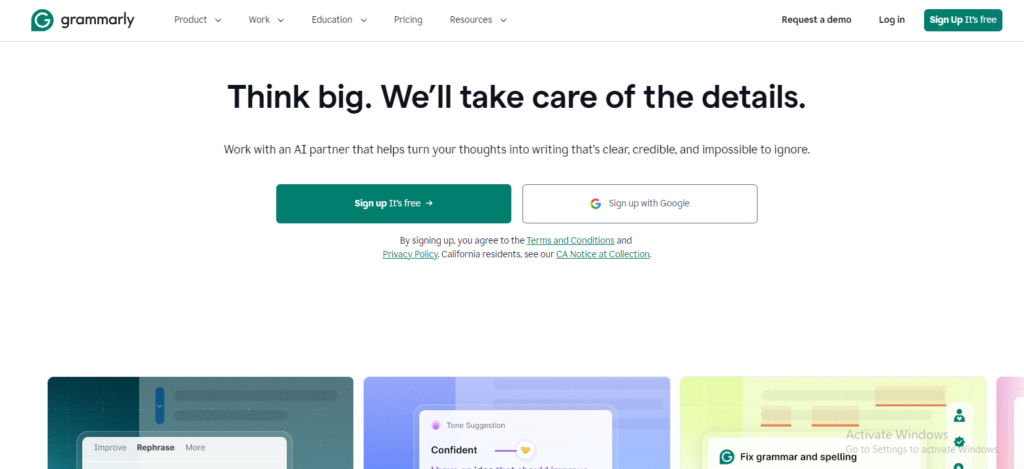
Grammarly offers AI-assisted writing support that can help students improve grammar, clarity, tone, and readability.
Student use cases:
- Identify grammar, spelling, and punctuation errors.
- Improve the clarity of sentences and paragraphs.
- Review the organisation and readability of written work.
- Identify areas where an explanation could be clearer.
Students should preserve their own ideas and writing voice, follow academic rules on AI assistance, and avoid using rewriting tools to disguise unauthorised AI-generated work.
Khanmigo: For Guided Tutoring and Practice
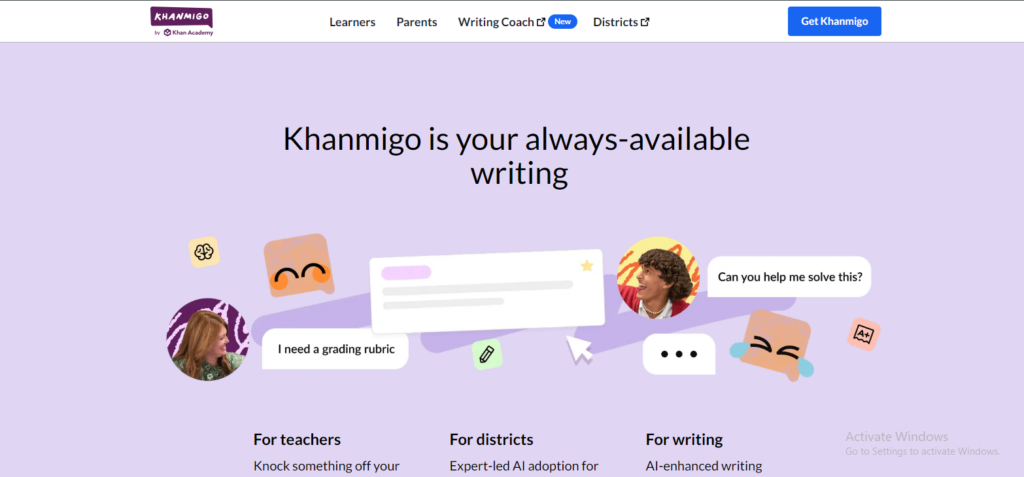
Khanmigo is an AI-powered learning assistant from Khan Academy designed to support guided learning. Its tutoring approach can help learners work through problems instead of immediately receiving a final answer.
Student use cases:
- Work through mathematics problems with guidance.
- Explore science concepts through questions and explanations.
- Practise reasoning and problem-solving.
- Identify gaps in understanding and revisit difficult concepts.
Availability and features may depend on the learner’s location, age, account, and the access arrangements offered by their school or family.
Canva: For Presentations and Visual Learning Materials

Canva provides design tools, including AI-powered features, that students can use to create visual learning materials and communicate ideas.
Student use cases:
- Design presentations for class projects.
- Create posters and infographics to explain complex topics.
- Organise information into visual summaries.
- Develop diagrams and other materials to support presentations.
Students should check generated content for accuracy and follow any requirements for image attribution, originality, and AI disclosure.
Choosing the Right AI Platform for Your Learning Needs
No single AI platform is the best choice for every task. Students should select tools according to what they need to accomplish, the reliability of the available information, and the rules governing their coursework.
Before using an AI platform, consider these questions:
- Does it support my learning goal? Choose a tool that helps with the specific task, whether that is research, revision, writing, or visual communication.
- Can I verify its output? Prefer workflows that allow you to check claims against original sources or course materials.
- Does it protect my information? Review the platform’s privacy policies and account settings before sharing personal or academic information.
- Am I using it responsibly? Follow your institution’s rules and ensure your submitted work reflects your own understanding.
The aim is not to use as many AI tools as possible. It is to understand what each tool can do, recognise its limitations, and use it in ways that strengthen independent learning and critical thinking.
How Alkademy Supports AI Literacy for Students
Developing AI literacy for students requires more than learning how to use AI tools.
Students also need opportunities to build their knowledge, practise new skills, and understand how technology can support their learning.
As an AI Powered Online Learning Ecosystem, Alkademy provides different learning formats to help students expand their knowledge and develop practical digital skills.
Alkademy helps students:
Build AI Knowledge Through Online Courses
Online courses give students a structured way to explore new subjects and develop their skills at their own pace. By exploring relevant courses, learners can strengthen their digital knowledge and build a foundation for understanding artificial intelligence and its applications.
Develop Understanding Through Live Classes
Live classes allow students to learn with instructors, ask questions, and clarify difficult concepts. This guided learning experience can help students deepen their understanding, engage with new ideas, and gain feedback as they progress.
Apply New Skills Through Workshops
Workshops provide opportunities for practical learning and exploration. Students can use these experiences to practise what they learn, work through challenges, and build confidence in applying new knowledge.
Through online courses, live classes, and workshops, Alkademy supports students as they continue learning and developing skills for an increasingly AI-driven world. Students can combine these learning opportunities with independent practice to strengthen their understanding of AI and become more confident, responsible technology users.
Ready to strengthen your digital skills and expand your knowledge? Explore Alkademy’s online courses, live classes, and workshops to find learning opportunities that align with your interests and goals.
FAQs
What Is AI Literacy for Students?
AI literacy is the ability to understand artificial intelligence, use AI tools effectively, evaluate their outputs, and make responsible decisions about their use. For students, it means knowing how to use AI to support learning while recognising its limitations.
Why Is AI Literacy Important for Students?
AI literacy helps students think critically, evaluate information, protect their privacy, and use technology responsibly. It also supports independent learning and helps students develop practical digital skills for education and future opportunities.
What Are Examples of AI Literacy for Students?
Examples include checking an AI-generated explanation against a textbook, improving a prompt to obtain a more useful response, identifying possible bias in generated content, and using AI-generated practice questions to prepare for exams.
How Can Students Improve Their AI Literacy?
Students can improve their AI literacy by learning AI fundamentals, practising with relevant tools, verifying information, strengthening critical thinking, and understanding responsible AI use. Practical exercises, online courses, live classes, and workshops can support their progress.
Can Students Learn AI Skills Through Alkademy?
Yes. Alkademy is an AI Powered Online Learning Ecosystem offering online courses, live classes, and workshops. Students can explore relevant learning opportunities to expand their knowledge, strengthen their digital skills, and build a foundation for learning about AI and its applications.
Final Thoughts on AI Literacy for Students
AI literacy is about more than knowing how to use the latest tools. It means understanding what AI can do, recognising where it falls short, and using it in ways that support genuine learning.
Students can develop these skills by asking better questions, checking information, practising independently, and making responsible decisions about AI use. As artificial intelligence continues to evolve, the ability to evaluate its outputs and think critically will remain important.
Building AI literacy takes time, practice, and a willingness to keep learning. With the right habits and learning opportunities, students can become more confident in using AI while maintaining their independence and curiosity.
Ready to build your digital skills and expand your knowledge?
Explore Alkademy‘s online courses, live classes, and workshops to discover learning opportunities that match your interests and support your learning journey.