Discover the best free online courses for university students. Explore AI, programming, data analysis, and other valuable skills with Alkademy.
TL;DR
- Free online courses help university students develop practical skills that complement their academic qualifications.
- Learn valuable skills such as artificial intelligence, prompt engineering, programming, data analysis, and digital marketing.
- Alkademy offers selected free AI courses, technical learning resources, educational ebooks, and other learning opportunities.
- Choose courses that align with your academic background, career interests, and future goals.
- Apply what you learn through practical projects, build a portfolio, and gain experience that demonstrates your abilities.
University is a good time to build skills that complement your degree and prepare you for work after graduation.
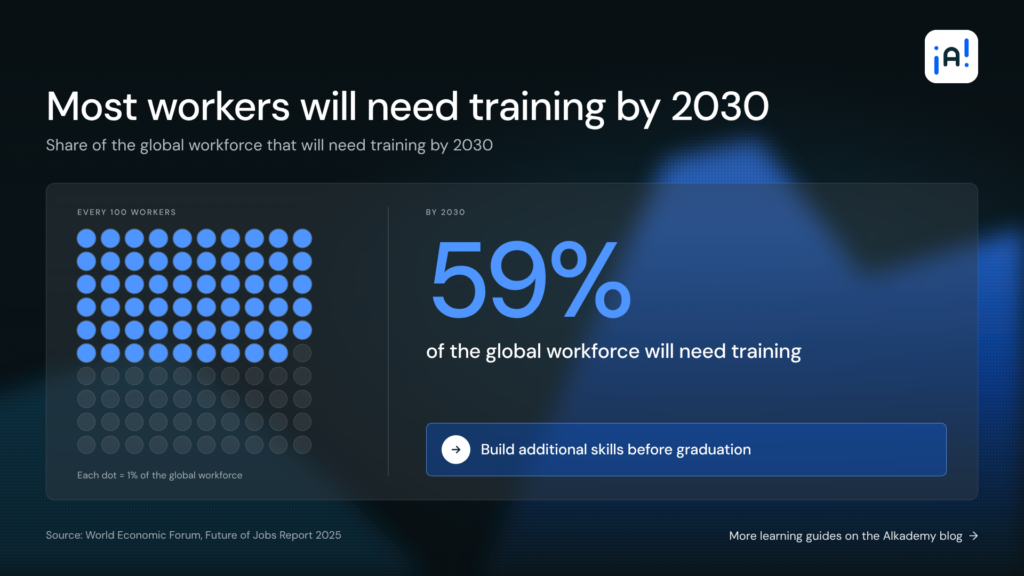
As workplace demands continue to evolve, continuous learning is becoming increasingly important. According to the World Economic Forum’s Future of Jobs Report 2025, 59% of the global workforce will need training by 2030. This highlights the importance of developing additional skills before graduation.
Free online courses offer an accessible way to explore AI, programming, data analysis, and digital marketing. In this guide, you’ll learn where to find valuable free courses and how to build practical skills.
Table of Contents
Why Should University Students Take Free Online Courses?
Free online courses give university students more opportunities to learn, develop useful skills, and prepare for life after graduation without worrying about additional tuition costs.
Here are some important ways they can help:
- Develop practical skills: Learn how to apply classroom knowledge to real-world tasks through courses in programming, data analysis, digital marketing, and other fields.
- Improve employability: Develop technical and professional skills that complement your degree and help you prepare for internships, job applications, and graduate opportunities.
- Explore different career paths: Try subjects outside your degree, discover new interests, and identify career opportunities you may not have previously considered.
- Stay updated with industry trends: Learn about emerging technologies, tools, and practices, including artificial intelligence and automation, that are changing different industries.
- Build confidence and independence: Take responsibility for your learning, solve practical problems, and become more confident in developing new abilities.
- Learn without financial pressure: Access educational resources without paying additional course fees, making it easier to develop skills while managing your student budget.
- Study at your own pace: Fit learning around lectures, assignments, examinations, and other commitments without following another fixed classroom schedule.
Where Can University Students Learn Valuable Skills for Free?
Finding a suitable learning platform is just as important as choosing what to study.
Alkademy is an AI-Powered Online Learning Ecosystem that provides courses, educational resources, and opportunities for students to develop technical and professional skills.
Its learning resources include selected free AI courses, a wider course catalogue, free AI ebooks, and learning opportunities such as live classes and workshops.
Here are some ways to use the platform:
Take Free AI Courses on Alkademy
Artificial intelligence is relevant to an increasing range of academic and professional activities. Understanding its fundamentals can help you explore how AI tools work and where they can be applied.
Alkademy’s free AI learning programme includes three learning tracks:
- AI Fundamentals: Explore artificial intelligence concepts, data literacy, prompt basics, and responsible AI use.
- Machine Learning Essentials: Learn about supervised and unsupervised learning, model training, evaluation, and feature engineering.
- AI for Real-World Applications: Explore automation, workflow design, and AI-assisted product development.
The programme also includes practical learning activities and certificates for eligible course completions.
To get started:
- Create a free Alkademy scholar account.
- Browse the available AI learning tracks.
- Select a course that matches your interests and experience.
- Complete the lessons and required assessments.
- Check your course requirements for certificate eligibility.
You can explore Alkademy’s free AI courses and choose a suitable starting point.
Explore Technical and Professional Courses
You may want to develop skills beyond artificial intelligence. Alkademy’s wider course catalogue covers several technical, business, and professional subjects.
Some areas worth exploring include:
- Programming and web development.
- Data science and databases.
- Artificial intelligence and machine learning.
- Cloud computing and DevOps.
- Cybersecurity.
- Project management and business skills.
- Career development and communication.
Courses are available at different skill levels, although availability and pricing vary.
Before enrolling, use the catalogue filters to check the subject, difficulty level, and whether a course is free or paid.
Visit Alkademy’s online course catalogue to explore the available options.
Use Educational Ebooks to Support Your Learning
Courses are not the only way to develop new knowledge. Reading can help you explore unfamiliar concepts, understand technical subjects, and revisit important ideas at your own pace.
Alkademy provides an ebook library with resources covering artificial intelligence and other learning subjects. Its free AI book collection includes topics such as:
- Machine learning.
- Generative AI.
- Deep learning.
- Natural language processing.
- AI ethics and responsible use.
- Data science and AI applications.
You can use these resources alongside your courses to reinforce what you learn.
Access conditions may vary by title, so check whether an ebook is free and what is required to access it.
Browse Alkademy’s ebook library or explore its free AI books.
Complement Self-Paced Learning with Other Opportunities
Sometimes, reading lessons and watching recorded materials are not enough. You may need additional guidance, feedback, or opportunities to interact with other learners.
Alkademy also provides learning opportunities such as:
- Live Classes: Learn through scheduled instructor-led sessions.
- Workshops: Explore specific topics through focused learning activities.
- Quizzes: Test your understanding and identify areas that need improvement.
- Find Tutors: Explore opportunities to get additional academic or learning support.
Check the current availability and access requirements for each activity before making plans.
Valuable Skills University Students Should Learn
With so many courses available, deciding what to learn can be challenging.
Rather than following every popular trend, focus on skills that complement your degree, match your interests, and have practical applications.
Here are five areas worth considering:
Artificial Intelligence and Prompt Engineering
AI tools are being used in research, education, business, and everyday productivity. Understanding how to use them responsibly can help you work more effectively.
Start with:
- AI fundamentals and common applications.
- Prompt writing and evaluation.
- Generative AI tools.
- Responsible AI use and information verification.
Remember that AI-generated information can contain errors. Learn to evaluate its outputs rather than accepting every response as accurate.
Programming and Software Development
Programming helps you understand how digital products and applications are built. It is particularly useful for students interested in technology, engineering, automation, and data-related careers.
Useful starting points include:
- Python for general programming and automation.
- JavaScript for interactive websites.
- HTML and CSS for web development.
- Basic debugging and software development principles.
Choose one language based on your goals instead of trying to learn several simultaneously.
Data Analysis and Interpretation
Data analysis involves collecting, organizing, examining, and interpreting information to support decisions.
These skills are useful in business, economics, science, healthcare, and social research.
Consider learning:
- Excel or Google Sheets for organizing data.
- SQL for working with databases.
- Data visualization for presenting findings.
- Basic statistics for interpreting results.
A good practical exercise is to analyse a small dataset and explain the patterns you discover.
Digital Marketing and Online Business
Digital marketing helps businesses reach audiences, communicate their value, and promote products or services online.
Students interested in entrepreneurship, communication, business, or freelance work can explore:
- Search engine optimization (SEO).
- Social media marketing.
- Content creation.
- Email marketing.
- Digital advertising.
- E-commerce fundamentals.
You can practise by developing a simple marketing strategy for a student organization or personal project.
Communication, Leadership, and Project Management
Technical knowledge is important, but professional success also involves communicating ideas, working with others, and managing responsibilities.
Focus on developing:
- Communication: Write clearly, present ideas, and listen effectively.
- Leadership: Take responsibility and help coordinate team activities.
- Project management: Organize tasks, manage deadlines, and monitor progress.
- Teamwork: Collaborate with people who have different skills and perspectives.
These abilities complement technical knowledge and are useful across different industries.
How to Choose the Right Free Online Course
Not every free course will help you achieve your goals.
Before enrolling, evaluate the content and consider whether the learning outcomes justify your time.
Use these five criteria:
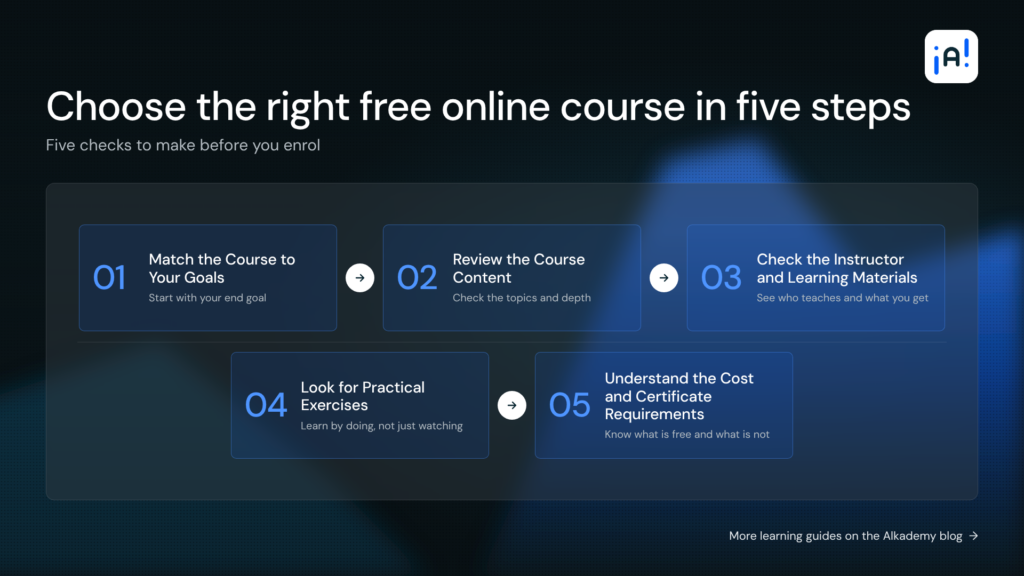
Match the Course to Your Goals
Start by identifying what you want to achieve.
A marketing student interested in digital business might prioritize SEO and content marketing. An engineering student could explore programming, data analysis, or cloud computing.
Choose courses that address a specific learning need instead of enrolling simply because a subject is trending.
Review the Course Content
Read the course description and syllabus before enrolling.
Look for clearly defined learning objectives, relevant topics, and lessons arranged in a logical sequence.
You should have a reasonable understanding of what you will be able to do after completing the course.
Check the Instructor and Learning Materials
Where instructor information is available, review their relevant experience and subject knowledge.
Also consider whether the course provides clear explanations, useful examples, and learning materials appropriate for your current skill level.
Look for Practical Exercises
A course becomes more useful when you have opportunities to apply what you learn.
Look for:
- Quizzes and assessments.
- Practical exercises.
- Guided projects.
- Assignments that reflect real-world tasks.
For example, a beginner programming course should give you opportunities to write and test code, not just explain programming terminology.
Understand the Cost and Certificate Requirements
The word free does not always mean every course feature is available without payment.
Before enrolling, confirm:
- If all lessons are free.
- If you need to pay for additional materials.
- If a certificate is included.
- What you must complete to earn it.
- How long you can access the course.
Also, remember that a course completion certificate is not automatically equivalent to an accredited academic qualification or professional licence.
How to Get the Most Out of Free Online Courses
Enrolling in a course is only the first step.
Your progress depends on how consistently you study and whether you can apply the knowledge.
These practical habits can make a difference:
Set a Clear Learning Goal
Avoid vague goals such as learning technology or becoming good at programming.
Instead, choose a specific outcome. For example, aim to build a basic website, analyse a dataset, or create a simple automated workflow.
A clear target makes it easier to measure your progress.
Create a Realistic Study Schedule
You do not need to spend several hours every day learning an additional skill.
Set aside manageable periods that fit around your university timetable. You might study for 30 minutes on selected weekdays or dedicate a few hours to learning over the weekend.
Consistency is more useful than creating a demanding schedule you cannot maintain.
Practise Through Personal Projects
One of the best ways to test your understanding is to build something with your new knowledge.
For example:
- Use Python to automate a simple repetitive task.
- Build a website using HTML, CSS, and JavaScript.
- Analyse a public dataset and present your findings.
- Develop an SEO plan for a small business.
- Create a simple AI-assisted workflow and evaluate its results.
Start small, document your process, and improve your work as your skills develop.
Build a Portfolio
A certificate shows that you completed a learning programme. A portfolio provides examples of what you can actually do.
Depending on your field, include:
- Programming projects and code repositories.
- Data analysis reports.
- Website designs.
- Marketing campaigns.
- Research projects and presentations.
Explain the problem you were trying to solve, the tools you used, and what you learned.
Look for Opportunities to Apply Your Skills
Do not limit your learning to online lessons.
Participate in student projects, join relevant communities, volunteer your skills, or apply for internships.Working with others exposes you to practical challenges and gives you opportunities to receive feedback.
FAQs
What are the best free online courses for university students?
Some useful options include courses in artificial intelligence, programming, data analysis, digital marketing, communication, and project management. Your best choice depends on your academic background and career goals.
Where can university students learn new skills for free?
Students can explore free learning resources through platforms such as Alkademy. Its selected free AI courses cover AI fundamentals, machine learning, and practical AI applications. Students can also explore its wider course catalogue and free AI ebooks.
Which skills are most valuable for university students?
AI literacy, programming, data analysis, digital marketing, communication, and project management are useful areas to consider. Prioritize skills that complement your degree and have practical applications in your intended career.
Can I get a certificate from a free online course?
Yes. Some platforms provide certificates when learners complete the required lessons, assessments, or projects. Alkademy offers certificates for eligible free AI course completions. Always check the individual course requirements and remember that completion certificates do not automatically represent formal academic credit or professional accreditation.
How do free online courses help students prepare for employment?
They allow students to develop skills beyond their academic qualifications. When combined with practical projects, internships, and a portfolio, these learning experiences can provide useful evidence of a student’s abilities when applying for opportunities.
Final Thoughts on Free Online Courses for University Students
Free online courses give university students an affordable way to develop practical skills, explore career opportunities, and prepare for life after graduation.
Start with a course that matches your interests, apply what you learn, and build projects that demonstrate your abilities.
Alkademy’s selected free AI courses and learning resources can help you take that first step.
Start building skills for your future today. Explore Alkademy’s free AI courses.