
Learn how to measure employee training effectiveness using practical evaluation methods, KPIs, training ROI and the Kirkpatrick Model.
TL;DR
- Employee training effectiveness measures how well training improves employees’ knowledge, skills and workplace performance.
- Organisations should evaluate learning outcomes, knowledge retention and practical skill application, not just course completion.
- Important KPIs include assessment scores, productivity, error reduction and training ROI.
- The Kirkpatrick Model provides four levels for evaluating training outcomes.
- Regular evaluation helps businesses improve training quality and workforce capabilities.
Employee training helps businesses build skilled, productive teams and prepare their workforce for changing demands.
However, organisations need to measure whether these programmes deliver meaningful results. The World Economic Forum’s Future of Jobs Report 2025 found that 63% of employers identify skills gaps as a major barrier to business transformation, while 85% plan to prioritise workforce upskilling.
Similarly, LinkedIn’s 2025 Workplace Learning Report found that 49% of L&D professionals say executives are concerned about skills gaps. Measuring training effectiveness helps organisations track learning outcomes and workplace improvements.
Recommended for You: Corporate Training Strategies: How to Improve Employee Skills and Workplace Performance
Table of Contents
What Is Employee Training Effectiveness?
Employee training effectiveness refers to how successfully a training programme helps employees develop relevant knowledge and skills and apply them to their responsibilities.
It goes beyond attendance and course completion. It examines whether employees have learned what they were taught and whether that learning improves their work.
For example, after customer service training, an organisation should assess whether employees communicate more effectively, resolve complaints appropriately and provide better customer experiences.
Training effectiveness can be examined through three key areas:
- Participation: Did employees attend and complete the training?
- Learning: Did they acquire the intended knowledge and skills?
- Application: Can they use those skills in their daily work?
Organisations can also examine wider business results, such as improved productivity, service quality and operational efficiency.
Why Should Organisations Measure Employee Training Effectiveness?
Evaluating training helps businesses understand whether their learning investments are delivering meaningful results.
Here are five important reasons:
- Evaluate training objectives: Determine whether employees have acquired the knowledge and skills outlined in the programme’s objectives.
- Identify skill gaps: Use assessment results and performance reviews to identify areas where employees need additional coaching, refresher courses or specialised training.
- Improve training quality: Gather employee feedback to identify weaknesses in training materials, delivery methods and course relevance, then use these insights to improve future programmes.
- Demonstrate business value: Measure improvements in productivity, work quality and customer service to understand how training contributes to organisational performance.
- Make better training decisions: Use evaluation data to identify effective programmes, determine which need improvement and allocate training resources more strategically.
Methods for Measuring Employee Training Effectiveness
Different training programmes require different evaluation methods.
The following approaches help organisations assess learning, workplace application and business outcomes:
Conduct Pre-Training and Post-Training Assessments
Assess employees before and after training to determine whether their knowledge and skills have improved.
Useful assessment methods include:
- Online quizzes and knowledge tests.
- Practical exercises.
- Technical skills assessments.
- Scenario-based questions.
For example, employees attending cybersecurity training can complete assessments before and after the programme to measure improvements in their understanding of common security threats.
Collect Employee Feedback
Ask employees whether the training was relevant, useful and easy to understand.
Useful questions include:
- Was the training relevant to your role?
- Were the learning materials clear?
- Did the practical exercises help you understand the subject?
- Do you feel confident applying what you learned?
Feedback helps identify areas for improvement, although positive responses alone do not prove that training improved performance.
Evaluate Knowledge Retention
Employees may perform well immediately after training but forget important information over time.
Conduct follow-up assessments several weeks or months later to determine whether they still remember and understand what they learned.
You can also ask employees to demonstrate previously learned skills or complete refresher exercises.
Observe Workplace Behaviour
Evaluate whether employees are applying their new skills in their daily responsibilities.
Managers can use workplace observations, performance reviews and practical demonstrations.
For example, after leadership training, supervisors can assess whether managers communicate more effectively, delegate tasks appropriately and handle team conflicts.
Monitor Employee Performance
Compare performance before and after training using relevant indicators such as:
- Productivity and task completion.
- Quality of work.
- Customer satisfaction.
- Sales performance.
- Workplace errors.
For example, after training employees on a new project management tool, managers can monitor project completion times and missed deadlines.
Remember that other factors, such as new technology or changes in workload, may also influence performance.
Track Training Participation and Completion
Monitor enrolment, attendance, course completion and participation in learning activities.
Low participation or completion rates may indicate scheduling problems, unsuitable learning formats or limited management support.
However, completing a course does not necessarily mean employees have acquired the intended skills.
Calculate Training Return on Investment (ROI)
Training ROI helps organisations assess whether the financial benefits of a programme justify its costs.
The formula is:
Training ROI (%) = [(Financial Benefits − Training Costs) ÷ Training Costs] × 100
For example, if a programme costs $5,000 and generates $8,000 in measurable financial benefits:
ROI = [(8,000 − 5,000) ÷ 5,000] × 100
ROI = 60%
This represents a 60% return on the investment, based on the estimated costs and benefits.
Training costs should include course delivery, learning materials, employee time and other relevant expenses. Organisations should also consider whether improvements resulted from training or other business changes.
Not every benefit can be measured financially. Better leadership, collaboration and employee confidence can also be valuable outcomes.
Compare Training Outcomes With Business Objectives
Training should support specific business goals.
For example:
- Sales training can be measured against conversion rates and sales performance.
- Customer service training can be evaluated through complaint resolution and customer satisfaction.
- Technical training can be assessed through task accuracy and error reduction.
- Leadership training can be evaluated through team performance and management practices.
This helps organisations determine whether employee development is contributing to their wider objectives.
Key KPIs for Measuring Employee Training Effectiveness
Key Performance Indicators (KPIs) help organisations track training outcomes and identify areas that need improvement.
| KPI | What It Measures |
| Training completion rate | Percentage of employees who finish training. |
| Assessment improvement | Change in pre-training and post-training scores. |
| Knowledge retention | Knowledge or skills retained during follow-up assessments. |
| Employee satisfaction | How participants rate the training. |
| Skill application | Whether employees use new skills at work. |
| Productivity improvement | Changes in employee output or efficiency. |
| Error reduction | Changes in workplace mistakes. |
| Training ROI | Financial return compared with training costs. |
Choose KPIs based on the purpose of each programme. For example, technical training may prioritise assessment scores and error reduction, while leadership development may focus on management practices and team performance.
How the Kirkpatrick Model Helps Evaluate Training Effectiveness
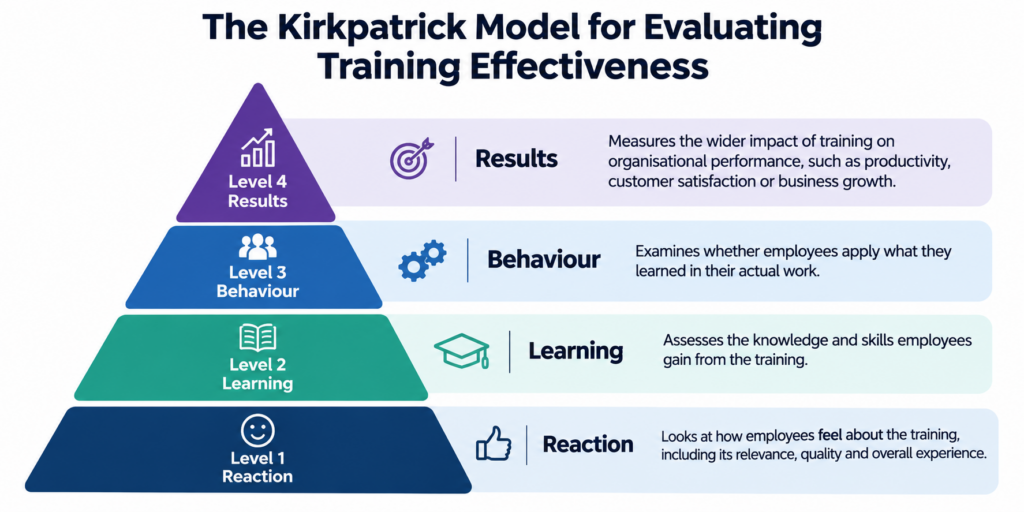
The Kirkpatrick Model is a recognised framework for evaluating training through four levels: Reaction, Learning, Behaviour and Results.
Level 1: Reaction
Measures how employees feel about the training. Feedback forms and surveys can help determine whether the programme was relevant and engaging.
Level 2: Learning
Evaluates whether employees acquired the intended knowledge and skills through assessments, practical exercises and demonstrations.
Level 3: Behaviour
Examines whether employees apply what they learned in their actual work. Managers can use observations and performance reviews to assess changes.
Level 4: Results
Measures the wider impact of training on business outcomes, such as productivity, customer satisfaction and operational efficiency.
The model helps organisations look beyond course completion and evaluate whether training contributes to meaningful workplace improvements.
Practical Steps for Measuring Training Effectiveness
A consistent evaluation process makes it easier to understand training outcomes.
- Identify skill gaps: Determine what employees need to improve through assessments, performance reviews and business objectives.
- Set clear objectives: Define what employees should know or be able to do after training.
- Establish a baseline: Record existing performance or skill levels before training begins.
- Choose evaluation methods: Select appropriate assessments, feedback methods and KPIs.
- Measure learning: Compare pre-training and post-training assessment results.
- Monitor application: Observe whether employees use their new skills at work.
- Review results: Compare outcomes with the original objectives and improve future programmes.
This process helps organisations turn evaluation findings into practical workforce development decisions.
Common Challenges in Measuring Training Effectiveness
Measuring employee training effectiveness is not always straightforward. Organisations may face several challenges, including:
- Unclear training objectives: Without clear goals, it becomes difficult to determine whether a training programme has achieved its purpose.
- Limited follow-up: Assessing employees immediately after training may not reveal whether they retain and apply what they have learned.
- Difficulty measuring ROI: Some training benefits, such as improved communication and leadership, are difficult to measure financially.
- Low employee feedback: Employees may be reluctant to complete surveys, making it harder to understand their training experience.
- Poor data collection: Inconsistent or incomplete training records can make it difficult to track progress and evaluate results.
- Limited management support: Without managers’ involvement, employees may struggle to apply their new skills in the workplace.
Best Practices for Building Effective Employee Training Programmes
To get better results from employee development:
- Identify actual workforce skill gaps before selecting training.
- Set clear and measurable learning objectives.
- Choose learning formats that suit the subject and employees.
- Combine assessments, feedback and workplace observations.
- Involve managers in supporting employee development.
- Schedule follow-up assessments.
- Use evaluation findings to improve future programmes.
- Encourage continuous learning and professional development.
These practices help businesses build training programmes that respond to employee needs and organisational priorities.
How Alkademy Supports Employee Training and Workforce Development

Measuring training effectiveness is important, but organisations also need relevant learning programmes to help employees develop the right skills.
Alkademy supports workforce development through its Corporate Training Solutions and AI Workforce Readiness programme.
Corporate Training Solutions
Alkademy’s Corporate Training Solutions help organisations develop employee capabilities through structured corporate learning and upskilling opportunities.
Businesses can focus on the technical, professional and leadership skills their teams need to meet changing workplace demands.
By identifying priority skills and setting clear training objectives, organisations can make employee development more relevant to their business goals.
AI Workforce Readiness
As AI becomes increasingly important across industries, employees need practical skills to use AI tools effectively and responsibly.
Alkademy’s AI Workforce Readiness programme offers three learning tracks:
- Foundation Track: Introduces employees to AI concepts, literacy and workplace applications.
- Applied Track: Develops practical skills for using AI tools to improve tasks and workflows.
- Leadership Track: Helps business leaders understand AI adoption, organisational change and AI strategy.
These learning tracks address different levels of workforce readiness, from basic AI understanding to practical application and leadership.
Organisations can evaluate the outcomes by assessing employees’ AI knowledge, reviewing their ability to complete relevant tasks and monitoring improvements in workplace processes.
By connecting training with practical skill development, businesses can build teams that are better prepared for evolving workplace demands.
Explore Alkademy’s Corporate Training Solutions and discover to how structured learning can support your organisation’s workforce development goals.
FAQs
How do you measure employee training effectiveness?
Organisations can use pre-training and post-training assessments, employee feedback, knowledge retention tests, workplace observations and performance data to determine whether training has improved employees’ skills and performance.
What are the most important training KPIs?
Key training KPIs include course completion rates, assessment improvements, knowledge retention, skill application, employee productivity, error reduction and training ROI. The right metrics depend on the programme’s objectives.
What are the four levels of the Kirkpatrick Model?
The four levels are Reaction, Learning, Behaviour and Results. They evaluate employees’ training experience, knowledge gained, workplace application and the overall impact on business performance.
How do you calculate training ROI?
Training ROI measures the financial return generated by a programme compared with its total cost.
Formula: ROI (%) = [(Financial Benefits − Training Costs) ÷ Training Costs] × 100.
For example, a programme costing $5,000 and generating $8,000 in measurable benefits delivers a 60% ROI.
How long does it take to measure training effectiveness?
The timeline depends on the training objectives. Knowledge can be assessed immediately after training, while retention, behavioural changes and business results may take several weeks or months to evaluate.
Final Thoughts on How to Measure Employee Training Effectiveness
Measuring employee training effectiveness helps organisations determine whether their learning programmes are delivering meaningful results.
Businesses should look beyond attendance and course completion to evaluate what employees have learned, whether they retain new skills and how they apply them at work.
Using relevant KPIs, assessments and the Kirkpatrick Model makes it easier to identify improvements and connect employee development with business objectives.
For organisations looking to strengthen their workforce, structured and relevant training is an important starting point.