Learn what a Press Archive Package (PAP) is, what it contains, and how Alkademy Press helps journals preserve, export, verify, and manage their complete publishing records.
TL;DR
- A Press Archive Package (PAP) is a portable .zip archive containing a journal’s data and files.
- It preserves more than published articles, including submissions, reviews, revisions, users, and metadata.
- PAP supports journal data portability, preservation, and migration.
- SHA-256 checksums help verify archive file integrity.
- Alkademy Press uses PAP to give journals a structured way to export their publishing records.
Academic journals create and accumulate a large amount of information over time.
Published articles are only one part of that record. Submissions, manuscript revisions, peer reviews, editorial activity, authors, journal metadata, and associated files can all form part of a journal’s publishing history. Keeping these records organized and accessible becomes increasingly important as a journal grows or changes how it manages its publishing operations.
Alkademy Press is an academic journal publishing platform designed to help publishers manage these activities in one place. As part of that approach, Alkademy Press provides the Press Archive Package (PAP), a structured .zip export containing the information and files associated with a single journal.
PAP gives publishers a portable representation of their journal’s publishing record. It brings together journal information, published content, editorial and peer-review history, users, manuscripts, and associated files, while also providing archive metadata and file integrity information.
This makes the archive useful for preservation, review, data portability, and potential journal migration.
What Is a Press Archive Package (PAP)?
A Press Archive Package (PAP) is a .zip archive containing the data and files associated with a single journal on Alkademy Press. Rather than exporting isolated pieces of information, PAP organizes the journal’s publishing records into a structured archive.
The package can contain:
- Journal identity and settings
- Volumes, issues, and publications
- Manuscript submissions and versions
- Authors and co-authors
- Peer-review rounds and reviews
- Editorial and review comments
- Journal members and users
- Manuscript and branding files
- Archive metadata and record counts
- File integrity checksums
This structure provides a more complete picture of a journal’s publishing activity than an archive containing only published article files.
What Is the Purpose of PAP?
PAP is designed to give journal publishers a practical way to retain and access a structured copy of their journal data. Its uses include:
- Preservation: Retain a journal’s publishing history in an organized format.
- Data portability: Maintain a portable copy of journal records and files.
- Migration: Provide structured data that can support a move to another publishing environment.
- Record keeping: Preserve editorial, submission, review, and publication information.
- Verification: Use archive metadata and checksums to help validate the exported files.
The goal is simple: give publishers greater visibility and control over the information that makes up their journal’s publishing record.
What Information Is Included in a Press Archive Package?
A PAP is organized into several areas, each representing a different part of the journal’s publishing record. At the top level, the archive includes the manifest and integrity information, followed by directories for the journal, catalog, editorial records, users, and files.
Journal Identity and Settings
The journal/ section contains information that identifies and describes the journal.
The journal record can include:
- Journal name and description
- ISSN
- Journal ID and website slug
- Journal type
- Journal settings
- Article Processing Charge configuration
- Submission status
- References to journal branding
The package also includes journal member information, such as roles and whether a member should appear on the journal’s public page.
Preserving this information helps ensure that an archive represents the journal itself, rather than simply storing a collection of articles.
Published Volumes, Issues, and Publications
The catalog/ section represents the journal’s published structure.
It includes records for:
- Volumes: Number, year, and title
- Issues: Volume relationship, issue number, title, description, publication date, cover image, and status
- Publications: Article relationships, DOI, pages, publication date, and status
Together, these records provide a structured view of how the journal’s published content is organized.
Editorial and Submission Records
The editorial/ section captures the publishing activity that happens before and around publication.
Submission records can include:
- Manuscript title
- Abstract
- Keywords
- Author reference
- Submission status
- DOI
- Metadata
- Creation and update dates
PAP can also preserve co-author information, manuscript versions, review rounds, reviews, and editorial comments. This means the archive can retain important parts of the editorial history that would otherwise be absent from a collection of published articles alone.
How PAP Preserves the Editorial History of a Journal
The editorial/ directory contains records associated with submissions, contributors, manuscript versions, review rounds, reviews, and comments. Together, these records provide context around the editorial journey of a manuscript.
Manuscript Submission Records
The editorial/submissions.json file contains information about manuscripts submitted to the journal.
Records can include:
- Submission ID and author reference
- Manuscript title and abstract
- Keywords and DOI
- Submission status
- Associated metadata
- Creation and update timestamps
This allows the archive to retain information about manuscripts beyond those that ultimately become published articles.
Co-Authors and Contributor Information
The editorial/co-authors.json file records contributors associated with submissions.
It can include:
- Name and email
- Affiliation
- ORCID
- Author order
- Submission relationship
- Contributor status
- Acceptance date
Preserving this information helps maintain the relationship between manuscripts and their contributors.
Manuscript Versions and Revisions
Academic manuscripts can go through several revisions before a final editorial decision or publication. PAP preserves each recorded version through submission-versions.json.
Each version can include:
- Version number
- Review round
- Filename and file size
- Associated metadata
- Archive path to the manuscript file
This provides a clearer record of how a manuscript changed throughout the editorial process.
How PAP Preserves Peer-Review Records
Peer review is an important part of the scholarly publishing record. PAP preserves information about review rounds, individual reviews, and comments so that the editorial history is not reduced to the final publication outcome.
Review Rounds
The review-rounds.json file records the review stages associated with a submission.
Information can include:
- Review round number
- Status
- Who opened or closed the round
- Opening and closing dates
- Reason for closing
- Associated metadata
This helps distinguish different stages of review when a manuscript goes through multiple rounds.
Individual Reviews
The reviews.json file contains records for individual peer reviews.
Depending on the available record, this can include:
- Reviewer reference
- Rating
- Review status
- Editorial decision
- Feedback
- Due date
- Conflict-of-interest information
- Creation and update dates
Review and Editorial Comments
The review-comments.json file preserves comments made during the editorial and review process.
Comments can be connected to:
- A submission
- A specific manuscript version
- The person who made the comment
- A parent comment where applicable
- Creation and update timestamps
This helps retain the discussion and context surrounding editorial activity.
How PAP Preserves Authors, Editors, Reviewers, and Users
People are central to journal publishing, and their relationships with submissions, reviews, and journal activities form part of the publishing record.
Journal Members
The journal/members.json file identifies people with roles within the journal.
It records information such as:
- Member ID
- User reference
- Journal role
- Whether the member appears on the public journal page
Authors and Co-Authors
Author information can appear across submission and co-author records, allowing the archive to preserve contributor relationships, affiliations, ORCID information, and author order.
User Records
The users/users.json file contains user information referenced throughout the archive.
Records can include:
- User ID
- Name
- Account status
- ORCID
- Avatar reference
- Creation and update dates
These records help connect people to the publishing activities represented elsewhere in the archive.
Security Consideration: Passwords Are Not Included
Passwords are never included in a Press Archive Package. Authentication credentials are excluded from the export, helping prevent sensitive login information from becoming part of a portable journal archive.
How Files Are Stored in a Press Archive Package
PAP contains the actual files associated with journal records, rather than simply storing references to files that exist elsewhere.
Manuscript Files
Each uploaded manuscript PDF is stored using a structure that connects it to its submission and version:
files/{submissionId}/{versionId}/{fileName}
The corresponding archivePath in submission-versions.json identifies where the manuscript is located within the archive.
Journal Branding Files
The journal’s branding assets are also included in the archive:
files/_journal/logo{ext}
files/_journal/banner{ext}
This allows the journal’s logo and banner to remain part of the portable archive rather than depending solely on external file locations.
What Happens When a File Cannot Be Retrieved?
A missing file does not stop the entire export.
When a file cannot be retrieved:
- The unavailable file is skipped.
- The failure is recorded in the warnings section of manifest.json.
- The rest of the archive is generated normally.
This approach allows publishers to receive the available journal records while still having a clear record of files that require attention.
How PAP Documents and Verifies the Archive
A useful journal archive should make it clear what was exported and provide a way to check the integrity of its files. PAP does this through two key files at the root of the archive: manifest.json and checksums.sha256.
manifest.json
The manifest.json file serves as the index and summary of the archive. It provides an overview of what the export contains and identifies the journal covered by the archive.
It can include:
- Archive format and format version
- Export date and time
- Alkademy Press exporter information
- Journal and tenant identifiers
- Export options
- Record counts
- Warnings about files or information that could not be included
This gives publishers a quick way to understand the contents and scope of an archive without opening every individual file.
checksums.sha256
The checksums.sha256 file contains a SHA-256 integrity hash for each file in the archive.
A checksum provides a unique value calculated from a file’s contents. If the file changes, its calculated checksum will normally change as well. Publishers can therefore use these hashes to check whether archived files remain unchanged after being transferred or stored.
Why File Integrity Matters
Journal archives may need to be retained for years or transferred between systems and teams. File integrity checks provide an additional way to confirm that the archived files have not been unintentionally altered or corrupted.
This is particularly useful when:
- Moving an archive between storage locations
- Preparing journal data for migration
- Maintaining long-term copies
- Reviewing an archive after export
- Verifying files received by another team
PAP Archive vs. a Conventional Backup
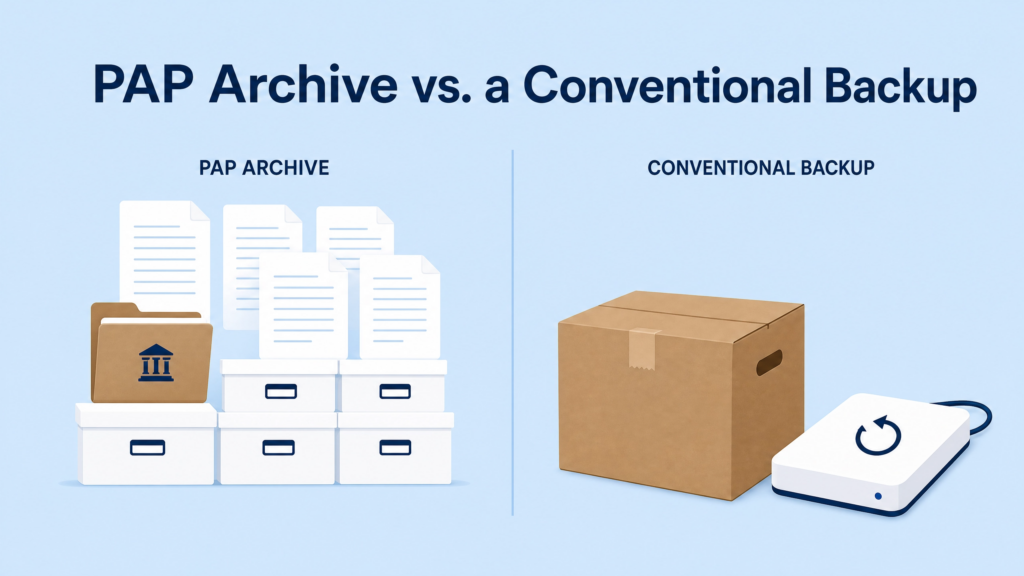
An archive and a backup solve related but different problems.
A backup is primarily intended to support recovery after data loss, system failure, or operational error. A journal archive, by contrast, is generally intended to retain records for future access, reference, transfer, or preservation.
That distinction is important.
A system backup may be optimized for restoring an application’s database and configuration. A journal archive can instead be organized around the information a publisher needs to understand and retain about the journal’s publishing history.
PAP brings together journal information, catalog records, editorial data, users, metadata, and associated files in one package.
However, having an export does not by itself constitute a complete preservation program. Publishers responsible for long-term retention should also consider:
- Storage redundancy
- Access controls
- Retention periods
- Environmental and organizational risks
- Periodic integrity checks
- Documentation
- Format sustainability
- Legal and privacy requirements
PAP can be one component of that broader process.
What Can a Press Archive Package Be Used For?
PAP is designed to provide more than a collection of files. By bringing journal records and associated files together in a structured archive, it can support several practical publishing needs.
Preserving a Journal’s Publishing History
A PAP can provide a consolidated record of a journal’s publishing activity, including its catalog, submissions, manuscript versions, editorial records, people, and files.
This can be valuable when publishers need to retain historical information beyond what is available on the journal’s public website.
Supporting Journal Migration
When a journal moves to a new publishing platform, having its existing records available in a structured archive can make the transition easier to plan and validate.
PAP can provide a reference for the journal’s:
- Publications
- Submissions
- Manuscript versions
- Review records
- Contributors
- Metadata
- Associated files
Maintaining Data Portability
Data portability gives publishers greater flexibility over how their journal information is retained and managed.
A structured archive allows journal data to exist outside the day-to-day publishing environment, making it easier to retain a copy of important records independently of the live platform.
Retaining Editorial and Peer-Review History
Published articles represent the final output of scholarly publishing, but they do not necessarily capture everything that happened before publication.
PAP can preserve records relating to submissions, manuscript revisions, review rounds, reviews, and editorial comments, giving publishers a broader record of the editorial process.
Supporting Institutional Continuity
Academic journals often experience changes in editors, staff, institutions, publishing arrangements, or technology. A structured archive can help preserve important information through these changes.
It gives authorized teams a consolidated record that can support continuity when responsibility for a journal moves from one group or system to another.
Why a Complete Journal Archive Should Contain More Than Published Articles
A collection of published PDFs may preserve the visible output of a journal, but it does not necessarily preserve the publishing process behind those articles.
A more complete journal archive can include:
| Basic Article Archive | Complete Journal Archive |
| Published article files | Published article files |
| Basic issue information | Volumes and issues |
| Limited publication metadata | Publication and journal metadata |
| Final versions | Submission and manuscript versions |
| No editorial history | Editorial and peer-review records |
| Limited contributor information | Authors, co-authors, members, and users |
| Separate file storage | Associated journal and manuscript files |
| Limited verification | Archive manifest and file checksums |
The distinction matters because a journal’s scholarly publishing record is made up of more than its final publications. Preserving the surrounding records provides a fuller representation of how the journal operates and how its content moves through the publishing process.
Press Archive Package and Academic Journal Data Portability
PAP also addresses a broader concern for modern journal publishers: data portability.
What Is Journal Data Portability?
Journal data portability refers to the ability to access, retain, and transfer a journal’s publishing data in a usable format.
For publishers, this can include having access to:
- Journal information
- Publication records
- Submission data
- Manuscript versions
- Peer-review records
- Contributor information
- Metadata
- Associated files
The goal is to ensure that important publishing records are not limited to a single live system.
Why Does Data Portability Matter?
Journal publishing platforms can change over time. A publisher may need to migrate a journal, reorganize its publishing operations, preserve historical records, or simply maintain an independent copy of its data.
Data portability helps publishers prepare for these situations by giving them access to a structured representation of their publishing records.
It can support:
- Platform migration
- Long-term preservation
- Institutional record keeping
- Data management
- Operational continuity
- Greater control over publishing records
What Should Publishers Look for in a Portable Journal Archive?
When evaluating a journal publishing platform, publishers should look beyond whether they can download individual articles. A useful archive should provide a structured representation of the journal and its publishing history.
Key considerations include:
- Complete records: Does the export cover publishing and editorial data, not just published articles?
- Structured data: Can the information be understood and processed independently?
- Associated files: Are manuscript and journal files included?
- Editorial history: Are submissions, revisions, reviews, and comments preserved?
- Metadata: Are important journal, publication, and contributor details retained?
- Integrity checks: Can exported files be verified?
- Export visibility: Can publishers see what was included and whether anything could not be retrieved?
For journal publishers, portability is ultimately about maintaining access to the records that support the journal’s publishing history, regardless of how that publishing environment changes over time.
Using PAP When Moving an Academic Journal to a New Platform
Changing journal publishing platforms involves more than transferring published articles. Publishers also need to account for submissions, manuscript versions, editorial records, users, metadata, and associated files. A structured archive such as PAP can provide a useful reference throughout this process.
Before Migration
Before moving a journal, publishers should identify the records and files that need to be preserved. This includes the published catalog, submissions, manuscript versions, peer-review records, contributor information, and journal assets.
A pre-migration review can help establish what should be present in the archive and make it easier to identify gaps later.
During Export
The export should capture the journal’s publishing records and associated files in a structured format.
PAP organizes these records into dedicated sections and includes a manifest.json file that provides information about:
- What was exported
- The journal covered by the archive
- Record counts
- Export options
- Any warnings generated during the process
After Export
Once the archive has been created, publishers can review its structure and contents before using it as part of a migration.
Useful checks include:
- Reviewing the manifest
- Checking record counts
- Reviewing export warnings
- Confirming important files are present
- Verifying file checksums
During Migration Validation
After data has been transferred to a new environment, the archive can serve as a reference for validating the migrated journal.
Publishers can compare important areas such as:
- Volumes, issues, and publications
- Submission records
- Manuscript versions
- Contributor information
- Editorial and peer-review records
- Associated files
The goal is to ensure that important publishing information has not been overlooked during the transition.
Press Archive Package Structure at a Glance
A PAP is organized into clearly defined sections so publishers can understand where different types of information are stored.
manifest.json
checksums.sha256
journal/
journal.json
members.json
catalog/
volumes.json
issues.json
publications.json
editorial/
submissions.json
co-authors.json
submission-versions.json
review-rounds.json
reviews.json
review-comments.json
users/
users.json
files/
{submissionId}/{versionId}/{fileName}
_journal/logo{ext}
_journal/banner{ext}
Each section has a specific purpose:
- journal/ contains the journal’s identity, settings, and members.
- catalog/ contains volumes, issues, and published articles.
- editorial/ contains submissions, manuscript versions, reviews, and editorial comments.
- users/ contains user information referenced throughout the archive.
- files/ contains manuscript and journal branding files.
- manifest.json summarizes the archive and its contents.
- checksums.sha256 provides file integrity information.
Security and Privacy Considerations for Journal Archives
A journal archive can contain information about authors, reviewers, editors, and other users. Publishers should therefore treat exported archives as important records and manage access appropriately.
Passwords and Authentication Information
Passwords and authentication credentials are not included in PAP. They are excluded from the export rather than being stored alongside journal records.
Reviewer Information
Reviewer records can contain feedback, decisions, due dates, and conflict-of-interest information. Where journals use anonymous peer review, publishers should take appropriate care when accessing, storing, or sharing exported review information.
Author and User Data
PAP can contain names, email addresses, affiliations, ORCID information, and other user-related records. Publishers should ensure that access to these archives is limited to people who are authorized to handle the information.
Archive Access
Exported archives should be stored securely and shared only when necessary. Publishers should also consider how long archives need to be retained and who should have access to them over time.
How Alkademy Press Supports Journal Data Portability With PAP
Alkademy Press provides the Press Archive Package as a structured way for journals to export their publishing records and associated files.
PAP brings together:
- Journal identity and settings
- Volumes, issues, and publications
- Manuscript submissions and versions
- Authors and co-authors
- Peer-review rounds and reviews
- Editorial and review comments
- Journal members and users
- Manuscript and branding files
- Archive metadata and record counts
- Export warnings
- SHA-256 file integrity information
The result is a portable archive that gives publishers a consolidated representation of their journal’s publishing history.
PAP is also designed to handle imperfect exports without abandoning the entire archive. If an individual file cannot be retrieved, it can be skipped while the issue is recorded in the manifest’s warnings. This gives publishers visibility into what requires attention without preventing the rest of the journal data from being exported.
FAQs
A Press Archive Package is a .zip archive containing the data and files associated with a single journal on Alkademy Press. It can include journal information, published content, editorial records, peer-review history, users, and associated files.
PAP can include journal identity and settings, volumes, issues, publications, submissions, co-authors, manuscript versions, review rounds, reviews, comments, users, and associated manuscript and branding files. The archive also includes manifest and file integrity information.
Yes. PAP can preserve review rounds, individual reviews, review feedback, conflict-of-interest information, editorial comments, and manuscript versions, providing a broader record of the editorial process.
Yes. PAP provides a structured representation of journal data and associated files that can be used as a reference when planning, transferring, and validating journal information during a platform migration.
PAP includes a checksums.sha256 file containing a SHA-256 hash for each file in the archive. These hashes can be used to check whether files have changed or become corrupted after export or transfer.
Final Thought on Press Archive Package
A journal’s publishing history is much larger than its collection of published articles. Manuscripts, revisions, peer reviews, editorial activity, contributors, metadata, and associated files all contribute to the record of how a journal operates.
A complete archive should preserve that broader record in a structured and portable form. With the Press Archive Package, Alkademy Press gives journals a practical way to export their publishing data and files while providing visibility into the archive’s contents and file integrity.
Ready to manage your journal with greater control over its publishing data? Explore Alkademy Press to manage submissions, peer review, editorial workflows, and publishing in one platform.