

Discover what makes an automated citation indexing system valuable for African scholars and how Afropus is making African research easier to find, connect, and reference.
TL;DR
- An automated citation indexing system helps organize scholarly publications and connect researchers, journals, institutions, and research.
- African scholarship is often spread across disconnected publishing ecosystems, making valuable research harder to discover.
- A strong indexing system needs reliable metadata, transparent standards, persistent identifiers, and meaningful coverage.
- Afropus is building an African-led index focused on making African scholarship more discoverable and connected.
African researchers face a discovery problem that is larger than simply finding individual papers.
Scholarly work is distributed across journals, universities, research institutes, repositories, publishers, and disciplinary databases. The harder it is to connect those records, the harder it becomes to discover relevant research, identify researchers working on similar questions, and follow connections across institutions and countries.
This is where an automated citation indexing system can play an important role. By organizing scholarly records and connecting publications with researchers, journals, institutions, and related research, indexing technology can make academic knowledge easier to navigate.
For African scholarship, however, effective indexing also requires an understanding of the continent’s diverse research and publishing landscape.
Afropus is built with this challenge in mind. As an African-led index, Afropus is creating a dedicated discovery layer for African scholarship, helping researchers find journals, works, researchers, institutions, topics, and ideas across the continent. The goal is straightforward: make African research easier to find, connect, and engage with.
Table of Contents
What Is an Automated Citation Indexing System?
A citation index is a structured system for organizing scholarly publications and the relationships between them.
It helps researchers find academic works, identify their authors, and understand how different publications are connected through references and citations.
An automated citation indexing system uses software and structured data to make this process faster and more scalable.
Instead of relying entirely on manual cataloguing, automation can help with tasks such as:
- Collecting publication metadata
- Identifying authors and institutions
- Organizing journal records
- Matching scholarly works
- Processing references and citation information
- Updating research records as new information becomes available
The real value comes from connecting these different pieces of information.
A research paper can be associated with its authors, their institutions, the journal that published it, its subject area, and other works connected to it. This allows researchers to explore the wider body of scholarship around a topic rather than searching for isolated papers.
For African scholarship, that connected approach matters. An index built with the continent’s research ecosystem in mind can help surface relationships across journals, institutions, countries, and disciplines that might otherwise remain difficult to discover.
Why African Scholars Need Better Research Discovery
African research is produced across a broad and diverse publishing landscape. Universities, research centres, academic societies, independent publishers, and specialist journals all contribute to the continent’s scholarly record.
The challenge is that this research is not always easy to find.
A researcher searching for work on an African public health issue, climate adaptation, education policy, or economic development may need to look across several different platforms and sources before finding relevant publications.
When valuable research is difficult to find
Poor discoverability can limit how far research travels.
When a publication is difficult to locate, researchers may have fewer opportunities to:
- Read and reference the work
- Build on existing findings
- Discover researchers working on similar questions
- Identify relevant journals
- Connect research across countries and disciplines
This does not mean difficult-to-find research is lower quality.
Visibility is not the same as research quality.
A study should not be judged by how prominently it appears in a search result. Better indexing should instead help quality research become easier to discover while maintaining clear standards for what enters an index.
For African scholars, this requires infrastructure that recognizes the continent’s diverse research ecosystems while connecting them to the broader scholarly community.
What Should You Look for in an Automated Citation Indexing System?
Not every indexing system serves the same purpose. When evaluating an automated citation indexing system, researchers, libraries, and publishers should look beyond the size of a database.
Several factors are particularly important.
Broad scholarly coverage
A useful index should make it possible to discover more than individual research papers.
Look for coverage that connects:
- Academic journals
- Research works
- Researchers
- Institutions
- Topics and disciplines
For an Africa-focused index, geographic coverage also matters. The system should reflect research being produced across the continent rather than concentrating visibility in only a few countries or institutions.
Reliable scholarly metadata
Good indexing depends on good data.
Important information includes:
- Author names
- Publication titles
- Journal details
- Institutional affiliations
- Publication dates
- Research subjects
- Persistent identifiers
Accurate metadata makes it easier to retrieve the right publication and correctly connect it to its author, institution, journal, and related research.
ORCID, DOI/Crossref and ROR
Persistent identifiers provide important links across the scholarly ecosystem.
ORCID helps distinguish researchers with similar names and maintain a consistent connection to their academic work.
DOI and Crossref help identify published research and connect publications with their associated metadata.
ROR provides persistent identifiers for research organizations and institutions.
Together, these identifiers can help an indexing system connect records beyond its own platform rather than creating another isolated database.
Published indexing criteria
Researchers and publishers should be able to understand why a journal or publication is included in an index.
Clear criteria should explain:
- What is assessed
- What standards must be met
- How inclusion decisions are made
- What happens when standards are no longer met
- Whether there is an appeals process
Transparency makes an index easier to evaluate and gives publishers a clearer understanding of what inclusion represents.
Independent evaluation
Independence matters because scholarly indexing should not simply become a pay-to-enter system.
A credible model should separate evaluation from commercial influence and establish clear procedures for:
- Inclusion
- Suspension
- De-indexing
- Appeals
This helps protect the integrity of the scholarly record.
Geographic representation
African scholarship spans North, West, Central, East, and Southern Africa, with each region containing distinct research communities and publishing networks.
An Africa-focused index should aim to represent this diversity while applying consistent standards across regions.
That balance is essential. Geographic representation should expand visibility, but it should never mean lowering the standards used to evaluate scholarly publications.
How Afropus Is Building an Index for African Scholarship
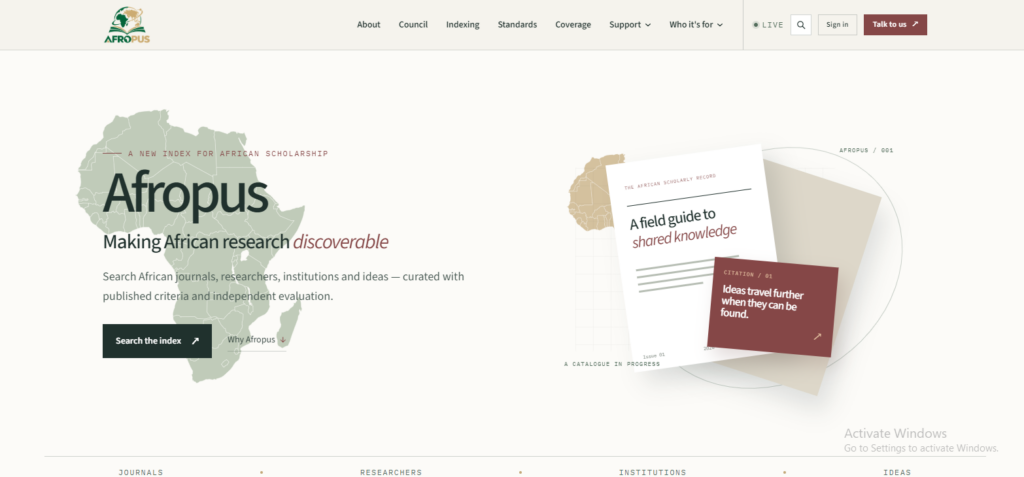
Afropus is being built around a simple idea: African research should be easier to find where it is produced.
Rather than treating African scholarship as a small segment of a much larger global database, Afropus is creating an Africa-focused discovery layer that brings different parts of the scholarly ecosystem into one place.
An index built around African scholarship
Afropus is building toward coverage across five regions and 55 jurisdictions:
- North Africa
- West Africa
- Central Africa
- East Africa
- Southern Africa
The goal is broader representation of African publishing ecosystems while maintaining consistent standards for inclusion.
More than research papers
Research discovery becomes more useful when users can see the connections surrounding a publication.
Afropus is designed to surface:
- Research papers
- Academic journals
- Researchers
- Institutions
- Topics and disciplines
This gives researchers more ways to explore a subject. Someone searching for a particular area of research can potentially move from a publication to its author, institution, journal, or wider research field.
Standards that can be examined
Afropus places published standards at the centre of its indexing approach.
Its evaluation framework is built around four principles:
- Published criteria
- Integrity gates
- Transparency
- Appeals
This makes inclusion an evaluative process rather than simply a matter of whether a publication wants to appear in the index.
Independent evaluation through ACEC
The Afropus Content Evaluation Council (ACEC) provides independent oversight of the evaluation process.
The principle is straightforward: decisions about inclusion, suspension, or de-indexing should not be controlled by sponsors or commercial relationships.
This independence helps protect the credibility of the index as it grows.
Connecting African scholarship to the wider scholarly web
Afropus also emphasizes interoperability rather than creating a closed ecosystem.
It uses established scholarly identifiers such as:
- ORCID for researchers
- DOI/Crossref for scholarly works
- ROR for research organizations
These identifiers help connect Afropus records with the wider systems researchers and institutions already use.
Afropus vs. Traditional Citation Indexes: A Difference in Purpose
Global citation and research indexes play an important role in academic discovery. They provide broad coverage across disciplines and countries and can be valuable for researchers who need a global view of scholarly literature.
Afropus approaches the problem from a different direction.
Its primary focus is African scholarship and African publishing ecosystems. Rather than trying to replace established global databases, Afropus is creating a dedicated layer for discovering research across the continent.
| Global Citation Indexes | Afropus |
| Broad international coverage | African scholarship at the centre |
| Multiple global research ecosystems | Focus on African publishing ecosystems |
| Global discovery | Africa-focused discovery |
| Useful for cross-border literature searches | Designed to surface African research and connections |
| Part of the wider scholarly infrastructure | Designed to connect African scholarship to that infrastructure |
The distinction is important.
Afropus does not claim that an indexed publication will automatically appear in Scopus, Web of Science, or another global database. It also does not position itself as a substitute for peer review or other scholarly quality processes.
Instead, its purpose is to make African scholarship more visible, connected, and discoverable within the broader research landscape.
How an Automated Citation Indexing System Can Help African Researchers
The value of better indexing becomes clearer when applied to everyday research.
Discover relevant research
Researchers can spend significant time searching for literature before they can even begin evaluating it.
A well-structured indexing system can make it easier to find research by:
- Topic
- Discipline
- Author
- Journal
- Institution
- Region
This can help researchers identify relevant African scholarship that may otherwise be missed.
Find researchers working on similar questions
Research is not only about publications. It is also about the people producing and developing ideas.
Connecting researchers with their work can help scholars identify others working on related subjects, potentially opening opportunities for collaboration, discussion, and further research.
Discover African journals
Journal discovery is particularly useful when researchers want to understand where work in a specific field is being published.
An index that brings journals into the same discovery environment as researchers and publications can make it easier to explore the publishing landscape around a subject.
Connect research across borders
African research does not stop at national boundaries.
A scholar studying coastal adaptation in West Africa may find relevant research from another country. A public health researcher in East Africa may discover related work from Southern or North Africa.
Better indexing can make these connections easier to see.
Follow research through persistent identifiers
Identifiers such as ORCID, DOI, and ROR provide stable ways to connect researchers, publications, and institutions.
This matters because names and organizational information can change, while persistent identifiers provide a more reliable foundation for linking scholarly records over time.
For African researchers, the benefit is not simply having another place to search. It is having a clearer way to navigate the research ecosystem and discover the connections within it.
Who Can Benefit From Afropus?
Afropus is designed for anyone who needs African scholarship to be easier to find, understand, and connect. Its value extends beyond individual researchers to the institutions and publishing communities that support academic work.
Researchers
Researchers can use Afropus to discover African journals, research works, authors, institutions, and areas of study in one environment.
This can make it easier to:
- Find relevant African research
- Identify researchers working in related fields
- Explore journals and institutions
- Discover research across different African regions
Libraries
Academic and research libraries need reliable information when helping users discover scholarship and make collection decisions.
Afropus provides a transparent indexing layer that can help libraries better understand African publishing and improve access to research produced across the continent.
Publishers
For journal publishers, discoverability can be an important part of reaching the researchers who need their work.
Afropus provides a pathway for eligible journals to be evaluated against published criteria. Inclusion is earned through evaluation rather than purchased through sponsorship.
Researchers Outside Africa
African scholarship should not only be discoverable by researchers based on the continent.
Researchers elsewhere can use an Africa-focused index to explore publications, researchers, institutions, and ideas relevant to African studies and research conducted across the continent.
What Afropus Is Not
Understanding what an index does is just as important as understanding what it does not do.
Afropus is not:
- A manuscript submission system
- A journal hosting platform
- A replacement for peer review
- An endorsement of every claim made in an indexed work
- A guarantee that an indexed journal or publication will be included in Scopus, Web of Science, or another database
These boundaries are intentional. They help ensure that an “indexed by Afropus” claim has a clear and specific meaning.
Afropus is a discovery and evaluation layer. Its role is to make scholarship easier to find while maintaining clear standards around what enters the index.
Why Transparency Matters
The more influence a scholarly index has over research discovery, the more important transparency becomes.
Published standards
Researchers and publishers should be able to see what an indexing service evaluates.
Clear governance
Users should understand who makes inclusion and removal decisions and how conflicts of interest are handled.
Appeals
An appeals process gives publishers a formal mechanism for challenging decisions rather than leaving them dependent on informal communication.
Correction and retraction policies
Scholarly metadata changes over time. An index therefore needs mechanisms for handling:
- Corrections
- Retractions
- Duplicate records
- Changed affiliations
- Updated publication information
- Identifier errors
These processes should be documented rather than assumed.
How to Choose the Best Automated Citation Indexing System
There is no single indexing system that is best for every research need. The right choice depends on what you are trying to discover and how much importance you place on coverage, data quality, transparency, and geographic representation.
Before choosing an automated citation indexing system, ask:
- Does it cover the research I need?
Check its geographic, disciplinary, and publication coverage. - Can I discover more than individual papers?
Look for connections between works, journals, researchers, and institutions. - Is the metadata reliable?
Accurate author, publication, journal, and affiliation information is essential. - Does it use persistent identifiers?
ORCID, DOI/Crossref, and ROR can strengthen connections between records. - Are the indexing criteria published?
You should be able to understand why something is included. - Is evaluation independent?
Commercial relationships should not determine scholarly inclusion. - Is there an appeals process?
Clear procedures matter when publishers or other stakeholders challenge decisions. - Does it represent African research meaningfully?
Consider whether coverage extends across different African regions and publishing ecosystems. - Is it transparent about its limitations?
A credible index should clearly explain what inclusion does and does not mean. - Does it connect to the wider scholarly ecosystem?
Interoperability makes research records more useful beyond a single platform.
For researchers focused on African scholarship, these questions are particularly important. The size of an index matters, but so does its ability to represent the research ecosystem you are actually trying to explore.
FAQs
An automated citation indexing system uses technology to organize scholarly publications and connect information such as authors, journals, institutions, references, and citations. This makes academic research easier to discover and navigate.
The best system depends on the researcher’s needs. For African scholarship, an effective index should offer meaningful African coverage, reliable metadata, persistent identifiers, transparent criteria, and independent evaluation. Afropus is being built around these principles with African scholarship at the centre of its discovery model.
Afropus is designed to bring African research works, journals, researchers, institutions, topics, and disciplines into a connected discovery environment. This can help researchers find relevant scholarship and explore connections across countries and fields.
No. Afropus is not a replacement for Scopus, Web of Science, or other global research databases. It serves a different purpose as an Africa-focused discovery and evaluation layer and does not guarantee inclusion in any other index.
Afropus uses published criteria and integrity gates as part of its evaluation framework. The Afropus Content Evaluation Council (ACEC) provides independent oversight, while transparency and appeals are part of the broader approach to maintaining credible indexing decisions.
Final Thoughts on Best Automated Citation Indexing System for African Scholars
Africa’s research community is producing knowledge that can shape policy, advance scientific understanding, strengthen institutions, and influence future research. But research can only travel as far as people can discover and engage with it.
That is why better indexing matters. Technology can organize and connect scholarly information, while transparent standards and independent evaluation help make those connections more trustworthy.
Afropus is building an African-led map of scholarship around that principle: making the continent’s journals, researchers, institutions, works, and ideas more discoverable and connected.
If you are looking for a better way to discover African scholarship, start with the research itself and follow where it leads. Explore Afropus and discover the index being built to make African scholarship more findable.