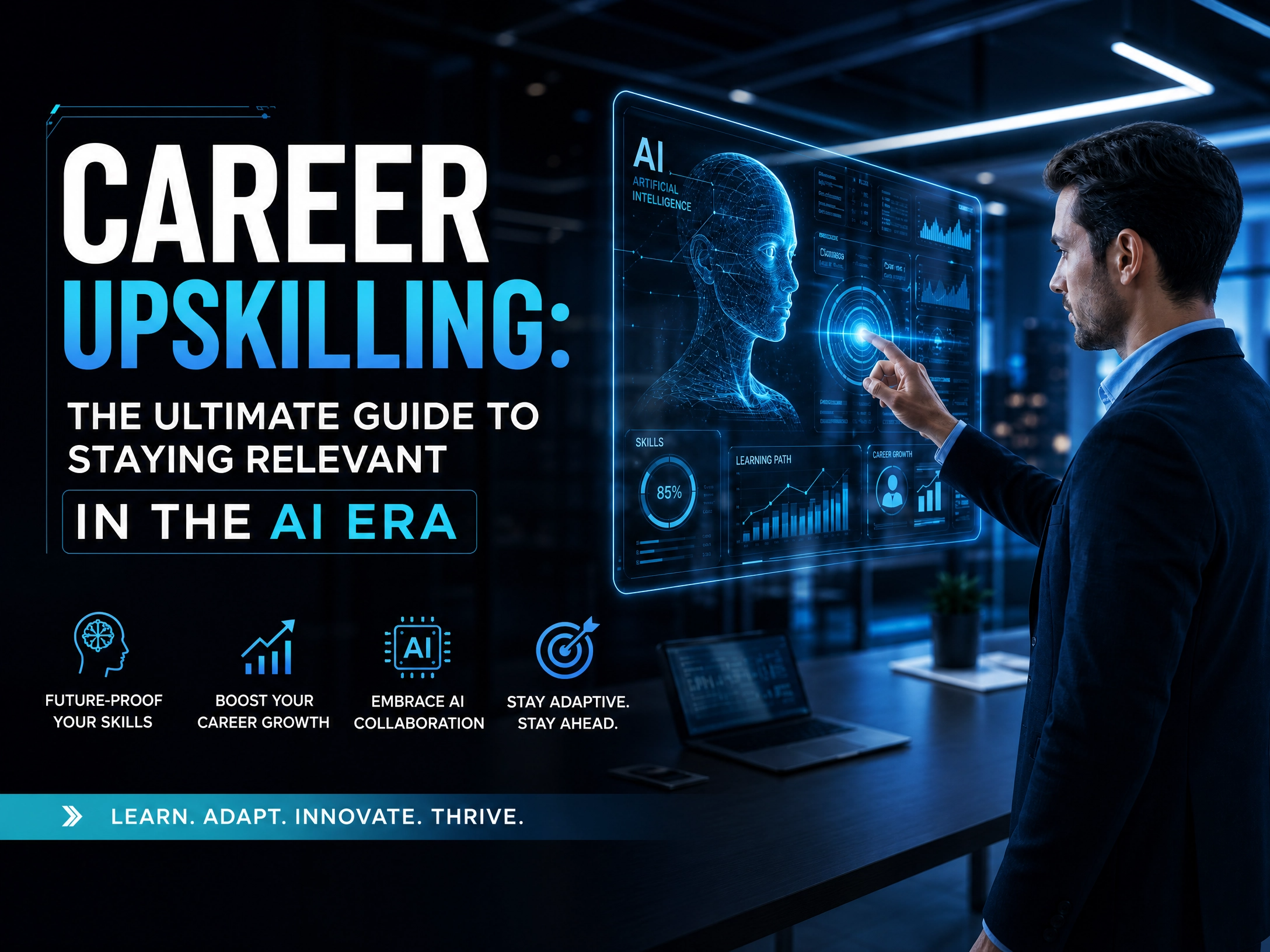
Future-proof your career with this complete guide to career upskilling for professionals. Discover the most valuable AI and workplace skills, learn how to build a practical upskilling plan, and stay competitive in an evolving job market with expert insights and actionable strategies.
TL;DR
- AI is changing how people work across every industry, making continuous learning essential for long-term career success.
- Professionals who combine AI literacy with technical expertise and strong human skills are better prepared for new opportunities.
- A structured upskilling plan is far more effective than taking random courses or following every new trend.
- Employers increasingly value practical experience, adaptability, and problem-solving over certificates alone.
- Career upskilling is one of the most effective ways to increase job security, career flexibility, and earning potential.
Artificial intelligence is changing the way we work across every industry. Tasks that once took hours can now be completed in minutes, and employers are looking for professionals who can work effectively with AI rather than compete against it.
As technology evolves, keeping your existing skills is no longer enough. Career upskilling helps you stay relevant by building practical, in-demand skills that match today’s workplace needs and prepare you for future opportunities.
At Alkademy, we believe continuous learning should be accessible, practical, and aligned with real career goals. Through AI-powered courses, live classes, and career development resources, we help professionals build the skills needed to succeed in a rapidly changing workplace.
Whether you want to earn a promotion, switch careers, increase your income, or simply stay competitive, continuous learning is one of the smartest investments you can make. In this guide, you’ll learn what career upskilling is, why it matters in the AI era, the skills employers value most, and how to create a learning plan that supports long-term career growth.
What Is Career Upskilling and Why Does It Matter?
Career upskilling is the process of developing new knowledge and improving existing skills so you can perform better in your current role or prepare for future career opportunities. Unlike traditional education, which often ends after earning a degree, upskilling is a continuous process that evolves alongside changes in technology, business needs, and industry trends.
Today, almost every profession is experiencing rapid transformation. Marketing teams rely on AI to analyse customer behaviour, healthcare professionals use intelligent systems to support diagnosis, financial analysts automate reporting, and software developers increasingly collaborate with AI coding assistants. Regardless of industry, professionals are expected to adapt to new tools, workflows, and ways of solving problems.
Rather than viewing AI as a threat, successful professionals see it as an opportunity to become more productive and deliver greater value. Upskilling provides the knowledge and confidence needed to work effectively with these technologies while strengthening the uniquely human skills that machines cannot easily replicate.
Career Upskilling vs. Reskilling
Although the terms are often used interchangeably, they serve different purposes.
Career upskilling focuses on improving your abilities within your current career path. It helps you become more effective, qualify for promotions, and take on greater responsibilities.
Examples include:
- Learning AI productivity tools as a project manager
- Studying data analytics as a marketer
- Developing leadership skills as a team supervisor
- Learning cloud technologies as an IT professional
Reskilling, on the other hand, involves learning an entirely new set of skills to transition into a different career.
Examples include:
- Moving from customer service into cybersecurity
- Transitioning from administration into data analysis
- Switching from accounting to software development
Both approaches are valuable, but career upskilling is often the first step professionals take to remain competitive before considering a complete career change.
Whether you’re looking to advance in your current role or prepare for a career transition, Alkademy offers structured learning paths, AI-powered courses, and live classes designed to help professionals build practical, job-ready skills.
Why AI Is Changing Career Development
Every major technological shift has changed the workplace, but AI is accelerating this transformation at an unprecedented pace. Instead of replacing every job, AI is changing how work is performed and redefining what employers consider valuable.
Many repetitive tasks are becoming automated, allowing professionals to spend more time on activities that require creativity, strategic thinking, communication, and complex decision-making.
This means professionals who understand how to work with AI gain several advantages:
- Complete routine work more efficiently
- Make faster, data-informed decisions
- Improve productivity without increasing workload
- Focus on higher-value responsibilities
- Adapt more quickly to new technologies
The result is a workplace where learning has become an essential part of career development rather than an occasional activity.
Workplace Trends Driving Career Upskilling
Several workplace trends are making continuous learning more important than ever.
AI Integration Across Industries
Artificial intelligence is no longer limited to technology companies. It is becoming part of daily operations in healthcare, education, manufacturing, finance, retail, logistics, and many other industries.
Professionals who understand how to use AI tools effectively can improve productivity and contribute more meaningfully to their organisations.
Skills Are Becoming More Valuable Than Job Titles
Employers increasingly evaluate candidates based on what they can do rather than where they have worked or which degree they hold.
Practical skills such as data analysis, AI literacy, leadership, and problem-solving often have a greater impact on hiring decisions than job titles alone.
Continuous Learning Is Becoming a Workplace Expectation
Learning no longer ends after onboarding or formal education.
Many organisations now encourage employees to:
- Complete online training
- Earn professional certifications
- Attend workshops
- Participate in mentoring programmes
- Develop cross-functional skills
Professionals who embrace continuous learning are often better positioned for promotions and leadership opportunities.
Human Skills Are Becoming More Important
As AI handles repetitive work, human abilities become increasingly valuable.
These include:
- Communication
- Creativity
- Leadership
- Critical thinking
- Emotional intelligence
- Collaboration
- Adaptability
These skills enable professionals to solve complex problems, build relationships, and make decisions that technology alone cannot.
The Benefits of Career Upskilling
Investing in your professional development creates long-term advantages that extend beyond finding your next job.
Career upskilling can help you:
- Stay competitive in a rapidly changing job market
- Increase earning potential
- Improve job security
- Qualify for promotions
- Adapt to technological change with confidence
- Build greater career flexibility
- Increase productivity through smarter workflows
- Expand your professional network
- Develop confidence in handling new responsibilities
Perhaps the greatest benefit is future readiness. Professionals who consistently invest in learning are better prepared to adapt as industries evolve, ensuring they remain valuable regardless of how technology changes. Platforms like Alkademy make it easier to build these skills through flexible online learning, helping professionals develop capabilities that employers actively seek.
The Skills Every Professional Needs in the AI Era
The skills that helped professionals succeed a decade ago are no longer enough on their own. While technical expertise remains important, employers increasingly look for people who can adapt, learn quickly, solve complex problems, and work effectively with AI.
The most successful professionals are not necessarily the ones who know the most. They are the ones who continuously develop skills that match changing business needs through practical, lifelong learning.
At Alkademy, our courses and live learning experiences are designed around the skills employers value today, helping professionals build both technical expertise and workplace-ready capabilities that support long-term career growth.
A balanced career development strategy focuses on four core skill areas: AI skills, technical skills, business skills, and human skills. Together, these create a strong foundation for staying competitive in an AI-driven workplace and advancing your career.
AI Skills
AI is becoming part of everyday work, regardless of industry. You do not need to become an AI engineer to benefit from artificial intelligence. Instead, understanding how to use AI responsibly and effectively can help you complete tasks faster and make better decisions.
AI Literacy
AI literacy is the ability to understand what artificial intelligence is, what it can do, and where its limitations lie.
Professionals with strong AI literacy can:
- Identify tasks that AI can automate
- Evaluate AI-generated information critically
- Use AI responsibly and ethically
- Choose the right AI tools for different tasks
- Understand the risks of inaccurate or biased outputs
As AI becomes more common in workplaces, AI literacy is quickly becoming as essential as digital literacy.
Prompt Engineering
The quality of AI-generated responses depends largely on the instructions you provide.
Learning how to write clear and detailed prompts allows professionals to:
- Produce better reports
- Generate higher-quality content
- Analyse data more effectively
- Brainstorm ideas faster
- Automate repetitive work
Prompt engineering is valuable across many industries, including marketing, education, finance, customer service, software development, and human resources.
AI Productivity
AI can significantly improve workplace productivity when used strategically.
Professionals now use AI to:
- Summarise meetings
- Draft emails
- Create presentations
- Analyse spreadsheets
- Research industry trends
- Generate reports
- Organise notes
- Plan projects
The goal is not to replace human expertise but to reduce repetitive work and create more time for higher-value tasks.
Technical Skills
Technology continues to influence every profession, even roles that are not traditionally considered technical.
Developing foundational digital skills allows professionals to work more efficiently and adapt to new tools with confidence.
Data Literacy
Every business generates data, but not everyone knows how to interpret it.
Data literacy involves understanding how to:
- Read reports
- Interpret dashboards
- Identify trends
- Make evidence-based decisions
- Communicate findings clearly
Professionals who can understand data are better equipped to support business growth and solve problems.
Digital Tools
Modern workplaces rely on digital platforms for communication, collaboration, and productivity.
Professionals should feel comfortable using:
- Project management software
- Collaboration platforms
- Cloud storage solutions
- Spreadsheet applications
- Digital documentation tools
- Customer relationship management systems
Learning new software becomes much easier once you develop strong digital confidence.
Automation
Automation is becoming a standard part of business operations.
Instead of completing repetitive tasks manually, professionals can automate activities such as:
- Scheduling
- Email responses
- Data entry
- File organisation
- Report generation
- Workflow approvals
Understanding automation helps employees spend more time on strategic work instead of routine administration.
Business Skills
Technical knowledge alone rarely leads to career advancement. Professionals also need business skills that help them collaborate, lead teams, and contribute to organisational goals.
Communication
Clear communication remains one of the most valuable workplace skills.
Strong communicators can:
- Explain ideas clearly
- Write professional emails
- Present information confidently
- Listen actively
- Adapt communication to different audiences
Even the best ideas have little impact if they cannot be communicated effectively.
Project Management
Almost every professional manages projects in some form, whether leading a team or organising personal workloads.
Project management skills help professionals:
- Prioritise tasks
- Manage deadlines
- Allocate resources
- Reduce risks
- Improve collaboration
- Deliver consistent results
These skills become increasingly valuable as responsibilities grow.
Leadership
Leadership is no longer limited to managers.
Professionals at every level benefit from learning how to:
- Influence others positively
- Solve problems
- Make informed decisions
- Mentor colleagues
- Take initiative
- Build trust within teams
Organisations often promote individuals who demonstrate leadership before they hold formal leadership positions.
Human Skills
As AI continues to automate repetitive work, human abilities become even more valuable.
These are the qualities that technology cannot easily replicate.
Critical Thinking
AI can generate information, but professionals must decide whether that information is accurate, relevant, and appropriate.
Critical thinking helps you:
- Evaluate evidence
- Identify weaknesses
- Challenge assumptions
- Solve complex problems
- Make informed decisions
Professionals who think critically are less likely to rely blindly on AI-generated content.
Creativity
Creativity remains one of the strongest competitive advantages in the AI era.
Creative professionals can:
- Develop innovative ideas
- Design better solutions
- Improve products and services
- Create engaging customer experiences
- Adapt quickly to change
AI can support creativity, but original thinking still comes from people.
Emotional Intelligence
Understanding people is becoming more valuable as technology becomes more advanced.
Emotional intelligence includes the ability to:
- Recognise emotions
- Build relationships
- Resolve conflicts
- Demonstrate empathy
- Communicate effectively
- Collaborate with diverse teams
These skills strengthen leadership and improve workplace culture.
Adaptability
Change is now a constant part of professional life.
New technologies, business models, and customer expectations emerge regularly, making adaptability essential for career growth.
Adaptable professionals are more likely to:
- Learn new skills quickly
- Embrace workplace changes
- Handle uncertainty with confidence
- Take advantage of emerging opportunities
Rather than resisting change, they see it as an opportunity to grow.
Building a Balanced Skill Set
One of the biggest mistakes professionals make is focusing on only one type of skill.
For example:
- A software developer who lacks communication skills may struggle to lead projects.
- A marketer who ignores AI tools may lose productivity compared to competitors.
- A manager who avoids learning new technologies may find it difficult to lead modern teams.
- A data analyst without critical thinking skills may misinterpret valuable insights.
Career growth comes from combining different skill areas into a well-rounded professional profile.
An effective career upskilling strategy should include:
- AI skills to improve efficiency and productivity
- Technical skills to work confidently with digital tools
- Business skills to contribute to organisational success
- Human skills to solve problems, collaborate, and lead others
Professionals who continuously strengthen all four areas are better prepared for promotions, career transitions, and the changing demands of the AI-powered workplace.
The workplace will continue to evolve, but one thing is unlikely to change. People who invest in learning, embrace new technologies, and develop both technical and human capabilities will remain valuable regardless of how industries transform.
How to Create a Career Upskilling Plan
Knowing which skills to learn is only part of the journey. The real challenge is turning that knowledge into consistent progress.
Many professionals start with enthusiasm, enroll in several courses, watch countless videos, and save dozens of articles. A few weeks later, work becomes busy, motivation fades, and learning comes to a stop. The problem is rarely a lack of ambition. It is usually the absence of a clear plan.
An effective career upskilling plan helps you focus on skills that support your career goals instead of chasing every new trend. It also makes learning manageable, measurable, and easier to maintain alongside work and personal commitments.
Assess Your Current Skills
Before deciding what to learn, understand where you stand today.
Take an honest look at your strengths and the areas where you need improvement. This creates a clear starting point and helps you avoid spending time on skills you already possess.
Ask yourself questions such as:
- Which tasks do I perform confidently?
- Which responsibilities do I avoid because I lack the necessary skills?
- Which skills appear repeatedly in job descriptions for the roles I want?
- Which new technologies are becoming common in my industry?
- What feedback have I received from managers or colleagues?
You can also review recent performance evaluations or compare your current skills with the requirements of your ideal role.
The goal is to identify your biggest skill gaps rather than trying to improve everything at once.
Set Clear Career Goals
Your learning plan should support where you want your career to go.
Without a clear destination, it becomes easy to jump from one course to another without making meaningful progress.
Your goals might include:
- Earning a promotion
- Transitioning into leadership
- Moving into a different department
- Becoming an AI specialist in your field
- Increasing your salary
- Starting a freelance career
- Building your own business
Once your goal is clear, it becomes much easier to decide which skills deserve your attention.
For example:
| Career Goal | Skills to Prioritize |
| Marketing Manager | AI content creation, analytics, leadership |
| Software Developer | AI-assisted coding, cloud computing, system design |
| HR Professional | AI recruiting tools, people analytics, communication |
| Finance Professional | Data analysis, automation, business intelligence |
| Entrepreneur | AI productivity, marketing, sales, strategic planning |
Learning becomes more purposeful when every new skill moves you closer to a specific objective.
Focus on High-Impact Skills
One of the biggest mistakes professionals make is trying to learn everything.
Technology changes quickly, and there will always be another tool, framework, or trend. Instead of chasing them all, concentrate on skills that create the greatest career impact.
Prioritise skills that:
- Are widely used in your industry
- Solve real workplace problems
- Improve productivity
- Increase your earning potential
- Complement your existing expertise
- Remain valuable over the long term
For most professionals, this means combining AI knowledge with strong business and human skills rather than focusing on technical skills alone.
Remember, depth is usually more valuable than breadth. Becoming highly competent in a few important areas often creates more opportunities than having basic knowledge of many unrelated topics.
Choose the Right Learning Resources
Not every learning resource offers the same value.
The best option depends on your goals, learning style, and available time.
Popular learning options include:
Online Courses
Ideal for structured learning at your own pace.
Best for:
- Technical skills
- AI tools
- Professional certifications
- Career development
Live Classes
Suitable for professionals who prefer real-time interaction.
Benefits include:
- Asking questions
- Learning from experienced instructors
- Participating in discussions
- Receiving immediate feedback
Workshops
Useful for building practical experience through guided activities and real-world scenarios.
Books and Industry Publications
Excellent for developing deeper knowledge and understanding broader concepts.
Professional Communities
Learning becomes easier when you engage with others.
Communities provide opportunities to:
- Exchange ideas
- Ask questions
- Receive career advice
- Build professional relationships
- Discover industry trends
A combination of structured learning and community engagement often produces the best results.
When evaluating learning platforms, look for practical projects, expert instructors, and career-focused learning paths. These are key principles behind Alkademy’s courses and live learning experiences.
Turn Learning Into Practice
Knowledge alone does not create career growth. Employers want evidence that you can apply what you have learned.
After completing a course or learning a new skill, look for opportunities to use it immediately.
You could:
- Automate a repetitive task at work
- Analyse company data
- Build a personal project
- Volunteer for a new responsibility
- Create a portfolio
- Write about what you learned
- Teach colleagues a new process
Applying knowledge strengthens understanding and builds confidence much faster than passive learning.
Even small projects demonstrate initiative and make your learning more memorable during interviews or performance reviews.
Make Learning a Habit
Consistency matters more than intensity.
Studying for an entire weekend and then taking several weeks off is far less effective than maintaining a regular learning routine.
Simple habits can make continuous learning easier:
- Block dedicated learning time in your calendar
- Focus on one skill at a time
- Review your progress regularly
- Celebrate small milestones
- Adjust your learning goals as your career evolves
The objective is to make learning part of your professional lifestyle rather than an occasional activity.
Track Your Progress
Without measuring progress, it is difficult to know whether your efforts are producing meaningful results.
Review your development regularly by asking yourself:
- Have I learned a valuable new skill?
- Can I apply this skill confidently?
- Have I improved my productivity?
- Have I completed practical projects?
- Am I closer to my career goals?
- Have new opportunities become available because of my learning?
You can also track measurable outcomes such as:
- New responsibilities at work
- Promotions
- Salary increases
- Portfolio projects completed
- Professional certifications
- Positive feedback from managers or clients
These indicators provide tangible evidence that your investment in learning is paying off.
Best Learning Resources and AI Tools for Professionals
One of the biggest advantages professionals have today is access to more learning resources than ever before. You no longer need to return to university or take an extended career break to develop valuable skills. High-quality learning opportunities are available online, allowing you to study whenever your schedule permits.
The challenge is not finding resources. It is choosing the ones that help you build practical skills and support your career goals.
The most effective professionals combine structured learning with hands-on practice, collaboration, and AI-powered tools that make learning faster and more engaging.
Online Courses
Online courses remain one of the most effective ways to build new skills because they provide a structured learning path. Instead of searching through random videos and articles, learners follow a curriculum designed to build knowledge step by step.
Look for courses that offer:
- Clear learning objectives
- Practical exercises
- Real-world projects
- Updated content
- Industry-relevant examples
- Certificates of completion
While certificates can strengthen your resume, the real value comes from the skills you gain and your ability to apply them in real situations.
Live Learning
Live classes offer something self-paced courses cannot: interaction.
Being able to ask questions, participate in discussions, and learn directly from experienced instructors often leads to a deeper understanding of complex topics.
Live learning is especially valuable for subjects such as:
- Artificial intelligence
- Data analysis
- Programming
- Leadership
- Business strategy
- Career development
It also creates opportunities to connect with other professionals who may become valuable members of your network.
Learning Through Real Projects
Reading about a skill is very different from using it.
Practical projects help transform theory into experience and improve your confidence much faster than passive learning alone.
Depending on your profession, your projects might include:
- Building an AI-powered workflow
- Creating a marketing campaign
- Developing a business dashboard
- Designing a website
- Writing automation scripts
- Analysing customer data
- Creating reports with AI assistance
Projects also become valuable additions to your portfolio, giving employers evidence of your capabilities.
Professional Communities
Learning does not happen in isolation.
Joining professional communities allows you to exchange ideas, ask questions, and stay informed about industry developments.
Benefits include:
- Learning from experienced professionals
- Receiving feedback on your work
- Discovering new tools and resources
- Sharing knowledge and experiences
- Building valuable professional relationships
- Finding mentors and collaborators
Communities can also expose you to different perspectives, helping you solve problems more effectively.
Mentorship
A mentor can accelerate your professional development by helping you avoid common mistakes and focus on the skills that matter most.
Mentors can provide guidance on:
- Career planning
- Skill development
- Industry trends
- Leadership
- Workplace challenges
- Professional networking
Even occasional conversations with someone who has experience in your field can provide valuable insights that are difficult to gain through courses alone.
Using AI to Learn More Efficiently
Artificial intelligence has changed how professionals learn. Instead of replacing traditional education, AI makes learning more personalised, interactive, and efficient.
Rather than spending hours searching for answers, professionals can use AI to receive explanations, generate ideas, review concepts, and organise information in seconds.
The key is to use AI as a learning partner, not as a shortcut that replaces critical thinking.
ChatGPT
ChatGPT is one of the most versatile AI learning assistants available.
Professionals commonly use it to:
- Explain complex concepts in simple language
- Summarise lengthy articles and reports
- Generate study notes
- Practise interview questions
- Brainstorm ideas
- Improve writing
- Create project outlines
Instead of simply asking for answers, use ChatGPT to deepen your understanding by requesting examples, case studies, and alternative explanations.
Claude
Claude is particularly useful for analysing long documents and producing thoughtful summaries.
It can help professionals:
- Review research papers
- Analyse reports
- Compare information
- Organise large amounts of text
- Refine written content
For professionals who regularly work with documentation, Claude can significantly reduce the time spent reviewing information.
Google Gemini
Gemini integrates well with Google’s productivity tools, making it useful for professionals already working within the Google ecosystem.
Common use cases include:
- Research assistance
- Content drafting
- Document creation
- Spreadsheet support
- Presentation development
Its integration with familiar workplace tools makes it a practical option for many teams.
Microsoft Copilot
Professionals who rely on Microsoft applications can use Copilot to improve productivity across their daily workflows.
It can assist with:
- Drafting documents
- Analysing spreadsheets
- Creating presentations
- Summarising meetings
- Organising emails
Instead of performing repetitive tasks manually, professionals can focus on reviewing, improving, and making strategic decisions.
Perplexity
Perplexity is particularly valuable for research.
Unlike traditional search engines, it generates conversational answers while providing references that users can explore further.
Professionals often use it to:
- Research industry trends
- Compare technologies
- Explore business topics
- Gather supporting sources
- Learn unfamiliar concepts
It is especially useful when beginning research on a new subject.
Using AI Responsibly
AI can dramatically improve productivity, but it should never replace professional judgement.
Always:
- Verify important information
- Review AI-generated content carefully
- Protect confidential information
- Check facts before making decisions
- Apply your own expertise and experience
AI is most valuable when it supports human intelligence rather than replacing it.
Build a Learning System, Not Just a Course List
Many professionals believe that taking more courses automatically leads to career growth. In reality, successful learning comes from building a system that combines different resources.
A strong learning system often includes:
- Structured online courses for foundational knowledge
- Live classes for interaction and expert guidance
- Real projects for practical experience
- Professional communities for networking and support
- Mentorship for career advice
- AI tools for faster research, revision, and productivity
Each resource plays a different role, and together they create a continuous cycle of learning and improvement.
The professionals who thrive in the AI era are not necessarily those who spend the most time studying. They are the ones who consistently learn, apply new knowledge, seek feedback, and adapt as technology and workplace demands continue to evolve.
Common Career Upskilling Mistakes to Avoid
Career upskilling is most effective when your learning aligns with your career goals and produces measurable results. Avoiding these common mistakes will help you make better use of your time and develop skills that employers genuinely value.
Learning Without a Clear Goal
Many professionals start learning because a skill is trending rather than because it supports their career ambitions. This often leads to unfinished courses and scattered knowledge.
Before committing to a new skill, ask yourself:
- Does this support my long-term career goals?
- Is there demand for this skill in my industry?
- Will it improve my current role or prepare me for the next one?
Every learning decision should move you closer to a defined career objective.
Chasing Every New Trend
New AI tools and technologies appear constantly, but trying to master them all usually leads to shallow knowledge.
Instead:
- Focus on a few high-impact skills.
- Master tools that are widely adopted in your profession.
- Build expertise before moving to the next skill.
Depth creates greater career value than constantly switching focus.
Relying Only on Certifications
Certificates demonstrate commitment to learning, but they rarely prove competence on their own.
Strengthen your profile by pairing certifications with:
- Practical projects
- A professional portfolio
- Case studies
- Workplace achievements
Employers want evidence that you can apply your knowledge in real situations.
Ignoring Practical Experience
Learning becomes valuable only when it is applied.
Look for opportunities to:
- Automate a repetitive task
- Improve an existing workflow
- Build a personal project
- Volunteer for new responsibilities
- Solve real workplace problems
Practical experience reinforces learning and builds confidence far more effectively than theory alone.
Overlooking Human Skills
AI can automate many technical tasks, but it cannot replace qualities such as leadership, communication, creativity, and emotional intelligence.
Continue developing skills that help you:
- Collaborate effectively
- Lead teams
- Solve complex problems
- Build strong professional relationships
- Adapt to change
These abilities remain essential regardless of technological advances.
Learning Inconsistently
Consistent progress is more valuable than occasional bursts of motivation.
Build sustainable habits by:
- Scheduling regular learning time
- Focusing on one major skill at a time
- Reviewing your progress frequently
- Applying new knowledge immediately
Small improvements made consistently often produce the greatest long-term results.
FAQs
Career upskilling is the process of developing new knowledge and improving existing skills to perform better in your current role or prepare for future career opportunities. It focuses on continuous learning to keep pace with changing workplace demands and emerging technologies.
Professionals should focus on a balanced mix of AI literacy, digital and technical skills, communication, leadership, critical thinking, adaptability, and problem-solving. The right combination depends on your career goals and industry.
Create a realistic learning schedule that fits your routine. Online courses, live classes, AI learning tools, and short daily study sessions make it possible to build new skills without leaving your job. Flexible learning platforms such as Alkademy make it easier to fit AI courses and live classes around a full-time work schedule, allowing you to build new skills at your own pace.
No. Certifications demonstrate commitment to learning, but employers also value practical experience, portfolios, workplace achievements, and your ability to apply new skills to solve real problems.
Employers look for professionals who continuously learn, adapt to change, and apply their knowledge effectively. Practical projects, measurable results, strong problem-solving skills, and AI literacy often have a greater impact than certifications alone.
Final Thoughts On Career Upskilling
Career upskilling is one of the best investments you can make in your professional future. As AI continues to reshape the workplace, the professionals who stay curious, embrace continuous learning, and apply new skills will be best positioned for long-term success.
Start by identifying one high-impact skill, build a consistent learning habit, and apply what you learn through real projects. Small, continuous improvements can lead to significant career growth over time.
Ready to take the next step in your career? Explore Alkademy’s AI courses, live classes, and career development resources to build practical skills, grow your confidence, and stay competitive in an AI-driven world.