
Learn how to choose the right professional certification course for your career. Discover key factors to consider, avoid common mistakes, and find certifications aligned with your professional goals.
Key Takeaways
- The best professional certification aligns with your career goals, industry requirements, and current skill level.
- Industry recognition and practical relevance are often more important than certification popularity.
- Learning format, cost, flexibility, and career outcomes should all influence your decision.
- Certifications are most valuable when combined with practical experience and continuous learning.
- A structured decision-making process can help you avoid costly mistakes and choose certifications that support long-term career growth.
Professional certifications have become an increasingly important part of career development. Whether you want to advance in your current role, transition into a new industry, or develop specialized expertise, the right certification can help you build relevant skills and strengthen your professional credibility.
However, with thousands of certification programs available, choosing the right one can be challenging. Not all certifications offer the same value, and choosing a program based solely on popularity can waste time, money, and effort.
This guide explains how to choose a professional certification course that aligns with your career goals, industry requirements, and long-term professional development needs.
Should You Pursue a Professional Certification?
Professional certifications can be valuable career investments, but they are not always necessary for every learner or profession. Before enrolling in a certification program, it is important to determine whether a certification aligns with your career objectives and professional circumstances.
Certifications May Be Valuable If:
Professional certifications are often worth pursuing if:
- You want to advance in your current career.
- You are planning to transition into a new industry or role.
- Your industry highly values professional credentials.
- You need a structured learning pathway to develop new skills.
- You want to strengthen your professional credibility and marketability.
- You need to validate your expertise in a specialized area.
In many industries, certifications can improve employability, support career progression, and demonstrate commitment to continuous professional development.
Certifications May Not Be Necessary If:
In some situations, pursuing a certification may not be the most effective investment.
A certification may be less important if:
- You already possess extensive experience and a strong professional track record.
- Employers in your field prioritize portfolios, practical experience, or demonstrated skills over formal credentials.
- On-the-job training or workplace experience can provide similar outcomes.
- Your career goals can be achieved more effectively through practical projects, mentorship, or advanced education.
Ultimately, the decision should depend on your professional goals, industry expectations, and the value the certification is likely to provide. The best certifications are those that clearly support your long-term career objectives rather than simply adding another credential to your resume.
Define Your Career Goals and Skill Gaps
The right certification starts with a clear understanding of your professional goals.
A certification that helps one person advance their career may offer little value to someone with different objectives. Before comparing programs, take time to identify what you want to achieve and the skills you need to get there.
Are You Seeking Career Advancement?
Many professionals pursue certifications to qualify for promotions, move into leadership positions, or increase their earning potential.
If career advancement is your primary objective, prioritize certifications that are widely recognized within your industry and frequently requested by employers.
Are You Planning a Career Change?
Professional certifications can be especially valuable for career changers because they help build foundational knowledge and demonstrate commitment to a new field.
When transitioning into a different industry, focus on certifications that teach practical, job-relevant skills and provide a clear pathway into your target role.
Are You Looking to Develop Specialized Expertise?
Some professionals pursue certifications to deepen existing knowledge and become specialists in a particular area.
Specialized certifications can strengthen credibility, differentiate you from other candidates, and position you as a subject matter expert within your industry.
Are You Trying to Stay Current in Your Industry?
Industries evolve continuously, particularly in areas such as technology, healthcare, finance, and digital marketing.
Pursuing certifications in emerging technologies, changing regulations, or new industry practices can help professionals remain competitive and relevant.
Evaluate Your Current Skills
Once you have defined your career goals, assess your existing skills and knowledge.
Ask yourself:
- Which skills do I already possess?
- What competencies are required for my desired role?
- Which knowledge gaps could limit my career progression?
An honest assessment can help you avoid choosing programs that are either too advanced or too basic.
Research Employer Expectations
Your target employers can provide valuable guidance on which certifications are worth pursuing.
Review job descriptions for roles you aspire to and identify:
- Certifications employers commonly request.
- Frequently mentioned technical and professional skills.
- Emerging trends and in-demand competencies.
This research ensures that your certification investment aligns with actual market demand rather than assumptions.
Identify Your Skill Gaps
Compare your current capabilities with the requirements of your desired role or career path.
The goal is to identify the specific skills, knowledge, or competencies you need to develop. Once these gaps are clear, you can select certifications that directly support your career objectives rather than pursuing credentials simply because they are popular.
Common Types of Professional Certifications
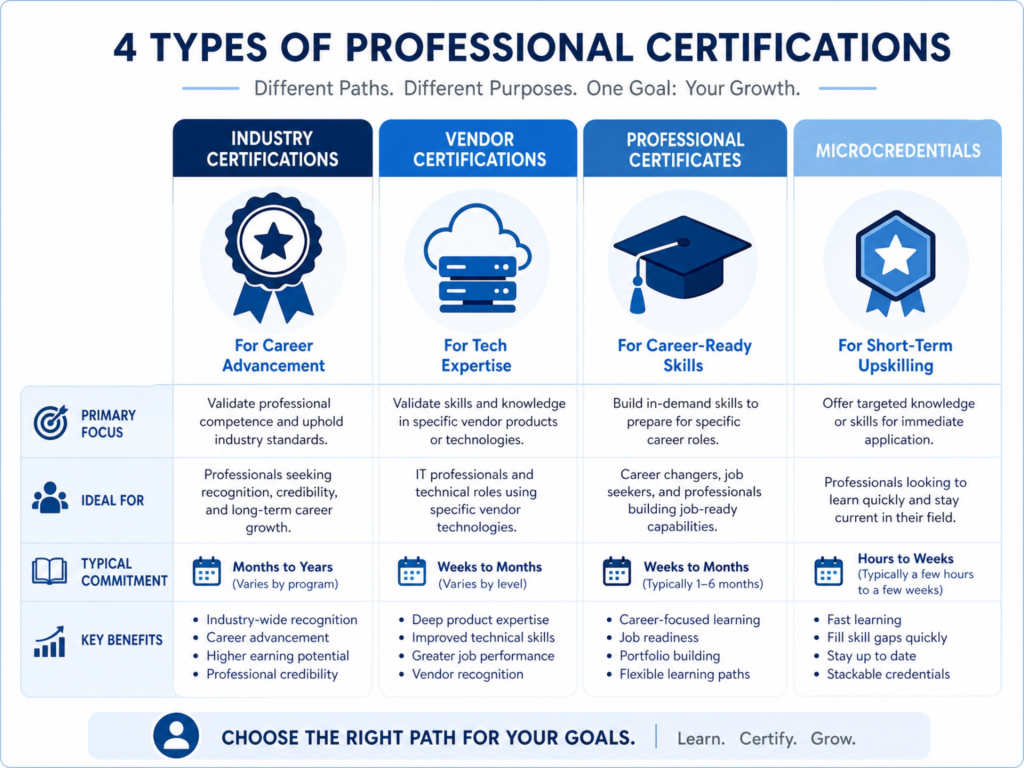
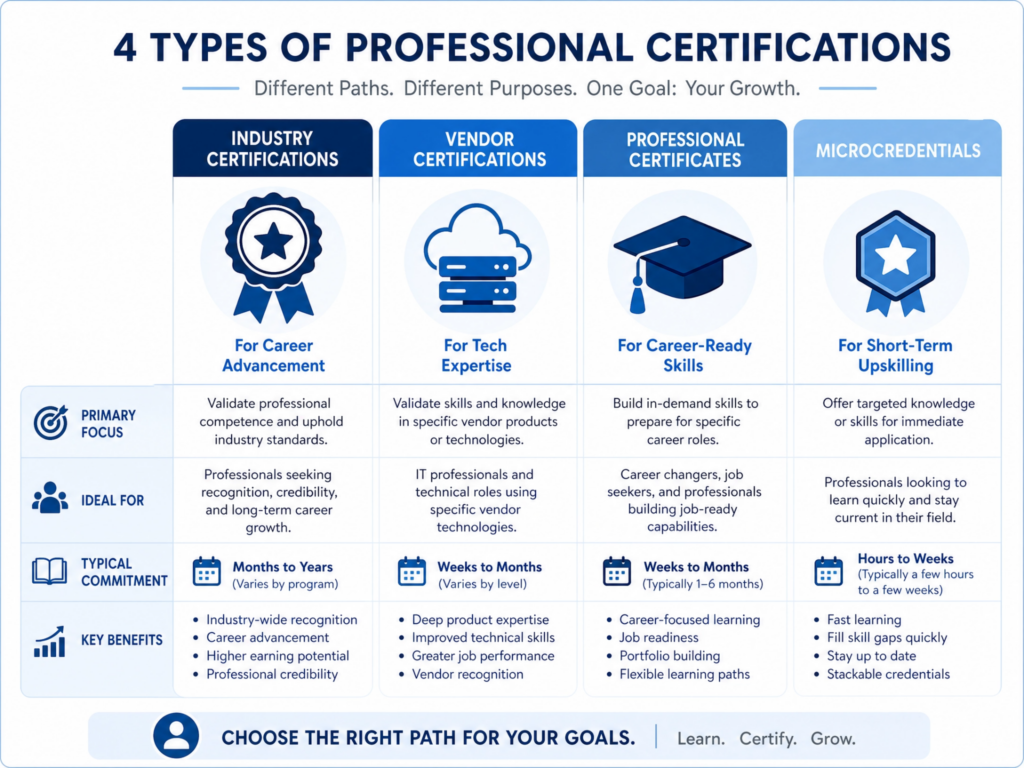
Professional certifications come in several forms, each designed for different career goals and learning needs.
Industry Certifications
Industry certifications are offered by professional associations or independent certification bodies to validate expertise and professional standards.
Examples:
- Project Management Professional (PMP)
- Certified Information Systems Security Professional (CISSP)
- SHRM Certified Professional (SHRM-CP)
Best for: Career advancement and professional credibility.
Vendor Certifications
Vendor certifications focus on specific technologies, software platforms, or products provided by companies.
Examples:
- AWS Certified Solutions Architect
- Microsoft Certified: Azure Administrator Associate
- Cisco Certified Network Associate (CCNA)
Best for: Technology and technical roles.
Professional Certificates
Professional certificates are structured programs that teach practical, career-focused skills through coursework and projects.
Examples:
- Google Career Certificates
- IBM Professional Certificates
- University professional certificate programs
Best for: Skill development and career transitions.
Microcredentials
Microcredentials are short, focused credentials that validate specific or emerging skills.
Examples:
- AI and Generative AI badges
- Digital marketing microcredentials
- Data analytics credentials
Best for: Quick upskilling and continuous learning.
| Certification Type | Best For | Examples |
| Industry Certifications | Career advancement | PMP, CISSP, SHRM-CP |
| Vendor Certifications | Technology expertise | AWS, Microsoft, Cisco |
| Professional Certificates | Career-ready skills | Google, IBM Certificates |
| Microcredentials | Short-term upskilling | AI badges, nano certificates |
For a broader overview of online learning pathways, explore our guide to online courses and professional certifications.
Key Factors to Consider Before Choosing a Certification Course
Not all certification programs provide the same value. Before enrolling, take time to evaluate several important factors to ensure the certification aligns with your career goals and offers a meaningful return on your investment.
Industry Recognition
One of the first questions to ask is whether employers and industry professionals recognize the certification.
A highly respected certification can strengthen your resume and improve career opportunities, while an unknown or poorly recognized credential may offer limited value.
Review job descriptions in your target industry to determine which certifications employers frequently request or prefer.
Career Alignment
The right certification should support your long-term career objectives.
Ask yourself:
- Does this certification help me move toward my desired role?
- Will it strengthen skills that are relevant to my career goals?
- Does it align with my current level of experience?
Avoid pursuing certifications simply because they are popular or trending.
Curriculum Quality
Carefully review the course curriculum before enrolling.
Look for programs that cover current industry practices, emerging trends, and practical applications. An outdated curriculum may leave you with skills that are no longer relevant in today’s workplace.
A strong certification program should clearly outline learning objectives, course content, assessments, and expected outcomes.
Practical Learning Opportunities
Employers increasingly value demonstrated skills rather than credentials alone.
Prioritize certification programs that include:
- Hands-on projects
- Case studies
- Labs and simulations
- Portfolio-building opportunities
- Real-world exercises
Practical learning experiences help bridge the gap between theory and workplace application.
Instructor and Provider Credibility
Research both the instructors and the organization offering the certification.
Consider:
- Instructor qualifications and industry experience
- Reputation of the institution or learning platform
- Employer recognition of the provider
- Reviews and learner feedback
Programs developed by recognized universities, professional organizations, or respected industry leaders often carry greater credibility.
Learning Format
Learning format can significantly influence your success.
Some learners thrive in self-paced environments, while others benefit from live instruction, workshops, and instructor interaction.
Choose a format that matches your learning preferences, schedule, and level of accountability required.
Flexibility and Schedule Requirements
Consider whether the certification program fits your existing responsibilities.
Evaluate:
- Program duration
- Weekly study requirements
- Assignment deadlines
- Live session schedules
- Overall time commitment
Selecting a program that fits your lifestyle can improve completion rates and learning outcomes.
Cost and Return on Investment
Cost should be evaluated alongside the potential benefits of the certification.
Ask yourself:
- Will this certification improve my employability?
- Could it increase my earning potential?
- Will it support career advancement?
- Does my employer offer tuition assistance or sponsorship?
The most expensive certification is not always the best option. Focus on overall value rather than price alone.
Career Outcomes
Finally, consider the outcomes you realistically expect from the certification.
A worthwhile program should clearly support one or more of the following:
- Career advancement
- Skill development
- Career transition
- Professional credibility
- Increased job opportunities
The strongest certifications are those that directly contribute to your long-term professional goals.
Red Flags and Warning Signs
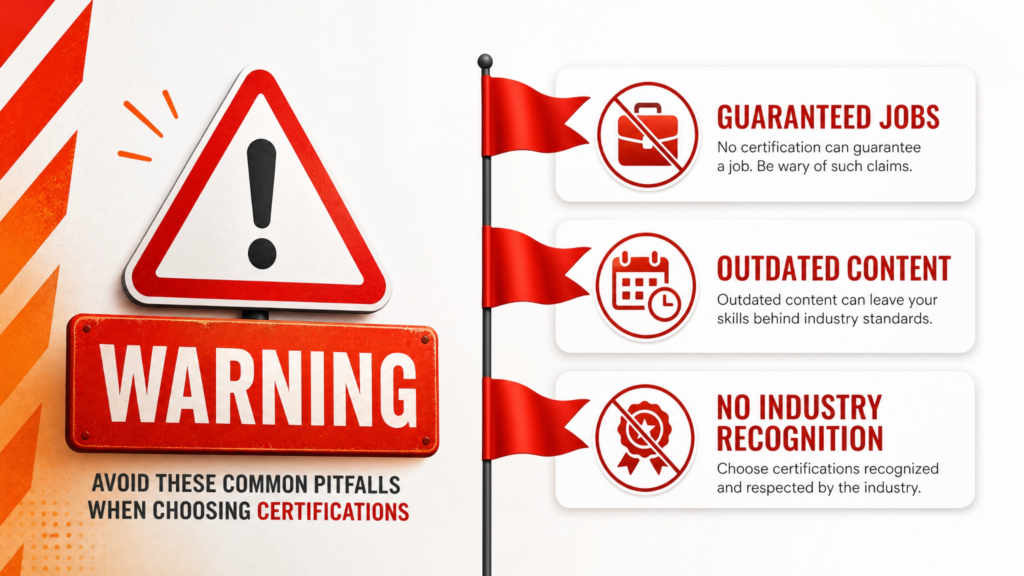
Not all certification programs provide meaningful value. Before investing your time and money, it is important to identify potential warning signs that may indicate a program is not the right fit.
Unrealistic Career Promises
Be cautious of certification providers that guarantee jobs, promotions, or significant salary increases.
While certifications can strengthen your professional profile, no program can guarantee specific career outcomes. Reputable providers focus on skill development and career support rather than making unrealistic promises.
Lack of Industry Recognition
A certification is most valuable when employers and industry professionals recognize it.
Before enrolling, research whether employers in your target industry actively request or value the credential. Reviewing job descriptions and speaking with professionals in your field can help determine whether a certification is worth pursuing.
Outdated Curriculum
Industries evolve continuously, particularly in technology, business, healthcare, and digital fields.
An outdated curriculum may leave you with skills that are no longer relevant. Review the course content carefully to ensure it reflects current industry practices, emerging trends, and modern tools.
Limited Practical Learning Opportunities
Programs that focus entirely on theory may not adequately prepare learners for real-world work environments.
Look for certifications that include projects, case studies, simulations, labs, or other hands-on learning experiences. Practical application helps learners translate knowledge into workplace skills.
Poor Instructor or Provider Credibility
Research both the instructors and the organization offering the certification.
Experienced instructors, recognized institutions, and positive learner reviews often indicate a higher-quality learning experience.
Unclear Career Outcomes
Before enrolling, ask yourself a simple question: How will this certification help me achieve my career goals?
If the answer is unclear, the program may not provide sufficient value. The best certifications have a clear connection to career advancement, skill development, or professional growth.
Common Mistakes When Choosing Professional Certifications
Choosing the right certification can significantly influence your career growth. However, many professionals make decisions that result in wasted time, money, and effort. Avoiding the following mistakes can help you make a more strategic investment in your professional development.
Following Trends Without Clear Career Goals
A certification may be popular, but that does not necessarily mean it is right for you.
Many learners pursue certifications simply because they are trending or widely discussed online. Instead, choose certifications that align with your long-term career objectives and the skills required for your desired role.
Choosing Certifications Solely Because They Are Popular
Well-known certifications often provide value, but popularity alone should not determine your decision.
Always evaluate whether the certification is relevant to your industry, experience level, and professional goals.
Ignoring Employer Demand
Before enrolling in a certification program, research what employers in your target industry actually value.
Review job postings, speak with industry professionals, and identify the certifications that employers frequently request. This helps ensure that your learning investment aligns with market demand.
Focusing Only on Cost
Cost is an important consideration, but it should not be the only factor influencing your decision.
The least expensive certification may not provide meaningful career benefits, while the most expensive option may not necessarily offer the best value. Consider the overall return on investment, including skill development, industry recognition, and career outcomes.
Collecting Certifications Without Applying Skills
Earning multiple certifications without applying the knowledge in real-world settings can limit their value.
Employers increasingly prioritize demonstrated skills, portfolios, projects, and practical experience. Focus on applying what you learn through workplace projects, freelance work, case studies, or personal initiatives.
Underestimating Time Commitments
Many certification programs require significant time and effort to complete successfully.
Before enrolling, evaluate the expected workload and ensure it fits realistically within your existing responsibilities and schedule.
How Employers Evaluate Certifications
Professional certifications can strengthen a candidate’s profile, but employers rarely make hiring decisions based on credentials alone. Most organizations evaluate certifications alongside skills, experience, and demonstrated ability.

Employers Value Relevant Certifications
Certifications can demonstrate initiative, commitment to professional development, and foundational knowledge in a particular field. In some industries, they may also validate specialized expertise and improve professional credibility.
However, certifications are most valuable when they are recognized by employers and directly relevant to the role.
Demonstrated Skills Often Matter More
Employers increasingly prioritize practical skills and real-world experience.
Many hiring managers want evidence that candidates can apply their knowledge effectively. Projects, portfolios, internships, workplace achievements, and hands-on experience often carry as much weight as certifications.
Continuous Learning Signals Adaptability
Industries evolve rapidly, and employers value professionals who continuously update their skills.
Rather than viewing a certification as the final destination, employers often see it as evidence of a learner’s commitment to ongoing professional development.
Ultimately, the strongest candidates combine recognized certifications with practical experience, relevant skills, and a continuous learning mindset.
FAQs
Start by defining your career goals and identifying the skills you need to develop. Then evaluate certification options based on industry recognition, curriculum quality, practical learning opportunities, learning format, cost, and expected career outcomes.
Professional certifications can be valuable investments when they align with your career objectives and industry requirements. They can strengthen professional credibility, support career advancement, and help learners develop in-demand skills. However, certifications are most effective when combined with practical experience and continuous learning.
Yes. Many employers value online certifications, particularly when they are offered by recognized institutions, professional organizations, or respected industry providers. Employers also consider practical skills, experience, and demonstrated ability alongside certifications.
The best learning format depends on your preferences and schedule. Self-paced courses offer flexibility and work well for independent learners, while live classes provide structure, instructor interaction, and accountability. Some learners benefit most from blended learning experiences that combine both approaches.
Final Thoughts on the Right Professional Certification Course for Your Career
Choosing the right professional certification course can strengthen your skills, enhance your credibility, and support long-term career growth. The most valuable certifications are those that align with your career goals, address relevant skill gaps, and are recognized within your industry.
Before enrolling, evaluate factors such as industry recognition, curriculum quality, learning format, practical learning opportunities, and expected career outcomes.
As skills-based hiring continues to grow, professionals who combine recognized credentials with practical experience and continuous learning are likely to remain highly competitive in the job market.
Platforms like Alkademy support this journey through flexible, career-focused learning experiences designed to help learners develop relevant skills and achieve their professional goals.